As a dog trainer that has seen what actually stops even the most intense dog brawls, I always tell owners that before they figure out how to stop dogs from fighting, they have to ask the more important question: why dog fights start. Your dogs start fights because the element of leadership – one that is very important for your dogs – is missing in your household. Unless you fill the leadership void, dog fights will never truly end.
Dog owners, I know you feel the shift in energy when your dogs are about to fight: they start posturing, growling, or snapping at each other.
And sometimes, you just see yourself standing there unsure how to stop the fight from escalating!
Many dog owners mistakenly believe that shouting or using displays of forced authority is the quickest way to end a conflict between their dogs. It’s no surprise when some of them come to me confused. “Dan, I tried shouting at them to get them to listen but it felt like I didn’t exist!”
The reality behind dog fights is quite different. Your dogs do not require fear or punishment to stop them from fighting; instead, they need you to recognize that they are not merely behaving aggressively…they are actually competing to settle the most important question in their minds: who is the true leader of the household?
Key Takeaways
- To effectively learn how to stop dogs from fighting, you must recognize that aggression is usually a symptom of a missing leadership dynamic in your home. Dogs often compete because they are trying to fulfill an unfilled leadership role, which explains why dogs keep fighting in the first place.
- Knowing how to get dogs to stop fighting in the heat of the moment requires a calm, structured approach to avoid injury. Use safe, non-contact methods like loud noises, physical barriers, or water to interrupt the conflict, and always avoid placing your hands near their mouths.
- When dealing with dogs fighting in the same household, you must take responsibility for resource management away from them. By controlling all high-value items like food and toys, and ensuring attention is only given on your terms, you demonstrate that you are the leader who has already secured these resources.
- If you need to know how to reintroduce dogs after a fight, do not rush the process. Establish yourself as the calm, unmistakable leader first, and use controlled methods like parallel walking and shared movement to build positive associations before allowing them to interact freely again.
Ask Doggy Dan: Why Are My Dogs Fighting Non Stop?
A few years ago, I received this heartfelt email from a dedicated owner named Frances. It’s a scenario I hear far too often… a home where love has turned into a source of constant, high-stakes competition.
“Dear Dan,
I am at my wit’s end. My two dogs are fighting all the time, but it has turned into a nightmare.
They constantly demand my attention, pawing and nudging until I give in. They fight over toys. They steal each other’s food. I can’t count the times I’ve had to intervene because both of them are always at each other’s throats. I can’t relax anymore because it’s always complete chaos! They scramble to outrun each other to get my attention, or to get the food. I’m exhausted from looking out for them so I can stop a fight before it turns worse.
It feels like I’m losing control of my own home. I am so tired. What do I do to stop this endless fight for everything?”
Reading Frances’ words, you can feel the weight of her frustration. She wanted a home where there was peace.
The tragedy here is that her dogs weren’t being bad but they were simply trying to fill a role that she hadn’t yet claimed.
If you’re confused, frustrated, and unsure like Frances right now, the answers you’ve been looking for are here.
Understanding the Leadership Gap: The REAL Reason Why Dogs Fight
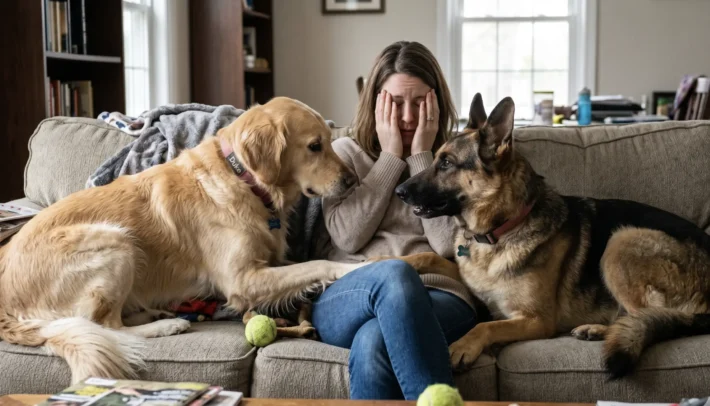
To understand how to stop dogs from fighting, we have to look at the world through the lens of dog psychology. In nature, a pack’s survival depends on clear organization. There is always a leader. They’re someone who decides when to move, when to rest, and how to stay safe. Your dogs instinctively cling to leadership because it provides them with the safety, survival, and security they need to thrive.
The “Leadership Gap” occurs when your dogs look at you—their humans—and don’t see that calm, decisive energy.
When they sense that the leadership role is vacant, their survival instincts kick in: If nobody is leading, I have to take charge.
Think of your household like a business. If the CEO (you) is absent, stressed, or fails to provide clear direction, the managers (your dogs) will start arguing over who gets to run the company. They aren’t fighting because they are mean or power-hungry; they are fighting because they are both trying to fulfill a role that they believe is currently unfilled.
They are competing to prove who is the most capable of protecting the pack and the property. When dogs fight for your attention or access to a specific area, they are treating you or that space as the most valuable asset in the room.
Why This Causes Dog on Dog Aggression
When both dogs believe they are responsible for your safety and the home, they view the other dog as a competitor for the leadership role.
Consistent dog-on-dog aggression is simply a byproduct of this confusion. If your dog snaps at their housemate for getting too close to you or a shared resource, they are performing a duty. They are effectively communicating, “I am the one in charge of protecting our leader, and you are not allowed to interfere.”
What Factors Cause Competition Between Dogs?
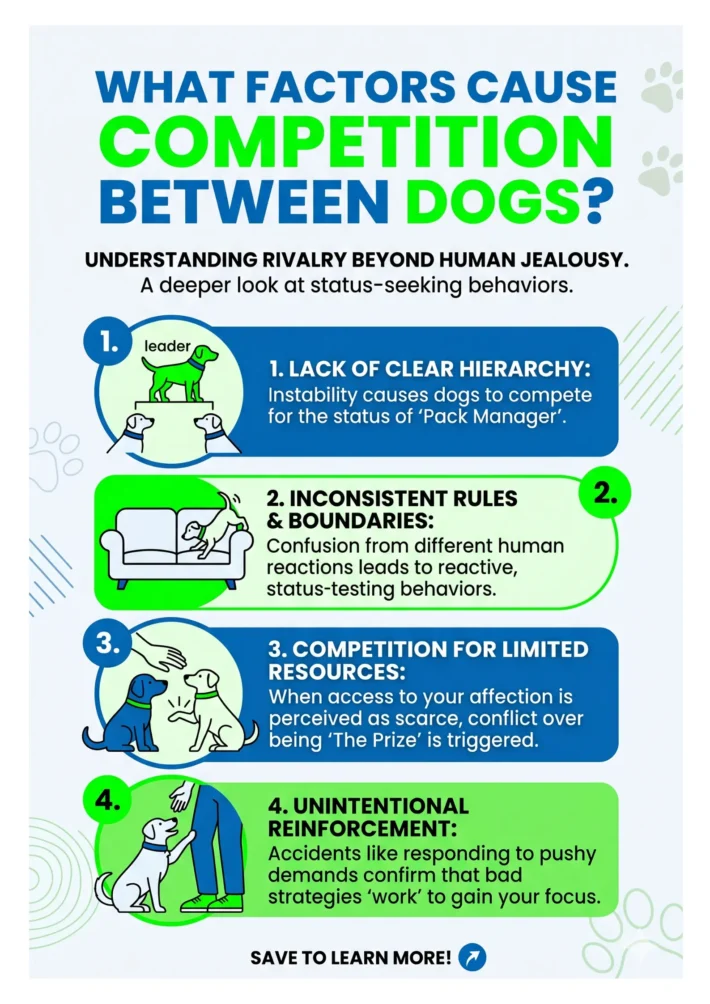
While it’s easy to interpret a dog’s behavior as human-like jealousy, this competitive tension is usually a symptom of status-seeking behavior. When dogs are unsure of their place or the house rules, they naturally compete for the most important resources, including you. Here is a deeper look at the factors that fuel this rivalry:
Lack of Clear Hierarchy
In a pack, a clear, stable structure allows life to function without constant conflict. When there is no defined leader in your home, your dogs often feel an instinctive, stressful obligation to manage the environment themselves. Because you are the primary provider of safety and resources, they perceive you as the ultimate prize to be guarded. When two dogs feel equally responsible for managing the pack, conflict is inevitable.
Inconsistent Rules and Boundaries
Dogs thrive on predictability. If one family member allows a dog to jump on the couch or nudge for pets, while another forbids it, it creates a zone of confusion. This inconsistency makes dogs feel insecure, leading them to push boundaries harder to see what they can get away with. When rules shift based on who is holding the leash or sitting on the sofa, dogs become reactive as they constantly test their status against one another.
Competition for Limited Resources
Conflict often flares up during moments of perceived scarcity. If your dogs notice that you are only available for cuddles during specific times, like when you’re relaxing on the couch, you have become a limited resource. Because there is only one of you, the dogs don’t see space for cooperation; they see a prize to be claimed. This scarcity triggers a “me vs. you” mentality, where the space next to you becomes a battlefield.
Unintentional Reinforcement
Perhaps the most common driver of competitive behavior is the way we accidentally reward it. When a dog nudges, paws, or barks at you to demand attention, and you respond—even by just looking at them—you are inadvertently validating their behavior. To the dog, your reaction confirms that their pushy stance was successful in grabbing your focus. By responding, you are essentially telling them, “Your strategy works, and you are in control of my attention.”
How To Break A Dog Fight
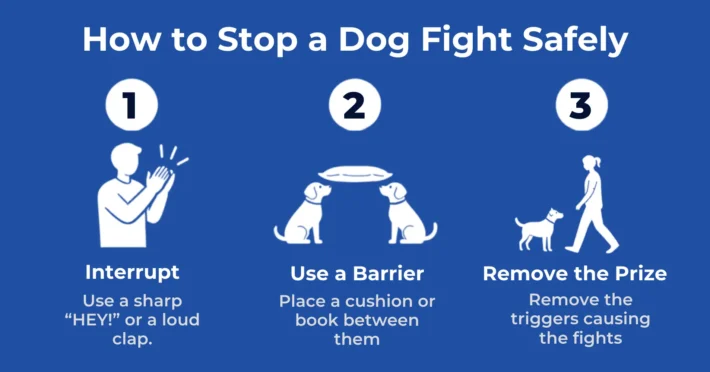
When a fight breaks out, your immediate, absolute priority is to stop the conflict safely and instantly.
While understanding the underlying causes of fighting is crucial for long-term change, you must know exactly how to stop dogs from fighting the moment it happens to prevent serious injury to both you and your dogs.
Prioritize your safety above all else, and follow this list of ideal, safest actions to interrupt the chaos:
#1: Interrupt With A Loud, Sharp Noise
Immediately clap your hands, shout, or bang a pot to startle them and break their focus.
#2: Use A Physical Barrier
Without putting your body in the middle, slide a chair, a large board, or another large object between the dogs to create an immediate visual and physical break.
#3: Toss Water
If available, a bucket of water or a quick spray from a hose can be a highly effective, safe way to break their concentration.
#4: Create Distance
Once the fight is interrupted, promptly move one dog into a separate room to allow the adrenaline to settle.
#5: Opt For Safer Strategies
Never attempt to grab their collars, never place your hands between their mouths, and avoid screaming in panic or flailing around.
If you are wondering how to get dogs to stop fighting without getting hurt, the rule is simple: interrupt first, separate second, and keep your hands out of the fray entirely.
#6: Keep Your Energy In Check
Remember that your energy matters—panic only feeds panic, so staying as calm and grounded as possible is your best tool for regaining control. Whether you are dealing with dogs fighting in the same household or trying to understand why do my dogs keep fighting, these immediate steps are the safest way to maintain order and protect everyone involved.
How to Stop Dogs from Fighting Over Food and Toys
When your dogs clash over food, bones, or favorite toys, it is easy to view this as simple possessiveness. However, to understand why your dogs keep fighting over these items, we must look at what these objects represent to them. In the eyes of your dogs, food and toys are not just simple playthings or meals—they are vital commodities.
In a dog’s mind, these items are essential for survival. If your dogs haven’t clearly identified you as the pack leader, they may feel an instinctive, heavy burden to manage these resources themselves. When a dog hides a bone, hoards a toy, or snaps when approached while eating, they are often acting out of a perceived necessity to protect the pack’s survival assets. They believe they are the ones responsible for securing these critical resources, and in their mind, allowing another dog to approach is a failure of their leadership duty.
The Importance of Control
To stop dogs fighting in the same household over these items, you must take the responsibility of resource management off their shoulders.
This is where the Dog Calming Code™ emphasizes the importance of your role as the pack leader. Specifically, you must be the one to control all high-value resources.
You decide when the food comes out, when they will eat, and when the toys are brought out for play.
When you take charge of these highly valuable items, your dogs see that the true leader has already secured them. Because you are the one in control, they stop fighting over who gets the resource—they realize there is no need to compete because you have already provided it for them.
Here is how you can manage this:
- Feed your dogs in separate rooms or behind closed barriers so there is no immediate pressure to defend their bowl.
- If toys or bones cause tension, pick them up when the dogs are together.
- Use these items as rewards for calm behavior rather than leaving them lying around as “prizes” for the dogs to compete over.
- When you are the one who decides when a toy is given and when it is put away, you reclaim the role of the decision-maker, and the need for your dogs to fight over these commodities fades away.
When you provide the clear leadership they are looking for, they no longer feel the need to “hide” or “guard” their survival resources. They learn to trust that you are in charge of the pack’s well-being, allowing them to finally let go of the stress and tension that leads to fighting.
How to Stop Dogs From Fighting For Your Attention
It is a common misconception that your dogs are fighting over your love; in reality, they are competing for rank. In their minds, access to you, whether it’s through pats, attention, or proximity, is a signal of who holds higher status in the hierarchy. That status is what is truly being contested.
As I always emphasize, these dogs are taking matters into their own hands rather than turning to you. The reason they feel they can do that is because they view themselves as the decision-makers.
The Solution: Lead from Above
The fix is not about managing the rivalry between them; it is about stepping clearly above both dogs. When you establish yourself as the calm, unmistakable leader through the Dog Calming Code™, neither dog has a “top spot” to fight over, because that position is already taken by you. Once this leadership is established, the squabbling often shifts from a serious power struggle to simple sibling bickering, as the real contest of “who is the boss” has already been resolved.
The Power of Attention on YOUR Terms
A key part of this foundation is simple: never give a dog attention just because they push for it. You should offer no patting and no speaking to them unless you have called them first. If they nudge your hand, demand a pat, or push the other dog out of the way to get to you, ignore the behavior completely. Wait until they have backed off and settled, then you decide when to invite them over.
This practice is Rule No. 3 in the Dog Calming Code™, and it is a move that can happen hundreds of times a week. Every time you respond to a demand, you confirm to that dog that pushing and competing works.
Essential Tips for Multi-Dog Homes
Avoid Choosing Sides
Do not try to pick a favorite or “promote” one dog above the other, as this almost always backfires and increases tension.
Let Them Find Their Own Order
You do not need to decide the pecking order between them; let them sort that out. Your only job is to sit clearly above both of them.
Maintain Household Consistency
Make sure everyone in the household is applying the rules the same way. If even one person lets a dog demand pats, it quietly undermines everything everyone else is doing.
How to Stop Dogs from Fighting During Walks
Walking two dogs that are prone to fighting can be an incredibly high-stress experience, but it doesn’t have to be. To maintain safety and prevent dangerous leash-based conflicts, follow these guidelines:
Walk Separately
If your dogs have an established history of fighting, stop walking them together immediately. Attempting to manage a fight while both dogs are on leashes is dangerous for you and can lead to serious injuries.
Use Proper Equipment
Use a sturdy, no-pull harness and a reliable, fixed-length leash for each dog. Avoid using retractable leashes, as they can easily get tangled, restrict your control, and cause panic during a tense moment.
Parallel Walking
Once they are ready, practice “parallel walking” where you and another handler walk the dogs on opposite sides of the street. Only after several weeks of calm behavior and focus on you should you slowly decrease the distance between them.
How to Reintroduce Dogs After a Fight
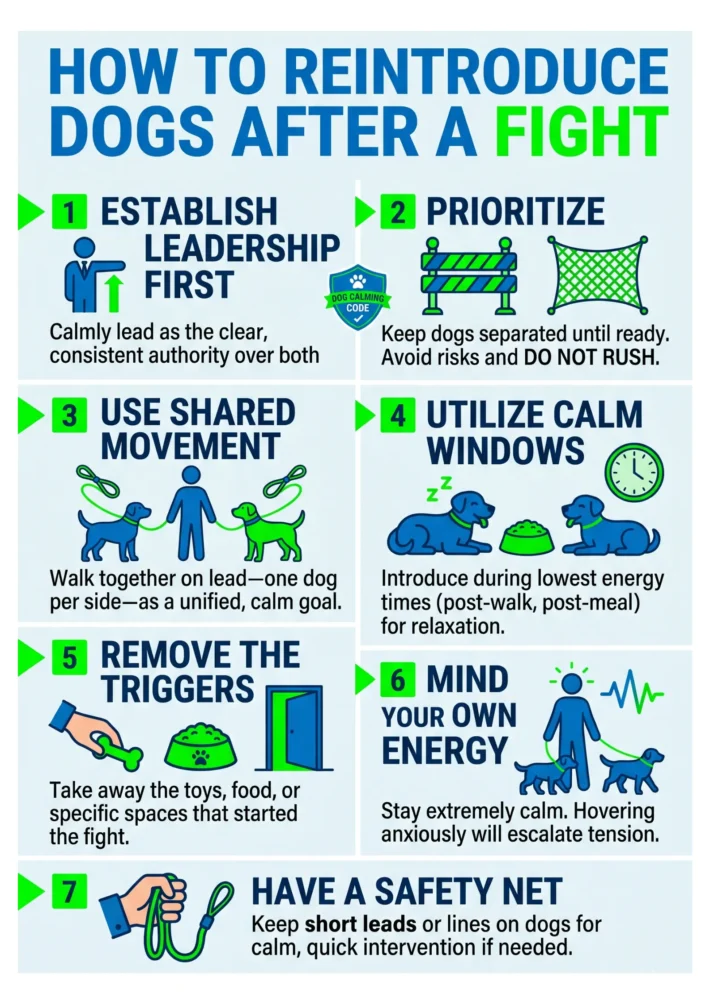
When it comes to bringing dogs back together after a conflict, I don’t believe in rushing the process. If you want a lasting, peaceful outcome, you need a structured plan that tells your dogs “Hey, no need to fight. The leader you need is here.”
Here is how I recommend you approach reintroduction:
What I Recommend for Bringing Dogs Back Together
Establish Your Leadership First
You must clearly establish yourself as the calm, unmistakable leader above both dogs. This isn’t just about picking one rule; it’s about applying all five of the Dog Calming Code™ rules, done properly, and consistently by everyone in your home. This is the non-negotiable step that must happen before you try anything else.
Prioritize Safety
Keep the dogs separated in the meantime if there is a real risk of another fight. Your primary goal is safety, so do not rush the process and do not take unnecessary risks.
Use Shared Movement
Walking them together on lead—one on each side of you—is one of the most powerful tools in your kit. This shared movement with you as the clear leader gives them a unified goal and builds a positive association naturally. This is completely different from free play; it is structured, calm, and you are in charge.
Utilize Their Calm Windows
Create positive time together after a long walk and a full meal. That is when your dogs have the least amount of energy and are most likely to relax beside each other, so use those windows deliberately.
Remove The Triggers
Whatever sparked the original fight, whether it was a toy, a specific space, a doorway, or food, you must remove it from the equation during the early stages of reintroduction.
Mind Your Own Energy
When you are reintroducing them, stay calm and do not hover anxiously. Your energy matters enormously to them. If you are tense, they will read that and escalate. Walk in calmly, and keep your leads loose, as a tight lead signals tension. Let them settle at their own pace.
Have A Safety Net
Keep a short lead or line on them if you feel it is needed. This allows you to calmly intervene without having to grab at them or shout if things start to heat up.
You Can Make Dogs Stop Fighting… For Good
Ultimately, learning how to stop dogs from fighting is not just about breaking up physical brawls. It is also about removing the underlying reasons why they feel the need to fight in the first place.
When you step into the role of a calm, consistent leader, your dogs feel secure enough to stop managing the environment themselves.
As that pressure to compete vanishes, the tension eases, the guarding softens, and a peaceful household becomes possible once again.
Ready to bring harmony back to your home? Join my free webinar to discover exactly how to get started and learn more about how The Dog Calming Code™ can transform your pack’s dynamic.
Register for the free webinar here.
Your dogs are counting on you, and I’m here to support you and guide you every step of the way.

— Doggy Dan