I know you’re frustrated, and eager to know how to get two dogs to stop fighting. But before you spend thousands of dollars on training strategies that only address the triggers but not the cause, I recommend you keep your mind open and remember this: dog fights are proof you’re not giving your dogs the leadership they’re looking for. The real reason for dog fights is not food, or jealousy, or just the need to be aggressive; the true reason why dogs get into fights all the time is because there’s a leadership issue… and you have to change that.
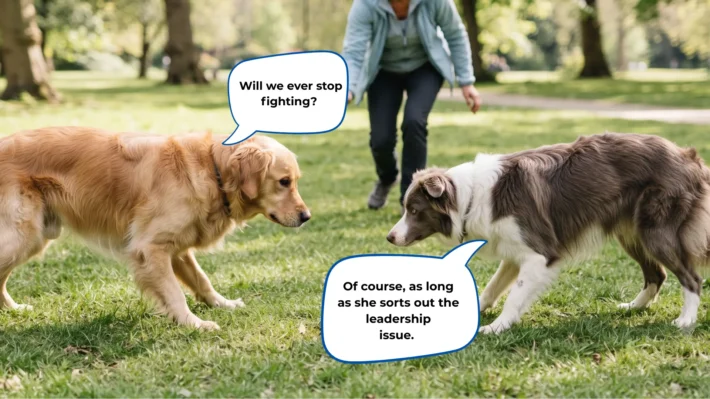
There are so many things to unlearn when it comes to dog fights.
No, your dogs aren’t fighting because they hate each other. And yes, your dogs will continue fighting even if you think you’ve given them the specific resource they’ve been clashing over.
Even separating them for a time won’t be enough if the underlying issue remains unaddressed.
Many owners are surprised when I tell them that dog aggression in the home isn’t about the dogs being “bad”—it is a clear sign they are desperately searching for something vital that’s missing: consistent leadership.
When leadership for dogs is not clearly established in the household, your pets are left in a state of constant, stressful uncertainty. If they can’t figure out who is in charge, they will attempt to settle the hierarchy the only way they know how: by fighting each other for that role. Unless you understand this dynamic, the conflict will persist, no matter how many other solutions you have exhausted.
So, how to get dogs to stop fighting for good? It starts with you reclaiming your role as the pack leader. This blog will teach you exactly how to restore peace to your household.
Read on.
FREE WEBINAR: STOP HOUSEHOLD DOG FIGHTING BEFORE IT ESCALATES — REGISTER HEREKey Takeaways
- Dog fights are often a symptom of an underlying leadership issue rather than just aggression. When dogs feel there is no clear leader in the household to provide guidance and security, they may fight for that role as a survival mechanism.
- Prevention through active management is critical to stopping conflict. This includes controlling access to high-value resources like food and attention, as well as using physical barriers like baby gates to prevent dogs from practicing fighting behaviors.
- During a fight, never use your hands to intervene, as this can lead to injury. If fighting occurs, dogs should be separated for a “cool-down” period to allow stress hormones to subside, followed by a gradual, controlled reintroduction protocol—such as parallel walking—only when they are relaxed.
Why Is Leadership The Main Issue Why Two Dogs Are Fighting?
Leadership for dogs is important because dogs are pack animals. In their DNA is the need to belong to a pack, and survive with the pack.
Dogs strongly associate leadership with survival. In the wild, dogs look greatly to their pack leader for getting food, for surviving danger, and for having protection. Remove that leadership and everything will be in a limbo. The dogs will feel vulnerable, scared, and unsure how to survive the wild.
Dogs aren’t that different, even if they’re already safe and provided in your home. You’d probably think “My dogs are well taken care of at home. Surely they won’t feel anxious?” Unfortunately, if they think no one’s leading your “pack” (that’s you and the home), they will always be anxious.
In your anxious dogs’ mind, as they wonder why do my dogs keep fighting, there is always this question: who leads the pack now?
If they don’t see it in you, they will fight for that role. Their fighting is not a show of canine aggression or dog aggression; it is actually a fight for survival.
Let’s use dog psychology to really understand why dogs are suddenly fighting and what to do to stop this.
Lack of leadership makes your dogs go “Oh no. There’s no leader. How can my pack survive this place?”
And because their minds are already anxious, they do everything to survive.
If you see your dogs fighting over food, it’s not just one that is jealous of the other. If you take a peek into their minds, you will see them go “This is an important resource! Give this to me for my pack’s survival!”
If you notice your dogs fighting over your attention, it’s not because they don’t want you to give attention to the other. The fight means “Our dog owner is my responsibility. If I don’t guard them, they will not survive.”
The cycle of fighting will continue unless you step in and really tell your dogs, “You can relax now. I’m your true leader.” This is the foundation of how to get dogs to stop fighting. This principle is also essential for multi-dog household management. By establishing your role, you can finally learn how to get two dogs to stop fighting and create true peace in your home.
What Are The Signs That There Is A Leadership Issue At Home?
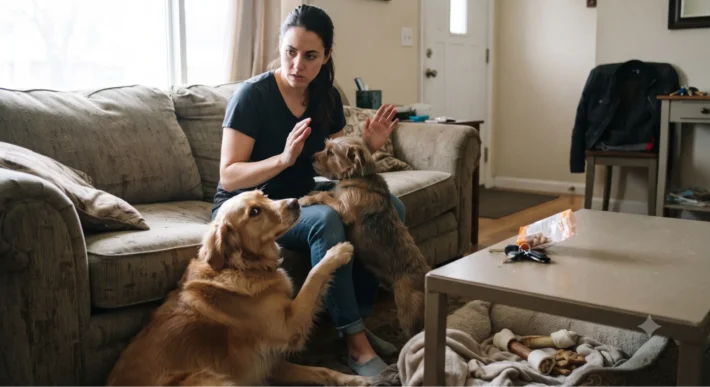
The fighting is the most explosive symptom of a struggle for leadership for dogs, but there are subtle, persistent stress signals you shouldn’t ignore if you want to know how to get dogs to stop fighting.
#1: Your Dogs Are Hiding Food
If you find hidden scraps or treats in your dog’s designated space, this is a clear survival-based behavior stemming from resource guarding. They are storing items because they don’t think that you are managing the food supply.
By taking control of mealtime, and being in charge of when your dogs get food, you prove you are the provider.
#2: Constant Demand for Attention
When both dogs are constantly competing to paw at you, nudge your hand, or climb into your lap for cuddles, they are vying for the most “valuable” resource in the home: you.
This behavior often fuels dog aggression in the home because they see your affection as a prize to be won. In a stable pack, the leader decides when affection is given; when the dogs demand it, they are essentially taking the role of the pack leader, leading to territorial behavior and conflict.
#3: Restlessness When You Leave
If your dogs become visibly agitated or pace when they see you grabbing your keys, it’s not just love. It’s actually a lack of security. Because they see themselves as your leader and protector, the very thought of you going away is making them feel vulnerable.
When you establish yourself as a calm leader who can handle anything, they learn that you are capable of being safe even when you aren’t in the room. This absolutely helps reduce dog anxiety and agitation.
#4: Separation Anxiety
Excessive howling or barking when you are out of sight is a classic sign of an insecure pack. They are calling out because they feel the pack is broken and directionless without your presence. Providing a structured routine helps them feel secure enough to rest while you are gone, moving them away from the fear-based aggression that often causes in-home conflict.
#5: Excessive Protectiveness
Whether at home or on a walk, if your dogs bark at everyone, every passing shadow, or visitors knocking at the door, they are performing a duty they believe you are failing at.
They have taken on the role of the ultimate protector because they don’t believe you are capable of handling the threats yourself. This is a common trigger that leads to canine aggression.
By addressing these triggers for dog aggression through consistent, calm, and firm leadership—and utilizing proper multi-dog household management—you can move away from the chaos and toward the harmony your household deserves.
THIS FREE WEBINAR BREAKS DOWN THE EXACT SYSTEM THAT HAS RESOLVED HOUSEHOLD FIGHTING FOR OVER 125,000 DOGS — JOIN HEREHow You Become The Leader In The Home So Dog Fights Will Stop
Most owners try to stop canine aggression by shouting, or by trying to treat the dogs as “equals.” But in the dog world, equality is a myth. Dogs are pack animals who crave a calm, decisive leader to handle the weight of the world.
When you don’t fill that role, your dogs feel they must take it on. Leadership isn’t about being a dictator, but it’s about being the calm, loving guardian who decides when it’s time to eat, how to greet a visitor, and who is in charge of the household. When you reclaim this role, the tension that fuels dog aggression in the home naturally dissolves.
The Five Golden Rules Of Leadership
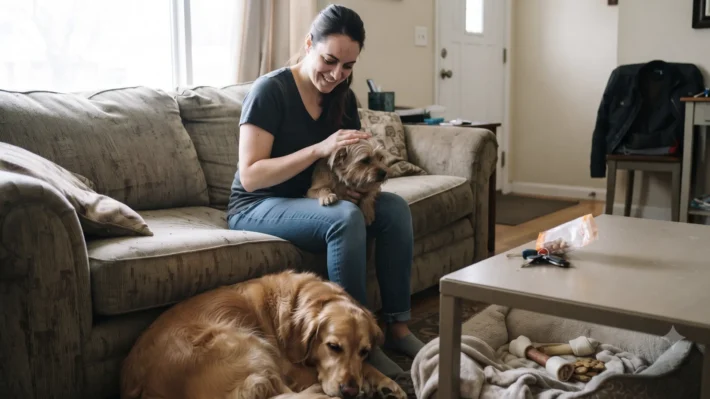
If you want your dogs to finally look at you and think, “Oh, yes! You’re the one in charge—I can finally relax,” you have to speak their language.
I’ve formulated the Five Golden Rules of Leadership within The Dog Calming Code™ to help you do exactly that. These rules are grounded in the natural dog psychology that dictates pack survival. When you follow them, you stop the canine aggression and start the healing.
#1 Be The Source of Food
In the wild, the pack leader controls the most vital survival resource: the meal. By being the one who decides when, where, and how your dogs eat, you naturally establish your status.
Don’t leave food out as a “free-for-all.”
Instead, control the mealtime. When you hold the power over the food bowl, you are essentially telling your dogs, “I provide for this pack, so you don’t have to stress about survival.” This is a foundational step in how to prevent dogs from fighting over food.
#2 Be The Source of Affection
It sounds counterintuitive, but when you let your dogs demand attention—pawing at you, nudging your hand, or climbing into your lap—you are actually letting them lead. If you want to know how to stop dogs from fighting in the same household, you must start being the one to initiate affection. If they nudge you for a pet, gently ignore them until they are calm and settled. When you decide when the love is given, you reinforce your role as the calm, confident leader they crave.
#3 Do Everything In Your Terms
Dogs thrive on structure, not chaos. If you are constantly reacting to your dogs’ demands, you are living in a multi-dog household disaster. Whether it’s moving off the couch, opening a door, or entering a room, make it a habit to act first. If they are constantly jostling to get through a doorway before you, they are practicing territorial behavior. By making them wait for your signal, you are constantly reminding them that you manage the space and the flow of the pack.
#4 Handle Danger
When the doorbell rings or a stranger walks by, do your dogs bark like they’re defending the fortress? That’s because they don’t trust that you have the situation handled. When you see your dogs getting worked up, don’t yell—that just adds gasoline to the fire. Instead, calmly step in, block their view, and show them that you are the one “handling” the threat. When you show them that you are the calm protector, they can stop playing the role of the security guard and finally rest.
#5 Handle Walks
The walk is the most important mission a pack undertakes. If your dogs are pulling on the leash, zigzagging in front of you, or hyper-fixating on every passing dog, they are acting as the leaders of the walk. This dog dominance myth (that the dog must be in front to “lead”) is exactly what causes dogs fighting during outings. To get dogs to get along, you must be the one leading the walk. Keep them focused on you, and maintain a calm, steady pace. When you lead the way, you take the pressure off their shoulders, and they can finally stop fighting for the top spot.
By living out these five rules, you provide the clarity your dogs are desperate for. It’s not about being a dictator; it’s about being a loving, reliable guide. Once you master this, you’ll find that canine aggression fades, and the peace and order you’ve been searching for finally takes hold.
How To Get Two Dogs To Stop Fighting: Identifying The Triggers
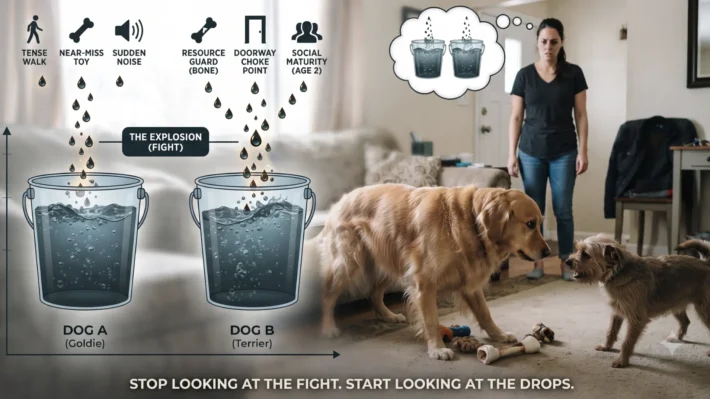
Think of each dog carrying a bucket. Every day, little stressors—a tense walk, a near-miss over a toy, a sudden noise—add a drop of stress. You can’t see the bucket filling, but it’s there, bubbling away. Eventually, one final, ordinary thing happens, and the bucket spills over. That’s the explosion you see. To know how to stop two dogs from fighting, you have to stop looking at the fight and start looking at the drops:
Resource Guarding
If your dogs are snapping over bones or bowls, they aren’t just being “greedy.” In their minds, these are vital survival assets. They believe they are the ones responsible for securing the pack’s food, and they’ll fight to protect that duty.
Doorway Tension
We call these “choke points.” When two dogs jostle to squeeze through a door first, they aren’t just trying to get outside—they are testing the hierarchy. They are asking, “Who gets to lead the way?”
The “Puppy Pass” Expiry
Often, sibling dogs fighting begins right as they hit social maturity, between ages 1 and 3. The “puppy pass” that allowed them to play rough as babies has expired, and now they are negotiating their true adult rank in the pack.
The Hidden Pain
Always book a vet check. A dog in pain is a dog with a hair-trigger fuse. If your dog has a sore hip or a dental issue, they are always on edge.
WANT TO LEARN EXACTLY HOW TO BECOME THE LEADER YOUR DOGS NEED? START WITH THIS FREE WEBINAR.How To Get Dogs To Stop Fighting: A Step-By-Step Process
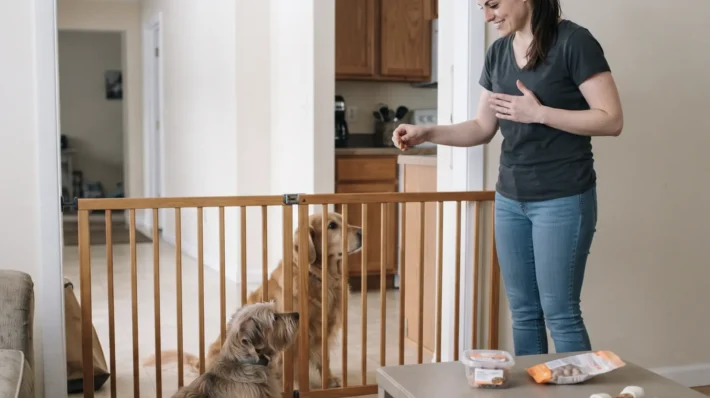
You don’t need a complex training manual; you need a strategy that restores calm and proves you are the leader.
Use Baby Gates To Separate Your Dogs
Use baby gates to separate them. If they aren’t fighting, they aren’t practicing bad behavior. It’s that simple.
Learn About The Five Golden Rules
Start practicing the calm, structured leadership taught in The Dog Calming Code™. When you control the food, the toys, and the affection, you tell them: “I am the provider, and I have everything under control.”
Controlled Movement
When you move through the house, lead the way. If you walk through a door first, you prove you are the leader of that space, which naturally reduces territorial behavior.
Reward the Calm
When they are in the same room, reward them for being calm. They have to know that calm, unthreatening behavior is what earns them rewards. This is the heart of how to get dogs to get along.
What Is The Safest Way To Stop A Dog Fight?
Many of you found this article in the immediate aftermath of a fight — or you’re terrified of the next one. So let’s cover safety, because protecting yourself matters just as much as protecting your dogs.
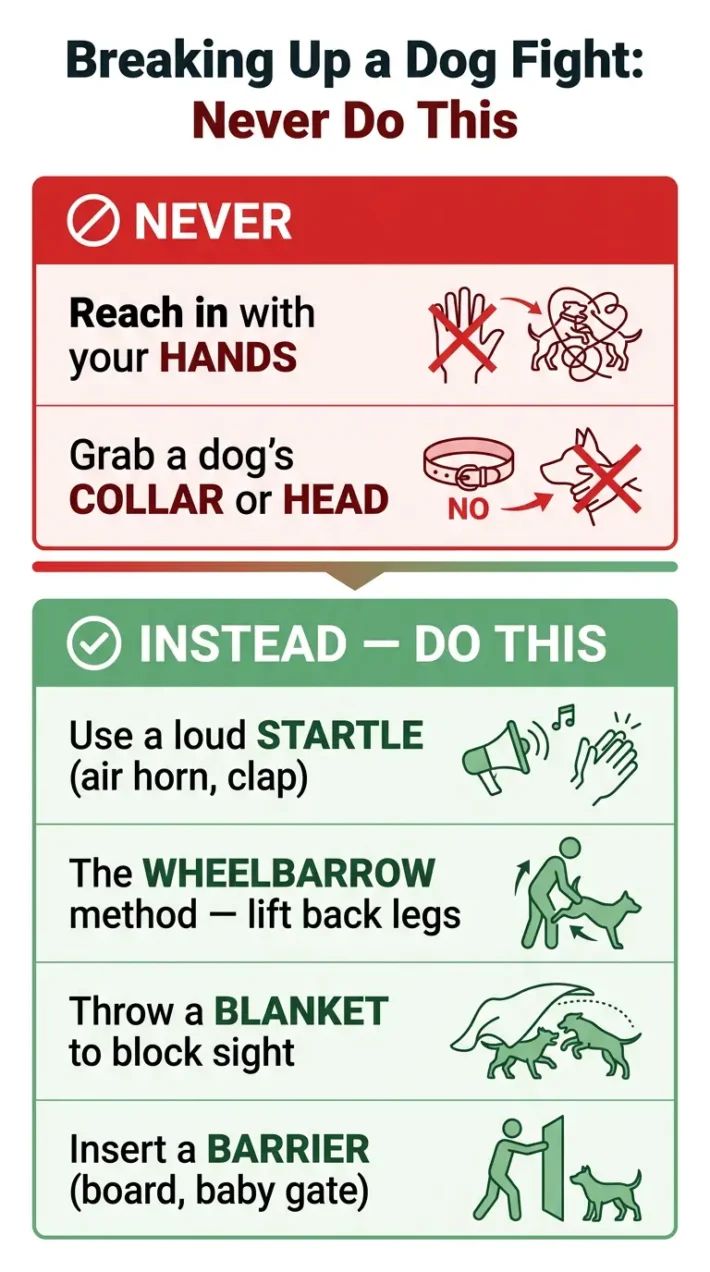
Two mistakes cause most dog-fight injuries: grabbing collars and reaching in with bare hands. These safer methods help you stop a fight without getting hurt.
The Two Things You Should NEVER Do
#1: Never put your hands (or face) near the dogs’ heads. In the heat of a fight, a dog’s thinking brain is offline. They will bite whatever is near their mouth — including you — without meaning to. This is how most owners get seriously injured.
#2: Never grab collars. Reaching in to grab a collar puts your hands right in the danger zone, and it can actually intensify the fight.
Safer Ways to Separate Fighting Dogs
- Make a loud, sudden noise — clap, bang two metal pots, or use an air horn — to startle them into breaking contact.
- Use a barrier — slide a large board, baby gate, or even a chair between them.
- Douse them with water — a bucket, hose, or even a citronella spray can interrupt the moment.
- The wheelbarrow method (with two people, only if safe) — each person calmly takes the back legs of one dog and walks backward, away from the head end.
Once separated, get the dogs into different rooms immediately and begin the cool-down period. For situations involving a dog with a serious bite history, please don’t attempt this alone — a basket muzzle and a professional trainer are well worth it to keep everyone safe.
When Should You Separate Dogs?
If the fighting is a recurring issue, separate them immediately. This isn’t a punishment; it is a 48-to-72-hour “cool-down” period. Their bodies are flooded with adrenaline and cortisol, and they need time for those hormones to drain away. If you are searching for dogs suddenly fighting and what to do, the answer is always to create distance first.
When you’re ready to bring them back together, follow the Calm Reintroduction Ladder.
Please, do yourself and your dogs a favor: don’t look at a calendar. Don’t tell yourself, “It’s been a week, so they must be fine.” Instead, look at your dogs. Their body language is the only timeline that matters. If they aren’t calm, they aren’t ready to climb to the next rung.
Here are things you can do to prepare your dogs for reintroduction:
Rung 1: Complete Separation (The 48–72 Hour Cool-Down)
For the first two to three days, your dogs live entirely apart. Different rooms, separated by solid doors and baby gates. This is often called “crate and rotate” — one dog has freedom while the other rests, then you swap, so they never cross paths.
During this time, you’re doing two things: letting those stress hormones drain away, and beginning to establish yourself as the calm, decision-making leader of the home (more on that shortly).
Don’t move on until: Both dogs are eating normally, sleeping well, and showing relaxed body language — soft eyes, loose bodies, normal tail carriage.
Rung 2: Scent Reintroduction
Dogs experience the world through their noses long before their eyes. So before they see each other again, let them re-familiarize through scent.
Swap their bedding. Rub a cloth on one dog and place it near the other’s feeding area. Feed them on opposite sides of a closed door so they associate each other’s smell with something wonderful — dinner.
Don’t move on until: Both dogs are calm and relaxed around each other’s scent, with no growling, freezing, or fixation at the door.
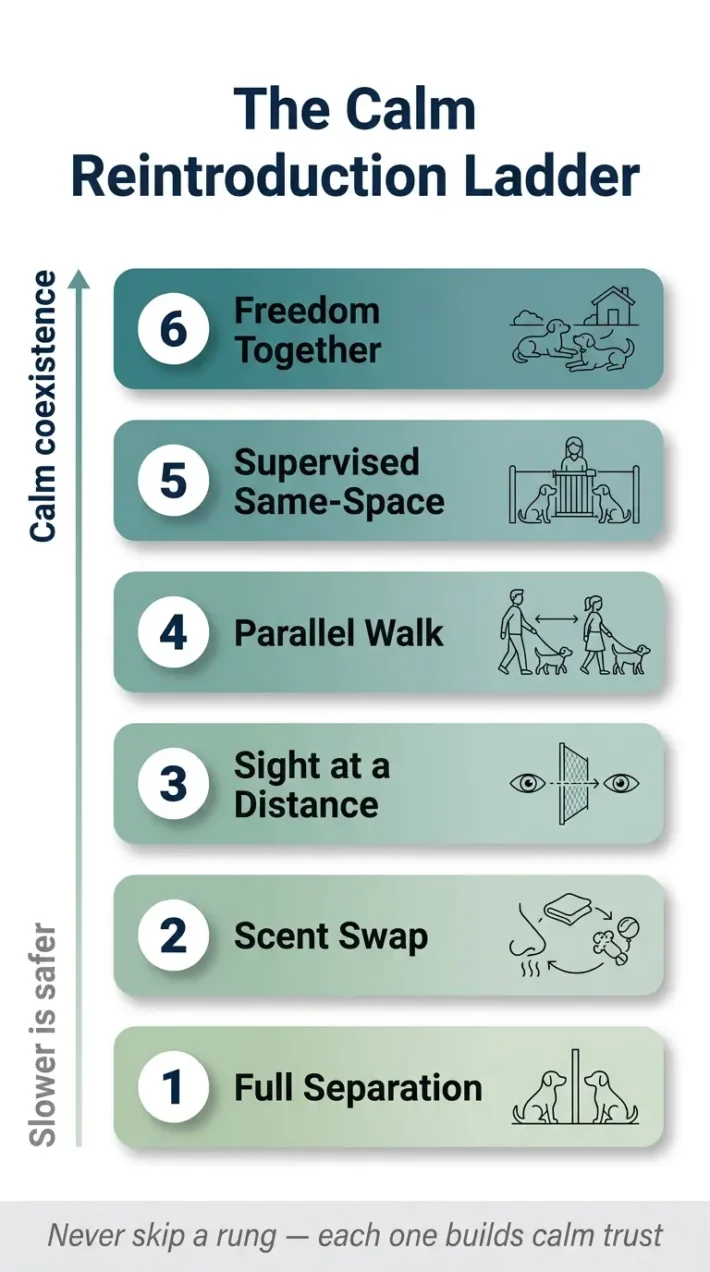
Rung 3: Controlled Sight (Through a Barrier)
Now they can see each other — but with a solid barrier between them, such as a baby gate or an exercise pen, and with both dogs on leash and a calm handler each (ideally one person per dog).
Keep these sessions short and sweet. The moment you see calm acknowledgment rather than tension, end on a high note and separate them again. You’re building positive, low-stakes experiences.
Don’t move on until: Both dogs can see each other through the barrier and remain relaxed — no hard staring, stiffening, or barking.
Rung 4: The Parallel Walk
This is the single most powerful tool in dog reintroduction, and every good trainer relies on it. Two handlers walk both dogs in the same direction, side by side but with plenty of distance between them — start across a wide road or a large field apart.
Why does it work so beautifully? Because dogs bond through shared activity, and walking forward together gives them a common purpose without the pressure of face-to-face confrontation. As they relax, you gradually — over many sessions — narrow the gap.
If your dogs pull, lunge, or struggle on leash during this stage, a well-fitted no-pull harness gives you gentle control without pain or choking, which matters enormously for an owner managing a strong dog through a delicate process. You may also find my guide to loose-leash training and lovely walks helpful here.
Don’t move on until: Both dogs can walk calmly within a few feet of each other, relaxed and loose.
Rung 5: Supervised Shared Space
This is the only time in the process where the dogs share the same room. Keep them on dragging leashes (light lines attached to harnesses so you can calmly intervene without grabbing), remove all triggers (food, bones, toys, prized sleeping spots), and keep sessions brief and supervised.
This is where the leadership work pays off. A calm leader sets the tone for the whole room. If you’re tense, white-knuckling the leash, your dogs feel it instantly — your stress becomes their stress.
Don’t move on until: The dogs can coexist calmly in shared space for extended, relaxed periods over many sessions.
Rung 6: Earned Freedom
Finally, you gradually reduce supervision and remove the dragging lines, but never all at once. Freedom is earned over weeks, not handed over after a few good days. Keep removing triggers from the environment, and keep being the calm, consistent leader who handles any “danger” so your dogs don’t feel they have to.
What Not To Do If You’re Stopping Dog Fights
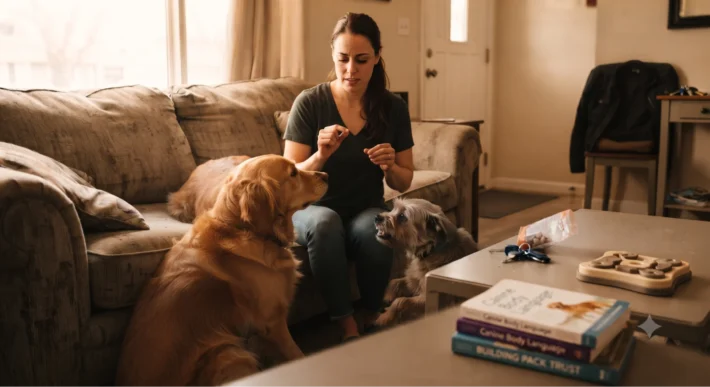
The path to peace is paved with the right intentions, but it’s easy to make mistakes that set you back to square one. Here is how to avoid them:
Don’t “Let Them Sort It Out”
That is an old-school, dangerous myth. They will “sort it out” with their teeth, and it will end in a trip to the vet, not a friendship. You are the leader, and it is your job to keep the peace.
Don’t Punish
When you see tension, don’t yell or use physical force. Fear-based training just adds more “gasoline” to their stress buckets. Contrary to what is usually taught, force and fear don’t create respect—in reality, force only creates fear and insecurity.
Don’t Force Interaction
You can’t force friendship. Don’t push them face-to-face or hold them near each other to “make them be nice.” Let the relationship build slowly, at a pace where they both feel secure.
Don’t Panic
This is harder than it sounds, but it’s vital. Your dogs read your energy like a book. If you are breathing shallow, hovering, or holding your breath because you’re braced for a fight, your dogs will feel your tension and assume there is a real reason to be afraid. If you are calm, they can be calm.
How A Dog Trainer Can Help Stop Dog Fights
If you feel like you’re at the end of your rope, don’t walk this path alone. A trainer who understands multi-dog household management can help you see the “invisible” cues that you are currently missing. They can teach you how to move past the dog dominance myth and show you the language your dogs are actually speaking.
You aren’t a failure for struggling. You are a leader in the making. By learning how to stop dogs from fighting in the same household, you are going to bring the calm back into your home—and into your own heart.
You Can Stop Sudden Dog Fights With The Dog Calming Code™
You don’t have to fear, and you don’t have to let your dogs run the show. As you take on the leadership role, your dogs will listen, and your dogs will be calm again.
The Dog Calming Code™ aims to help dog owners take control through loving leadership. When your dogs know you are the leader – one they can trust and respect – you will quickly see how their behavior changes. In fact, a lot of dog owners report to me that they see changes in under a week. This is how powerful the program is.
If you want to know more about The Dog Calming Code™, join my free webinar where I talk about the strategies that helped over 120,000 dog owners. Yes, the webinar is free, but it doesn’t run short of tips!
You got this.

— Doggy Dan
FREQUENTLY ASKED QUESTIONS
Is it normal for two dogs living together to fight?
While occasional low-level disagreements over resources or personal space can occur, persistent or violent fighting is not normal and indicates a significant breakdown in their relationship or a failure in environmental management.
Why would a dog attack another dog in the same house?
Common triggers often include resource guarding (food, toys, resting spots, or even human affection), fear, territoriality, or “re-directed aggression,” where a dog reacts to an outside stimulus (like another dog seen through a window) but lashes out at the dog nearest to them.
What are common triggers for dog fights?
High-value items are the biggest culprits. Keep a close eye on interactions during feeding times, when favorite toys are present, or when both dogs are competing for your attention. Additionally, changes in health, sudden shifts in the household dynamic, or lack of exercise can lower a dog’s threshold for frustration.
What should you not do during a dog fight?
Never put your hands or body parts between the fighting dogs, as you will likely be bitten. Do not scream or panic, as this often elevates the intensity of the conflict. Instead, use a physical barrier like a sturdy board or a chair to separate them, or create a loud, sudden noise (without physically touching them) to break their focus.
How to tell if a dog fight is serious?
A serious fight is characterized by the intent to cause harm, often involving sustained biting, shaking, or “locking on,” accompanied by deep, low growling rather than high-pitched, frantic barking. If there is blood, puncture wounds, or if one dog is pinning the other and not letting go, it is a life-threatening situation.
What to do after a dog fight in the same house?
Immediately separate the dogs. Keep them completely apart—even if they seem “fine”—to prevent further conflict while emotions are high. Assess both dogs for injuries and seek veterinary care for any bite wounds, as these can be deeper than they appear on the surface.
Do dogs forgive after a fight?
Unlike humans, dogs do not “forgive” in the sense of letting go of grudges or understanding apologies. If they are forced back together too quickly, a previous fight can actually increase the likelihood of future, more severe aggression because the association between them has become negative and fearful.
Can dogs still live together after fighting?
Often, yes, but it requires a strict management and re-introduction protocol. This typically involves crate-and-rotate systems, professional help from a veterinary behaviorist, and a long-term plan to desensitize them to each other’s presence.
How to stop two dogs from fighting in the same household?
The most effective strategy is prevention through management. Remove the triggers (e.g., don’t feed them together, remove toys), ensure each dog has their own safe “sanctuary” space, and prioritize individual exercise and training to build their confidence and focus on you.
Can dogs live together and get along again after a serious fight?
Yes, in the vast majority of cases they can. Dogs don’t hold grudges the way humans do because they live in the present. With a proper cool-down period, a slow staged reintroduction, and (crucially) calm human leadership that removes the reason they were fighting, even dogs who fought badly can rebuild a peaceful relationship. I’ve seen it countless times in over 125,000 transformations.
How long should I separate my dogs after a fight?
At an absolute minimum, 48–72 hours of complete separation, to allow the stress hormones from the fight to drain out of their systems. But the full reintroduction (climbing through scent, sight, parallel walks, and shared space) typically unfolds over one to several weeks. Let calm behavior, not the calendar, set your pace.
What is the 3-3-3 rule, and should I follow it for reintroduction?
The “3-3-3 rule” usually refers to a rescue dog’s adjustment timeline (3 days, 3 weeks, 3 months). It’s not really a reintroduction protocol. Rigid day-counts can be misleading because every pair of dogs is different. I prefer the Calm Reintroduction Ladder: you climb each stage only when your dogs are genuinely calm, which respects their individual pace far better than a fixed countdown.
Why did my two dogs suddenly start fighting when they were fine for years?
It feels sudden, but it’s almost always been brewing. Think of each dog’s invisible “stress bucket” slowly filling with small stressors until one final drop makes it overflow. Common reasons include social maturity (the hierarchy renegotiating as a younger dog grows up), resource guarding, an undiagnosed pain or medical issue, or, most fundamentally, a leadership vacuum where the dogs feel they must run the household.
Do dogs forgive each other after a fight?
Dogs don’t experience grudges or “forgiveness” the way we do. They respond to how they feel in the moment. If both dogs are calm, relaxed, and confident that a trustworthy human is in charge, they can absolutely return to a friendly relationship. The lingering “tension” owners notice is usually leftover stress hormones plus an unresolved sense of who’s in charge — both of which the reintroduction process and leadership work resolve.
My dog is now scared of my other dog after the fight. What do I do?
This is common and very treatable. Don’t force the frightened dog to face the other one — that only deepens the fear. Go right back to the bottom of the ladder and move extra slowly, keeping every interaction calm and positive (lots of scent work and parallel walking at a comfortable distance). As your nervous dog builds confidence in you as a calm protector, their fear of the other dog fades. My guide on building confidence in a fearful dog goes deeper here.
Will a muzzle stop my dogs from fighting?
A basket muzzle is a valuable safety tool during reintroduction — it prevents injury and lets you work more confidently. But it’s not a solution to the fighting itself. A muzzled dog who still feels they must guard resources or run the household is still a stressed, conflicted dog. The muzzle buys safety; the leadership work fixes the cause.
Should I rehome one of my dogs if they keep fighting?
Please don’t make that decision from despair or before you’ve tried addressing the true root cause. Most repeated fighting comes from a leadership vacuum and ongoing trigger stacking — both fixable with the right, kind approach. Rehoming should be a genuine last resort after you’ve ruled out medical causes, followed a proper reintroduction, and established calm leadership. I’ve helped thousands of owners who were on the brink of giving up keep their whole family together. If you’re at that crossroads, start with my free reactivity webinar. It may change everything.