How to stop dogs fighting in the same household starts with understanding one thing: your dogs are not fighting because they dislike each other — they are fighting because there is no clear leader in your home, and they feel compelled to compete for that role themselves. When you step into that leadership position calmly and consistently, the reason for fighting disappears.
“I just need to know they can live together. I love them both and I’m terrified I’m going to have to choose.”
If you’ve ever stood in your own hallway, heart pounding, trying to get between two dogs you love, both of whom you brought home, both of whom you’ve cared for, I want you to know something important before we go any further.
You might wonder, “Why is my dog acting this way? Have I not shown them they are safe with me?”
This situation is not hopeless. This issue is far more fixable than you think.
I’m Doggy Dan, and over two decades of working with more than 125,000 dogs worldwide, I’ve seen household dog-fighting cases that seemed completely hopeless transform into peaceful, harmonious homes. I saw it happen faster than owners believed possible, and noticed it with dogs that other trainers had already given up on.
But I’ve also seen well-meaning owners make the problem worse not out of negligence, but out of love. Trying everything they could think of. And still watching their dogs fight.
So before we talk about what to do, I want to make sure you understand what’s actually going on. Because until you understand the real cause — not the triggers, the cause — no technique in the world will give you lasting peace.
Key Takeaways
- It’s not about the bone, the doorway, or the food bowl. Those are triggers. The real cause of dogs fighting in the same household is a leadership vacuum — and your dogs are fighting to fill it.
- No training technique alone will fix this. Treats, commands, corrections, and even desensitization protocols will not resolve in-home dog aggression if the underlying dynamic hasn’t changed. The Dog Calming Code™ — not a technique — is the fix.
- The 48-hour cortisol window is critical. After a fight, stress hormones remain dangerously elevated for two full days. Rushing reintroduction during this window almost always triggers another fight.
- Don’t assume it’s the obvious dog. In many multi-dog household cases, the quieter or smaller dog is the one stirring things up — subtly resource guarding, demanding attention, provoking conflict while appearing innocent. The Five Golden Rules must be applied equally to every dog in the home.
- Management is necessary — but it’s not the solution. Gates and crates keep your dogs safe while you do the real work: becoming the calm, consistent decision-maker your dogs have been waiting for.
What To Do When Your Dogs Start Fighting: Meet Bella and Rex
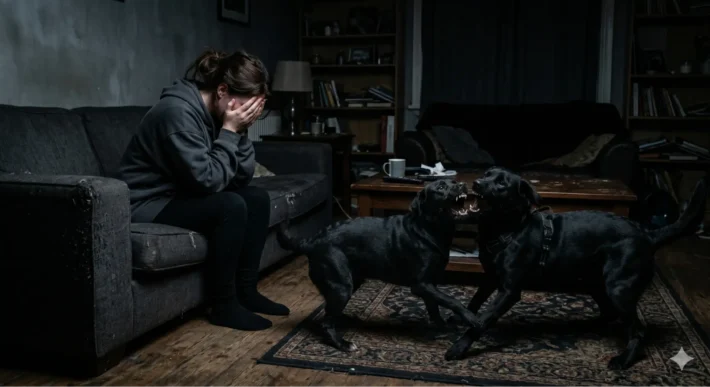
Sarah had two dogs she adored.
Bella, a five-year-old Labrador, had been with the family since puppyhood. Rex, a three-year-old Staffy cross, had joined them as a rescue eighteen months earlier. For the first year, they got along well enough. There are odd grumbles here and there, but nothing serious.
Then one Tuesday morning, over nothing — a dropped piece of toast — they exploded.
By the time Sarah called me, she hadn’t had both dogs in the same room for three weeks. She was rotating them between rooms, sleeping on the sofa to manage the schedule, and crying most evenings. She’d tried treats and keeping them distracted. There was a time she tried a recommended training collar. Nothing worked.
“Why are my dogs fighting all of a sudden?” she asked me. “They used to be fine.”
The answer, when I looked at her household, was clear immediately. There was no calm, consistent leader in that home. Not because Sarah was a bad owner — she was a wonderful, devoted owner. But she’d never been shown how to hold the leadership role her dogs needed her to hold. And Rex, now fully socially mature at three years old, had decided it was time to settle the question of who was in charge.
What Sarah needed wasn’t a new technique. She needed a fundamental shift in how her household operated.
When she came to me, I told her there was a big leadership gap that she wasn’t filling.
“But I thought they know that I’m their leader since I’m their owner?” She asked me. I proceeded to explain to her that the very reason for her dogs’ tense behavior was lack of leadership, and it’s a role she had to fill fast.
Sarah decided to get the Dog Calming Code™ and follow the rules to a T.
Within three weeks of implementing the Dog Calming Code, Bella and Rex were in the same room. Within two months, they were sleeping on the same sofa.
That shift is what this article is about.
Why Are My Dogs Fighting All of a Sudden? The Root Cause Explained
Let me be very clear about something, because it will change how you approach everything that follows:
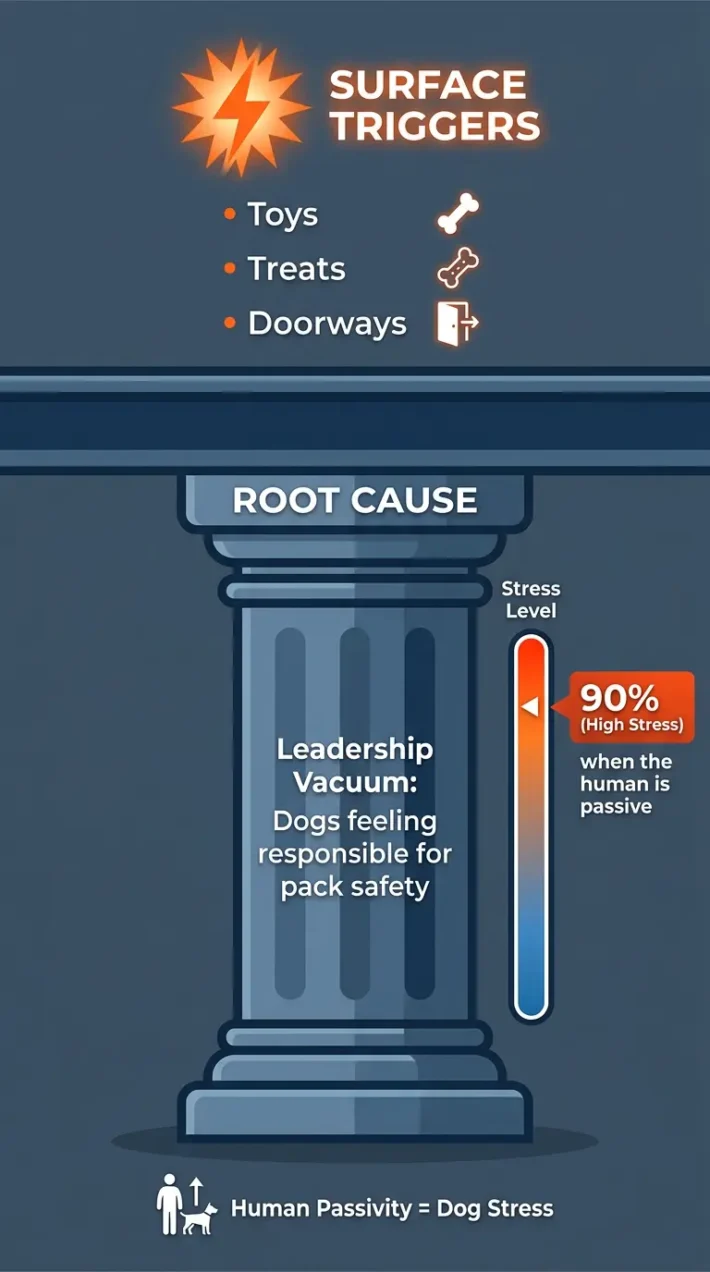
The triggers are not the cause.
The toast that fell on the ground? It’s a trigger but not the cause.
The resting spot that both your dogs seem to love? Another trigger, but absolutely not the cause.
When dogs fight in the same household, owners almost always point to something specific — food, a toy, a doorway, or someone walking into the room. And yes, those are real behavioral triggers. Identifying them matters for short-term management.
But here’s the honest truth: if you only manage the triggers, you will be managing them forever.
The real cause of dogs fighting in the same household — in almost every case I’ve seen — is a hierarchy vacuum. Your dogs don’t have a clear, trustworthy leader. So they compete to fill that role. And when two dogs both believe they are responsible for managing the household, conflict is inevitable.
Dog aggression in a multi-dog household is not random. It’s not personality. It’s not dominance for the sake of dominance. It is two stressed animals trying to resolve an unresolved question: who’s in charge here?
Your job isn’t to make them like each other more. Your job is to answer that question — by stepping into the leadership role yourself. YOU have to be the leader in charge.
When you do, the competition has no purpose. And it stops.
The Social Maturity Trigger: Why Dogs Fight When They Reach Age 2
One of the most common reasons dogs fight all of a sudden in a household that was previously peaceful is a developmental stage most owners don’t know exists.
Between 18 months and 3 years of age, dogs reach social maturity. Their personality fully emerges, their confidence solidifies, and their position within the pack hierarchy becomes critically important to them. A puppy who once deferred to an older dog may suddenly start challenging them. A once-submissive rescue may begin asserting themselves.
Watch their body language closely during this period. Stiffer posture, more deliberate eye contact, less playful deference — these are early stress signals that hierarchy tension is building. Caught early, this is manageable. Ignored, it escalates.
This is biology, not bad character. But without clear human leadership in place, it becomes the spark that lights a very difficult fire.
Pain and the Health Issues Make Dogs Snappy
Sudden dog aggression between dogs who previously coexisted peacefully often has a medical component that gets missed entirely.
A dog in pain guards their space more intensely because they feel vulnerable. Arthritis, dental disease, an undiagnosed internal injury — any of these can turn tolerance into threat perception. When the other dog approaches, what was once accepted becomes unbearable.
If your dogs have started fighting seemingly out of nowhere, please rule this out first with a thorough veterinary examination. I’ve seen cases where treating an underlying health issue removed the majority of the tension between dogs almost overnight.
Common health issues that cause aggression in dogs include:
- Musculoskeletal Pain: This is one of the most common drivers of irritability. Arthritis, hip dysplasia, or spinal issues (like intervertebral disc disease) can make a dog extremely sensitive to touch or movement. If a dog snaps when you try to lift them, pet their back, or help them up, they are likely guarding a painful area.
- Dental and Oral Issues: Tooth decay, gum disease, or retained deciduous (baby) teeth can cause significant pain. A dog may snap if their mouth is touched or if they are eating, as the pain makes them defensive and prone to lashing out.
- Ear and Skin Infections: Chronic ear infections or severe skin irritation are intensely painful and itchy. Dogs may become snappy if someone approaches their head or attempts to touch or treat the affected area.
- Neurological Conditions: Conditions such as brain tumors, encephalitis (inflammation of the brain), or epilepsy can alter a dog’s personality and judgment. These issues can cause confusion, sudden mood swings, or reactive behaviors that seem to come out of nowhere.
- Endocrine and Metabolic Disorders: Imbalances in hormones (such as thyroid issues) or organ dysfunction (kidney or liver disease) can lead to toxicity in the bloodstream. This can cause increased anxiety, irritability, and decreased stress tolerance.
- Sensory Decline: In senior dogs, the loss of sight or hearing can make the world feel unpredictable and frightening. A dog that is startled more easily because they can no longer sense an approaching person is much more likely to react defensively.
Can Jealousy Cause Dogs To Fight? The Trigger Nobody Talks About
Jealousy between dogs is one of the most underappreciated and underdiagnosed sources of tension in a multi-dog household, and it’s worth naming directly.
When one dog perceives another receiving more attention, more access, or preferential treatment, the resentment builds. Watch for whale eye, lip-licking, and stiff body language when you give attention to one dog in the other’s presence. These stress signals often precede a fight that seems to “come out of nowhere.”
This is why the Five Golden Rules include delayed acknowledgment — because the moment you allow either dog to demand your attention on their terms, you’re feeding the very dynamic that causes fighting.
Food Aggression, Resource Guarding, and Feeding Time
Food aggression and resource guarding are among the most common and dangerous behavioral triggers in a shared home. Dogs who are otherwise tolerant of each other can escalate rapidly when resources feel uncontrolled or scarce.
And it isn’t just food. Beds, toys, favorite spots on the sofa, and access to you can all become objects worth fighting over. Managing these triggers carefully is an important short-term step — but it only works long-term when paired with the leadership shift that removes the underlying competition.
What NOT to Do When Dogs Are Fighting in the Same Household
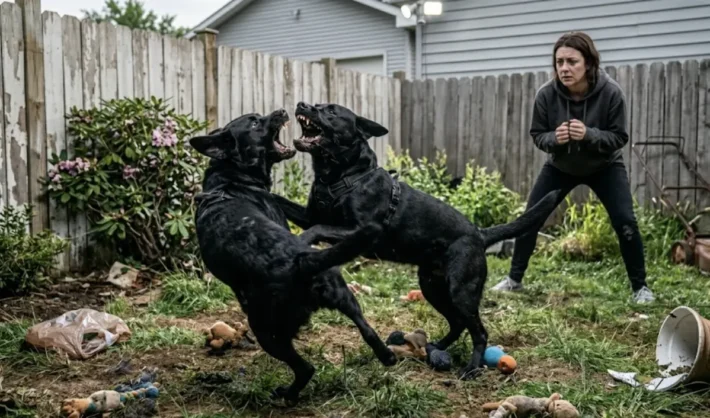
Before I walk you through what works, I want to address the approaches I see fail consistently — because most of them come from a genuinely good place, and I don’t want you wasting time on them.
#1: Don’t Rely On Treats To Create Peace.
I’ve seen countless owners try to reintroduce fighting dogs by placing treats between them, hoping to build positive associations. Here’s the problem: a treat rewards behavior in the moment. They don’t change the underlying hierarchy. The moment the treats stop, the tension returns — because the root cause remains untouched.
Desensitization and counter-conditioning can play a supporting role in specific cases, particularly where one dog has developed a fear response. But these techniques only work sustainably after the leadership dynamic has shifted. Without that foundation, you’re painting over damp walls.
#2: Don’t Punish After A Fight
Punishment after a fight increases cortisol, adds confusion, and makes future fights more likely. Your dog isn’t fighting because they’re bad — they’re fighting because they feel responsible for managing a situation they shouldn’t have to manage. Punishment adds to that burden. Leadership removes it.
#3: Don’t Try To Enforce A Pecking Order Yourself
Well-meaning owners sometimes try to “support the dominant dog” by feeding them first, greeting them first, or giving them preferential access. In my experience, this almost always makes things worse. Let your dogs sort out minor social dynamics once you clearly hold the top position. Trying to assign rank yourself — before you’ve established your own leadership — simply adds more confusion to an already-confused household.
#4: Don’t Rush The Reintroduction
After a fight, the instinct is to try to make it right quickly. But rushing reintroduction during the 48-hour cortisol window is one of the most common reasons dogs fight again immediately after being separated. Respect the biology. The patience you show here pays dividends later.
#5: Don’t Add Another Dog
Adding a third dog to a multi-dog household where dog aggression is unresolved will almost certainly make things significantly worse. More dogs means more competition and more hierarchy confusion. Fix the existing dynamic first.
How to Stop Dogs from Fighting: The Dog Calming Code Is the Real Fix
Here’s what I want you to hear, and I want to be very clear about it:
No training technique — on its own — will stop household dog fighting.
Not parallel walking. Not threshold control. Not counter-conditioning. These are all useful tools, and I’ll walk you through them. But tools only work when the foundation is solid. And the foundation, in every multi-dog household I’ve ever worked with, is human leadership.
The Dog Calming Code™ is not a trick. It’s not a command sequence. It is a communication system — a set of daily, consistent behaviors that show your dogs, clearly and without force, that you are the calm, trustworthy decision-maker they’ve been waiting for.
When you hold that position, your dogs no longer need to compete for it. The fighting loses its entire purpose.
The Five Golden Rules That Form The Foundation:
1. Control the Food
You decide when eating happens. This directly addresses food aggression and resource guarding at the source — because you own the resource, not the dogs. Feed them separately, in calm, controlled conditions, with you setting the pace.
2. Delayed Acknowledgment
Be the one to decide when greetings happen. Don’t rush to say hello to your dogs the moment you walk through the door. Wait until they are calm. This is especially powerful for reducing jealousy between dogs — because neither dog can demand your attention on their terms.
3. Improve Dog Obedience
Your dog should know you decide when play happens. Initiating and ending play on your terms — not theirs — reinforces your position as the calm decision-maker without force or confrontation.
4. Stop Dog Barking
You decide how perceived threats are handled. When you step in calmly to manage what your dogs are reacting to=[, you remove the need for them to take that responsibility on themselves.
5. Walk Your Dog Properly
Also be the one to decide the direction and pace of every walk. The walk is one of the most powerful daily reinforcements of pack dynamics — and walking your dogs together, with you leading, is one of the fastest ways to rebuild unity in a multi-dog household.
These are not dominance tactics. They are clarity. They are kindness. They are the answer to the question your dogs have been asking since the fighting started: is there someone in charge here who I can trust?
And here’s something critical that many owners overlook: apply the Five Golden Rules equally to every dog in the house. Don’t assume it’s the bigger dog, the louder dog, or the most obviously reactive dog who’s driving the conflict. I’ve worked with many multi-dog household cases where the quieter, smaller dog was the one stirring things up — resource guarding subtly, demanding attention in ways that were easy to miss, playing the general while looking like the victim. Every dog gets the same rules. No exceptions.
What Should You Do When Dogs Start Fighting? The 3-Step Immediate Protocol
While you’re building the leadership foundation, here’s what Dan recommends for managing things safely day-to-day.
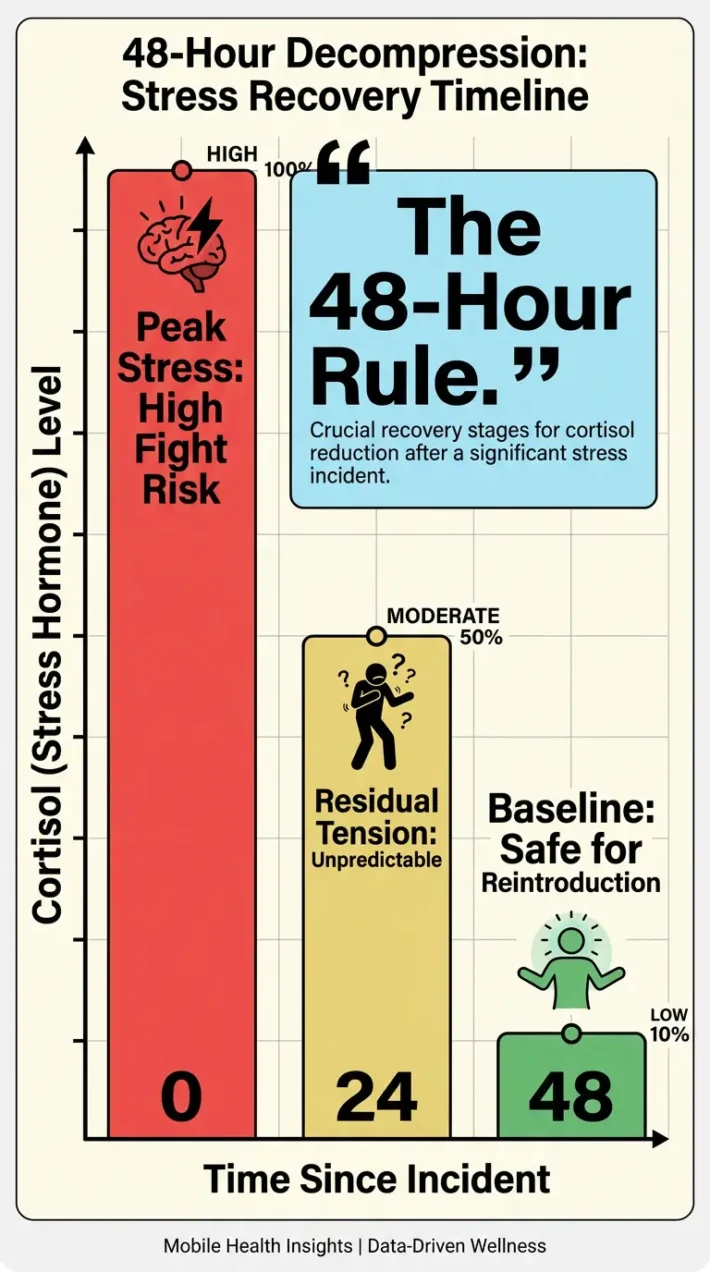
Step 1: The 48-Hour Decompression — Respect the Biology
After any fight, cortisol floods your dogs’ systems and stays dangerously elevated for a full 48 hours. During this window, both dogs are hyper-reactive. Their threshold for another explosion is paper-thin. A look, a sound, even proximity can be enough.
This is also why preventing further fights is the single most important short-term priority. Every fight that happens makes future fights more likely. The pattern compounds neurologically. The more they rehearse it, the more automatic it becomes.
For the first 48 hours after a fight:
- Keep your dogs completely separated — no visual contact if possible.
- Keep the environment calm and quiet.
- Remove all known behavioral triggers: food bowls, toys, high-value chews, contested spots.
- Do not attempt any reconciliation. Do not try to “introduce them slowly” yet.
This is not avoiding the problem. This is respecting the fact that their nervous systems need to return to baseline before any progress is possible.
Step 2: Walk Them Together — With You Leading
Once the 48-hour window has passed, the single most powerful tool for how to get dogs to stop fighting and start rebuilding a sense of shared pack purpose is this: walk them together, with you in the lead.
One dog on each side of you. Standard leashes, not retractable. A neutral location — somewhere neither dog has claimed as territory. Start at a safe distance between them.
Walk calmly and purposefully forward. You are leading. The movement is shared. The purpose is shared. And both dogs are looking to you — not to each other — for direction.
Watch their body language carefully. Relaxed posture, loose tail, forward movement without fixation on each other — that’s what you’re looking for. The moment you see stress signals — stiffening, hard staring, raised hackles — increase distance and continue walking forward.
Do this for 20–30 minutes daily. The best window, Dan specifically recommends, is after a long walk and a feed — when physical energy is already low, and stress triggers are minimal. Over time, gradually reduce the distance between the dogs as their calm body language confirms they’re genuinely comfortable.
This is not a trick. It is “pack” dynamics in action. Moving forward together — with a calm, consistent leader at the front — is one of the most natural things a dog can do. It builds unity without forcing interaction.
Step 3: Manage the Environment While You Build the Foundation
Management tools — baby gates, crates, separate rooms — are not the solution. But they are absolutely necessary while you’re implementing the deeper work.
The distinction is important:
- Management = physical separation, removing triggers, controlling access to flashpoint areas
- The Dog Calming Code™ = the psychological shift that makes management eventually unnecessary
Use both. Don’t rely on management alone — it keeps your dogs safe but never resolves anything. And don’t skip management in the name of “letting them sort it out” — every unsupervised fight sets you back further.
Create calm time together deliberately. After a long walk, after feeding, when energy is naturally low — these are your windows. Keep sessions short and supervised. Reward calm, relaxed body language with quiet, composed acknowledgment. You’re not looking for them to play. You’re looking for them to simply coexist without tension.
That’s where peaceful multi-dog households are built — in those quiet, unremarkable moments of calm togetherness.
How to Reintroduce Dogs After a Fight: The Step-by-Step Process
How to reintroduce dogs after a fight is a question I get asked constantly — and the answer is always the same: slowly, structured, and never on your timeline.
Move at the pace of the most nervous dog, not your own impatience. Here’s the process:
Phase 1: Complete Separation (0–48 hours)
No contact. No visual. No proximity. Remove triggers. Let their nervous systems reset.
Phase 2: Neutral Ground Parallel Walking (Day 3 onwards)
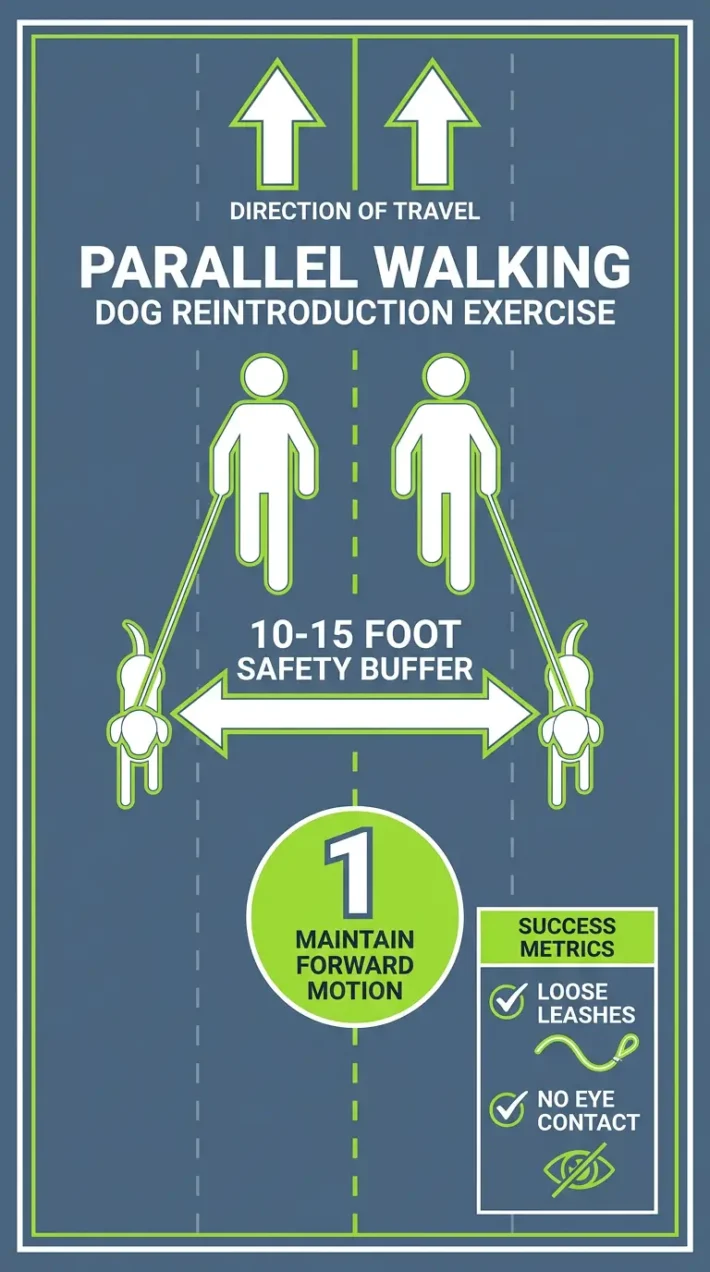
As described above. Begin at 15–20 feet apart. Both dogs walking forward with you. No forced interaction. Watch body language carefully. Only reduce distance when both dogs are consistently relaxed.
Phase 3: Threshold Control Indoors
Once parallel walking is going well, it’s time to bring that structure indoors.
Control Doorways
Before your dog walks through any doorway, have them sit and wait. You go first. Then you release them. You control access — not them.
Control Room Entry
When bringing both dogs into the same space, do so one at a time. First dog enters and settles calmly. Second dog enters and settles calmly. You reward calm body language — not with excitement, but with quiet, composed acknowledgment.
Interrupt Early
If either dog begins to fixate on the other, redirect their attention to you immediately. A calm physical presence between them, or a quiet but firm redirection, tells them: I’m handling this. You don’t need to.
What you’re teaching them through all of this is simple and profound: you are the one who decides what happens in this home. When they know that — really know it — they can stop competing and start relaxing.
What You Should Do To Stop Dog Fighting For Good
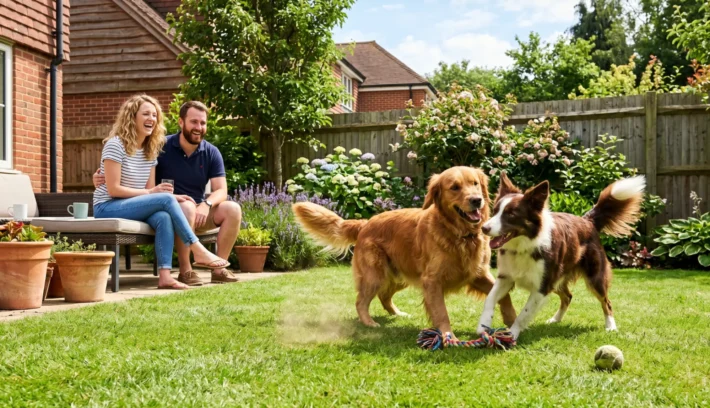
Dogs who keep fighting in the same household are almost always dogs who are exhausted.
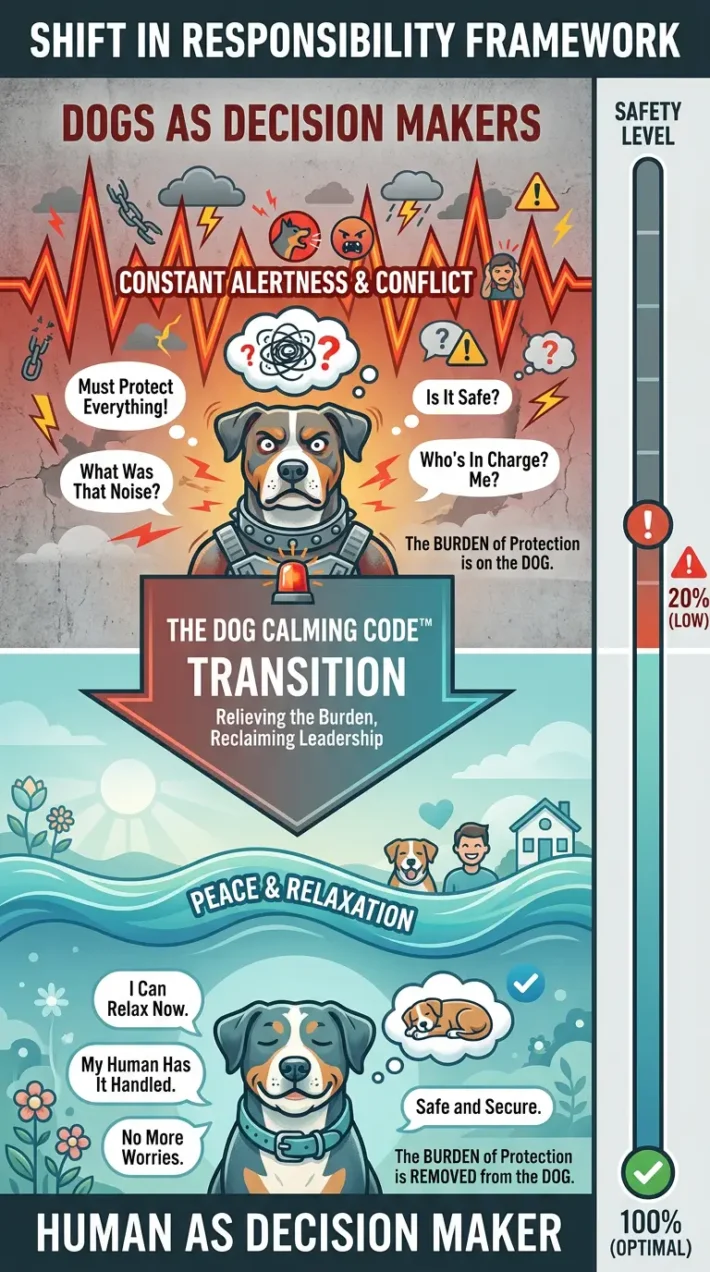
Not physically — emotionally. The weight of managing a household, protecting resources, settling hierarchy, and monitoring every interaction — it’s an enormous burden for any dog to carry. And it produces exactly the kind of stress signals, reactive behavior, and dog aggression that owners are desperate to stop.
Here’s what I want you to understand: when you implement the Dog Calming Code™, you’re not taking something away from your dogs. You’re giving them the most valuable thing possible. Permission to relax.
Through every calm, consistent action — every controlled feeding, every structured walk, every quiet redirection — you’re telling them:
- “I’ve got this.”
- “You don’t need to guard the door.”
- “Please don’t feel like you need to control the other dog.”
- “My furry friend, you can just be a dog.”
That shift — from a household where dogs feel responsible for managing everything, to a household where a calm, trustworthy human holds that role — is the thing that changes everything.
It’s not magic. It’s not complicated. But it does require consistency. And it requires you to start.
How To Start Training Dogs Not To Fight
If you haven’t already, begin with the Dog Calming Code™. This is your foundation. Without it, management strategies and reintroduction techniques will produce temporary results at best.
(I share the strategies of the Dog Calming Code™ in my FREE webinar.)
If you’re living behind gates right now — rotating your dogs between rooms, dreading the sound of growling, wondering if you’ll ever be able to just sit down with both of them — I want to leave you with this:
You are not stuck here.
Knowing how to stop dogs fighting in the same household is not about finding the perfect intervention in the heat of the moment. It’s about making a shift in how your entire household operates — stepping into the calm, consistent leadership role your dogs have been desperately waiting for you to fill.
The home you’re imagining, where your dogs lie in the same room, where you don’t tiptoe around triggers, where peace is the default… is not a fantasy. It is achievable. I’ve watched it happen in homes far more fractured than yours.
But it starts with you. Not a new technique. Not another management tool. You, deciding to become the leader your dogs need.
And the moment you do — the moment that shift happens — everything else begins to follow.
Your dogs don’t need to be separated forever.
They need you to lead.
And once you do, the peace you’ve been searching for will follow.

— Doggy Dan