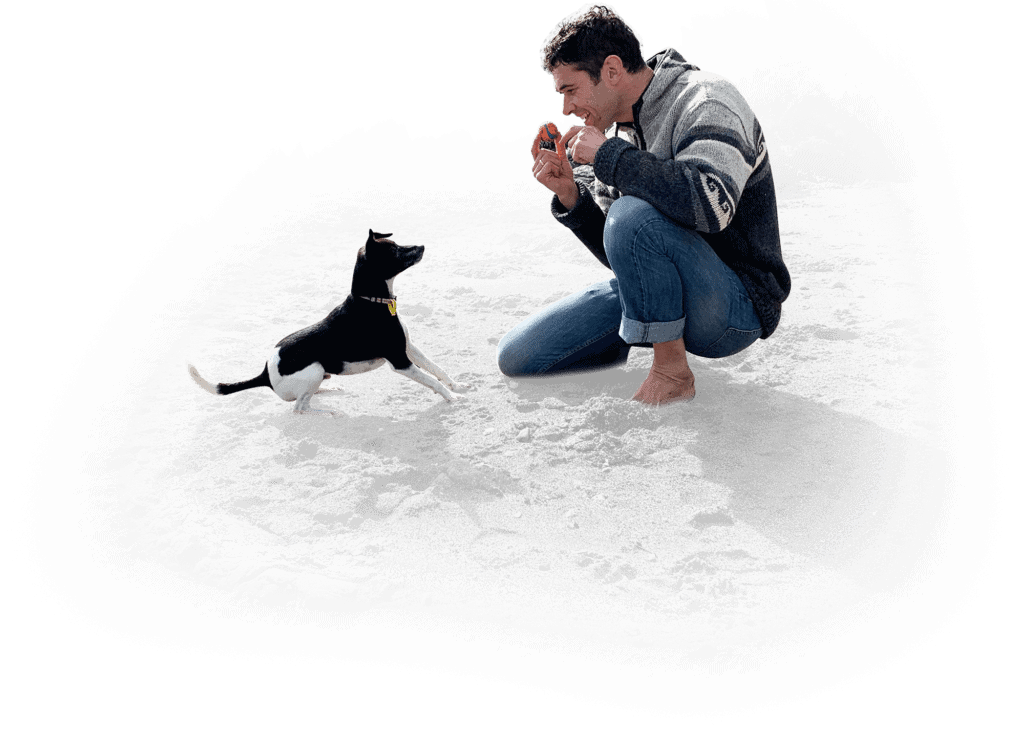
“Dan, why do my dogs keep fighting?” If fights are happening regularly in your home, stop overanalyzing every trigger and start with a bigger question: do your dogs truly see you as their leader? Because 98% of the time, ongoing conflict comes down to unclear leadership. When dogs don’t recognize a leader, they’ll try to sort it out themselves—and that’s when fights happen.
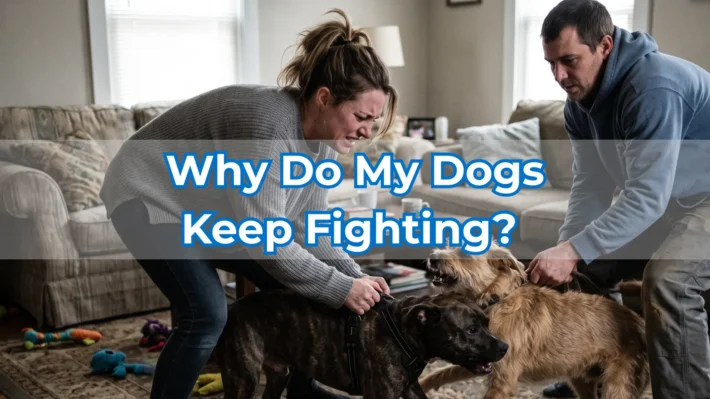
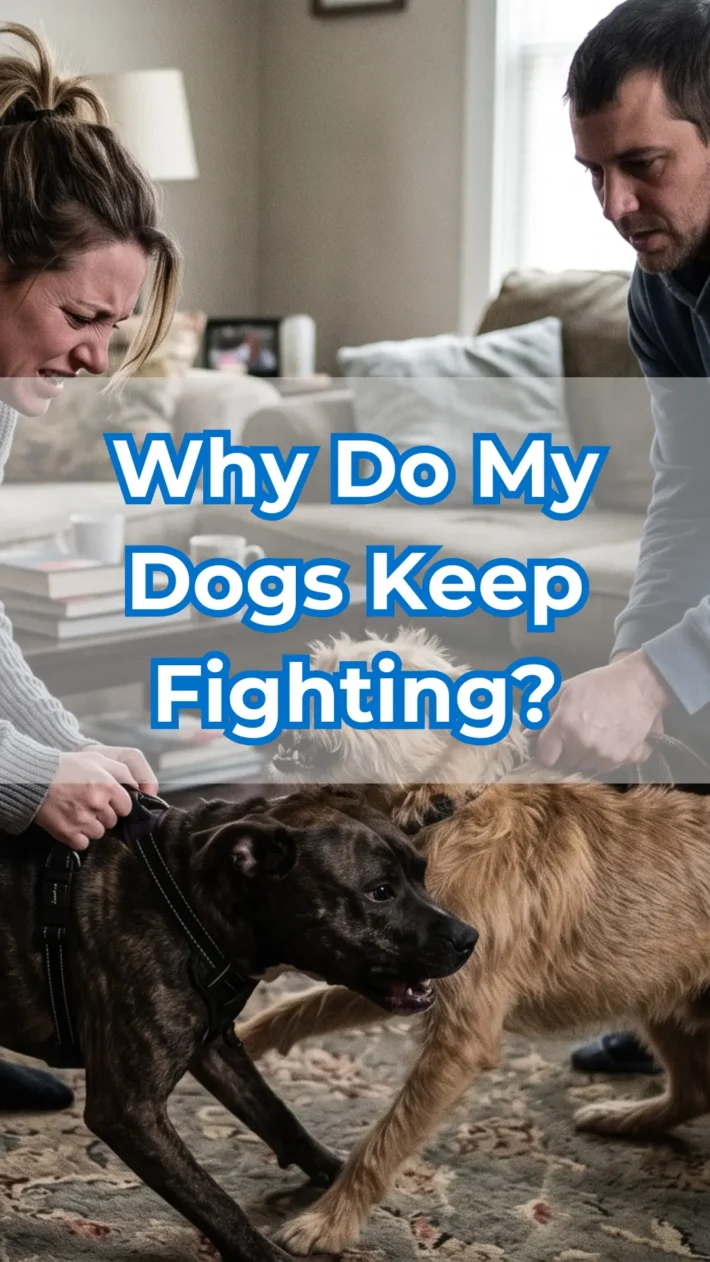
You love both your dogs, and you also know your dogs love each other. This fact is what makes dealing with dog fights all the more confusing. Can dogs really change their dynamic with each other overnight?
Sometimes, it starts with a growl over the food bowl. Maybe it escalated into a full-blown fight that left you shaking. Or maybe your dogs were perfectly fine together for months. And then, out of nowhere, everything changes.
It can be so overwhelming, can’t it? You find yourself searching for the “why,” trying to pinpoint the exact moment everything started to unravel, only to feel more lost than when you started.
Let me take your hand and help you understand this: something important to your dogs is missing. You may provide the food, the toys, the affection, but unless you give your dogs the leadership they’re looking for, they will always be restless. They will always fight for it.
If you fill in what’s missing, I guarantee you that the fights WILL stop. How do you do this? Read on to learn more.
Key Takeaways
- Sudden dog fights in the same household are rarely about the dogs being “bad”; they are usually a symptom of a missing leader. When you step into the role of a calm, confident decision-maker, your dogs no longer feel the burden of protecting the pack, which allows the tension to dissolve.
- While you work on long-term leadership, you can prevent immediate conflict by controlling your home environment. Simple steps like feeding separately, removing high-value items that trigger guarding, and providing each dog with a private safe zone keep your pets safe and lower the daily pressure in your home.
- When you see the warning signs like stiffening, hard stares, or whale eye, don’t react with panic or shouting, as this only adds to the chaos. By learning to calmly interrupt tense moments and addressing the root cause through a structured, predictable routine, you can move from managing conflict to creating a permanently harmonious home.
Lack of Leadership: The Very Reason Why Your Dogs Keep Fighting
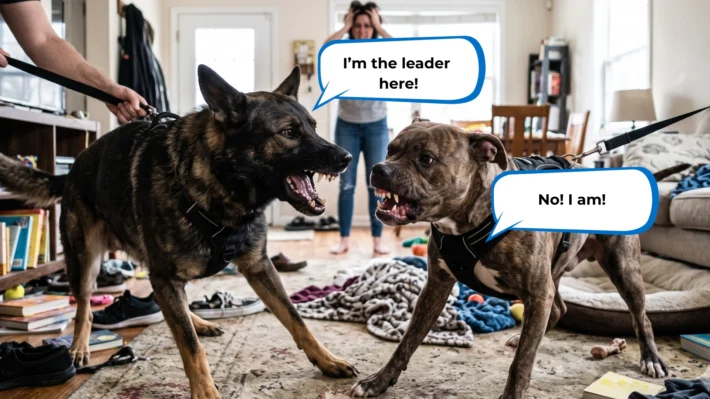
Have you ever gone on a trip where you had everything packed—the snacks, the gear, the money—but the whole vacation still felt like a disaster? Maybe you couldn’t agree on where to go, or you were just wandering around lost. It’s frustrating, isn’t it? It’s hard not to feel grumpy when nobody knows who’s in charge.
Believe it or not, this is exactly how your dog feels when there isn’t a clear leader at home. When our dogs act out or get into trouble, it’s rarely because they are being “bad” on purpose. They act out because they feel lost. They are simply waiting for you to be the calm, confident guide they need. When that leadership is missing, they get stressed and confused, and that is often when the brawling begins.
The Story of Gianina
I once worked with a client named Gianina who knew this struggle all too well.
Gianina was exhausted. To stop the fights, she had turned her home into a complex, high-stress operation. She created rigid schedules for everything—who ate first, who went outside first, and who received her attention first. She spent weeks managing her dogs like a traffic controller, keeping them separated at all costs.
Every so often, she would feel a glimmer of hope. She would get excited, thinking they were finally ready to be together again. But that hope would quickly vanish the moment they caught sight of each other, barking and lunging with fire in their eyes.
“I can’t keep up with this, Dan,” she told me, defeated. “This isn’t working, and I can’t live my life constantly managing these separate schedules.”
That was the moment I told her the truth: She didn’t have to work that hard to find peace. She didn’t need to keep her dogs apart—dogs who were actually capable of being best friends—just to keep her home quiet. She just needed a different approach.
I told her that her dogs are letting her know that something’s missing, something they need for survival: leadership that tells them “I am in charge, you can calm down. I will keep you safe.”
And only she can give that.
How Gianina Stopped Dog Fights
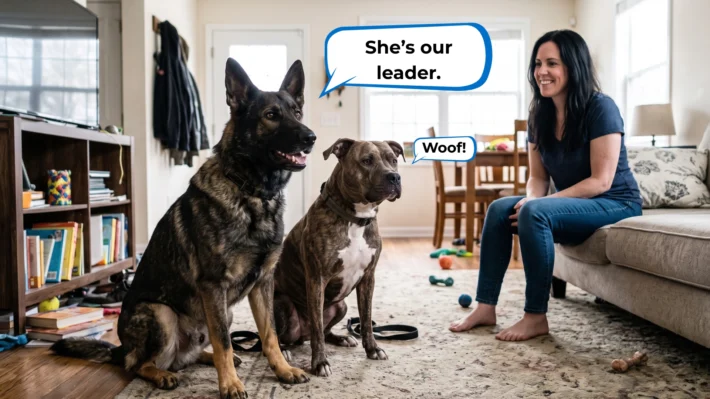
Instead of playing traffic controller, Gianina started practicing the leadership techniques from The Dog Calming Code™. She learned to communicate with her energy, providing the steady guidance that told her dogs, “I’m in charge now. You don’t have to worry about anything.”
It didn’t happen overnight, but the change was profound. As she filled that leadership role, the tension in the house began to evaporate. The constant state of high alert that had gripped her home for so long simply melted away.
A week later, I received a message from Gianina that I’ll never forget. She didn’t have to keep them on separate rotations anymore. She didn’t have to hover or micromanage their every move. She sent me a picture of her two dogs, once bitter rivals, curled up together on the living room rug, fast asleep.
They’re finally at peace.
Why Is Lack Of Leadership Causing Sudden Dogs Fight?
To understand your dog, you first have to remember that they are pack animals by nature. For them, survival is the only goal that truly matters.
In the wild, a pack’s survival relies entirely on its leader. The leader decides when to hunt for food and when to run from danger. Because of this, when a dog trusts their leader, their brain finally breathes a sigh of relief. It’s like they’re saying, “I can finally calm down now. Someone else is in charge, and they’re making sure we’re safe.”
When you step into that role of a calm, capable leader, your dog stops worrying. They don’t have to stay on high alert because they know you’ve got everything handled.
But when there isn’t a clear leader, or you haven’t yet stepped into that role, your dog feels the burden of responsibility.
They feel like they have to take over, “squaring up” to protect the pack—and that includes you. They aren’t fighting to be mean; they are fighting because they think someone has to lead to keep you all alive.
In my program, The Dog Calming Code™, my biggest goal is to help you see the world through your dog’s eyes. We dive deep into dog psychology to uncover the why behind their behavior—and show you exactly why having a calm, confident leader is the missing piece of the puzzle. When you understand how to fill that role, The Dog Calming Code™ helps quiet the chaos and brings true peace back to your home.
How To Become The Leader That Knows How To Stop Dogs From Fighting Each Other
To answer this, we need to look past the surface and go deep into dog psychology.
I’ve mentioned before that leadership is tied directly to survival—it is a fundamental necessity for your dogs. But here is the catch: don’t think of leadership from a human perspective. Shouting orders, being harsh, or scaring your dogs into obedience simply does not work.
If you want to stop aggression between dogs in your home, you must shift your mindset toward loving leadership.
What Is Loving Leadership?
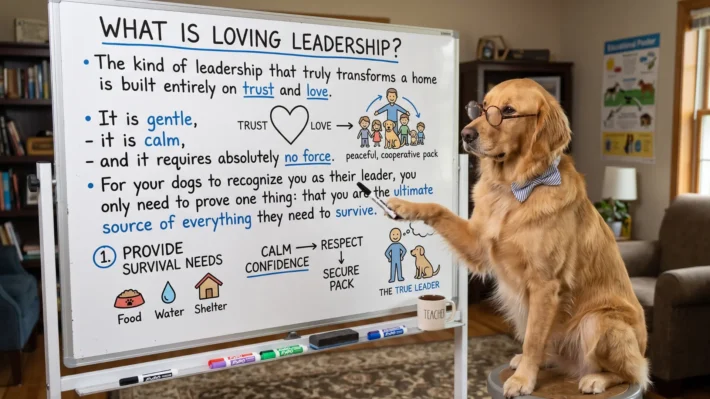
The kind of leadership that truly transforms a home is built entirely on trust and love. It is gentle, it is calm, and it requires absolutely no force.
For your dogs to recognize you as their leader, you only need to prove one thing: that you are the ultimate source of everything they need to survive.
You must consistently show them that you are the provider of their food, the guardian of their protection, the source of their affection, and—most importantly—the person who controls their favorite activity: the walk! (I teach dog owners how to do this using The Five Golden Rules taught in The Dog Calming Code™.)
You must consistently show them that you are the provider of their food, the guardian of their protection, the source of their affection, and—most importantly—the person who controls their favorite activity: the walk! (I teach dog owners how to do this using The Five Golden Rules taught in The Dog Calming Code™.)
Why Do Dogs Fight in the Same Household: The Triggers To Watch Out For
I want to be clear: the root of almost every sudden dog fight is a lack of leadership. When the foundation of your pack is shaky, those little everyday moments turn into explosive conflicts.
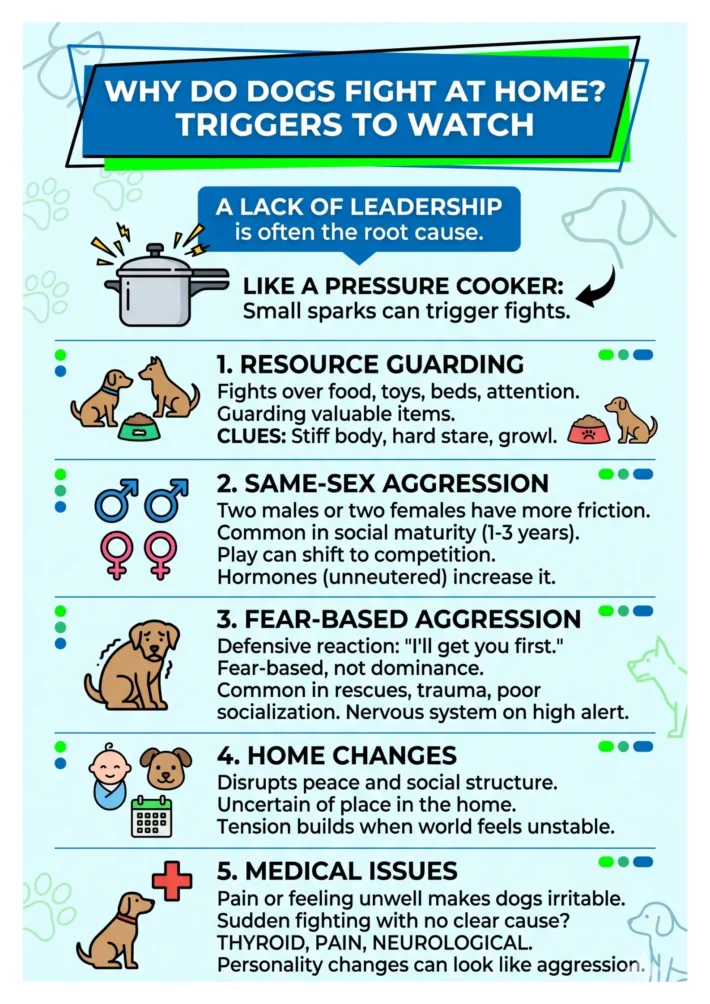
Think of it like a pressure cooker. Once the leadership is unclear, it only takes one small spark to set things off. Here are the most common triggers that cause those fights to boil over.
dog aggression between dogs
This is one of the biggest reasons dogs fight over food, toys, beds, or even your attention.
Resource guarding happens when a dog decides that something is so valuable they must protect it. In their mind, if they don’t defend it, they will lose it forever. You’ll often see this at mealtimes, when a new toy enters the room, or when one dog gets a little too close to you on the couch.
Watch for the clues: a stiff body, a hard stare, or a low growl. If those warnings are missed, a fight often follows.
2. Same-Sex Aggression
Two males or two females living under the same roof often face more friction than a mixed-sex pair.
This is very common as dogs reach social maturity, which usually happens between one and three years old. What started as puppy play can shift into serious competition as they grow up. Hormones play a big part here, too; unneutered dogs, in particular, can become increasingly competitive as they try to claim their spot in the pack.
3. Fear-Based Aggression
Not every fight is about dominance. Sometimes, a dog fights simply because they are terrified.
Fear-based aggression is a defensive “I’ll get you before you get me” reaction. This is common in rescues, dogs with a history of trauma, or those who didn’t get enough socialization as puppies. Their nervous systems are already on high alert, and if another dog gets too close, it can tip them right over the edge.
4. Changes in Your Home
Dogs are creatures of habit, and they are incredibly sensitive to change.
A new baby, a new pet, a roommate moving in, or even just shifting your daily work schedule can disrupt the peace. When your dogs feel uncertain about how the “new” home works, tension starts to build. When their world feels unstable, they often feel the need to step up and defend it.
5. Medical Issues and Pain
This is the one that gets missed more than you might think.
A dog who is hurting or feeling unwell is naturally going to be irritable. If your dogs suddenly started fighting out of the blue with no clear cause, please head to the vet first.
Thyroid problems, neurological issues, or chronic pain can change a dog’s personality and make them lash out in ways that look like aggression, when they are really just asking for help.
Are Your Dogs About To Fight? The Warning Signs Before Dogs Fight
Learning to read your dog’s body language is like learning a new language—once you understand what they are saying, the “mysterious” outbursts in your home will start to make perfect sense.
Most dog fights don’t actually happen out of nowhere. Your dogs are almost always whispering their intentions long before they start shouting them. If you can learn to spot these subtle warnings, you can step in early and keep the peace.
Here are the cues you need to watch for, along with what they really mean:
Sign #1: The Stiffening
When you see your dog go completely still—as if they’ve suddenly been turned to stone—pay attention. Their mouth is usually closed, their muscles are rigid, and they might even look like they are holding their breath.
- What it means: They have reached their limit. They are preparing for a confrontation.
- What to do: Do not reach for them or try to push them apart. Simply step between them or use a calm, low-energy distraction (like moving toward the kitchen) to break their focus.
Sign #2: The Hard Stare
We aren’t talking about a soft, loving gaze. This is a direct, unwavering, and intense stare between the two dogs. It feels heavy and uncomfortable, even for a human to watch.
- What it means: This is a challenge. The dog is essentially saying, “I am watching your every move, and I’m ready to react.”
- What to do: Gently break the line of sight. By placing your body quietly between them, you become the leader who interrupts the tension before it turns into a stare-down.
Sign #3: Raised Hackles
The fur running along the spine, specifically at the shoulders or base of the tail, stands straight up.
- What it means: This is a physical sign of high arousal. It doesn’t always mean they are going to attack, but it does mean their adrenaline is spiking. They are in a state of high alert.
- What to do: Treat this as a “caution” sign. It’s time to move the dogs to separate, quiet areas to let their nervous systems settle down.
Sign #4: Whale Eye
This happens when a dog turns their head slightly but keeps their eyes fixed on the other dog, showing the whites of their eyes in a half-moon shape.
- What it means: Your dog is anxious and conflicted. They are trying to keep track of the other dog without turning their back on them. It’s a sign of significant stress.
- What to do: Your dog is feeling cornered. Give them some space and remove the object or situation (the “resource”) they are worried about losing.
Sign #5: Blocking or Shadowing
One dog stands over a toy, a food bowl, or even a doorway, physically preventing the other dog from passing or approaching.
- What it means: This is classic resource guarding. Even if the dog isn’t growling yet, they are claiming the space or the object as their own.
- What to do: Do not let this slide. Gently guide the “blocker” away from the area. By doing this, you are showing them that you control the resources, not them.
Sign #6: The Low Growl or Lip Curl
These are the most obvious warnings, but they are often punished by owners who want “polite” dogs. Never punish a growl.
- What it means: Your dog is communicating, “I am uncomfortable and I need you to back off.” If you punish the growl, they may stop giving warnings and jump straight to biting next time.
- What to do: Listen to the warning. It is a gift! It tells you that a fight is brewing right now. Calmly remove one dog from the room to give everyone a chance to breathe.
How to Intervene Like a Leader
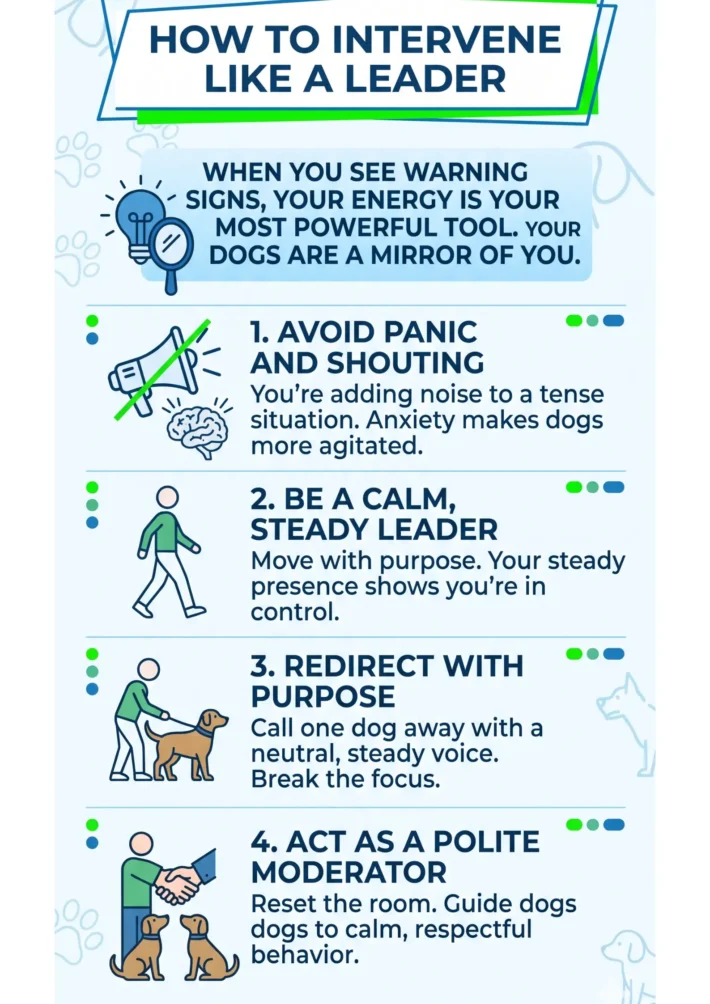
When you see those early warning signs, your energy is the most powerful tool you have. Your dogs are a mirror of your energy… so be very careful with it.
- If you panic or shout, you are just adding noise to an already tense situation. Your anxiety can actually make your dogs more agitated.
- You don’t need to be aggressive. Just move with purpose. A steady, calm movement to redirect them tells your dogs that you have everything under control, so they don’t have to worry about it themselves.
- Think of yourself as a polite, firm moderator. Simply walking between them or calling one dog away with a neutral, steady voice is often enough to break the tension and reset the room.
By keeping a sharp eye on these signals, you move from being a stressed spectator of the chaos to being the leader who prevents it.
How to Stop Dogs From Fighting Safely
Breaking Up a Fight
First, never put your hands near their mouths. This is how people get seriously injured, even by dogs they love and trust. A dog in fight mode is not processing normally; they will bite without meaning to.
If you need to break up a fight, keep these safe options in mind:
- The Wheelbarrow Method: If two people are present, each person grabs the back legs of one dog and walks backward, pulling them apart simultaneously.
- Use a Barrier: A baby gate, a chair, or even a piece of cardboard placed between the dogs can interrupt the fight without putting your hands in danger.
- Loud Noise: A sharp clap, a whistle, or a sudden, loud “Hey!” can sometimes break the intensity enough to separate them.
- Water: A bucket of water or a quick spray from a hose can act as an effective, safe distraction.
Once separated, keep the dogs apart until they are fully calm. Resist the urge to comfort them excessively while they are still agitated; they need space to decompress.
Managing Dog Fight Triggers at Home
Once you identify what is causing the fights, you can start managing your environment to keep the peace.
Feed Separately
When dogs are in a competitive mindset, mealtimes can feel like a high-stakes event. Feeding them in separate rooms or at opposite ends of a space removes that pressure entirely.
If your dogs tense up when they hear the kibble hit the bowl, feed one in the kitchen with a closed door and the other in the laundry room. This allows them to finish their meals without the stress of feeling like they need to guard their food from their housemate.
Remove Temptation
High-value items—like a meaty bone, a squeaky toy, or a plush bed—can often trigger a “this is mine” reaction. When your dogs are together, it is best to put these items away.
If you notice your dogs bicker over a specific chew toy, keep all toys in a basket on a high shelf. Only bring them out for individual play sessions, and put them away as soon as the session ends.
Balance Attention
Sometimes, a dog fights because they are worried they will lose your affection to the other dog. By keeping your greetings and petting sessions calm and equal, you remove the competition for your attention.
If you come home from work and both dogs rush to you, stand tall and wait for them to settle before petting. Greet them one at a time, or pet them simultaneously with two hands, keeping your energy low and steady rather than high-pitched or chaotic.
Designate Their Safe Space
Every dog needs a sanctuary where they can go to escape the stress of the pack. This is their safe zone, or the place where the other dog is never allowed to intrude.
Place a dog bed or a crate in a quiet corner of the house. Teach your other dog that they are never allowed to enter that bed or approach that crate while the first dog is resting there. This gives both dogs a place to “clock out” and relax.
Supervise Interactions
Until your home is fully stable, you should never leave your dogs together unsupervised. The “rate and rotate method where one dog enjoys free time while the other rests in a crate is a great way to keep everyone safe while you work on the root cause.
If you need to shower or run to the store, one dog stays in their crate or a secured room while the other remains with you or in a different area. This prevents accidents from happening when you aren’t there to provide leadership.
Long-Term Solutions: How to Stop Dogs From Fighting For Good
Managing the environment buys you time, but lasting change comes from addressing the why behind the behavior.
Become the Leader
This is the cornerstone of everything. When your dogs see you as the calm, confident decision-maker, they don’t feel the need to compete for that role. The tension dissolves because the question “Who is in charge?” has already been answered. This is exactly what the Dog Calming Code™ teaches—not tricks, but the leadership dynamic that brings genuine peace.
Instead of nervously reacting when your dogs start staring each other down, walk between them with a calm, neutral demeanor. Your firm, quiet movement shows them that you are handling the situation, so they don’t have to.
Create a Predictable Routine
Dogs thrive on consistency. Regular meal times, set exercise, and a steady daily structure reduce the baseline anxiety that makes fights more likely.
If you currently feed and walk your dogs at different times every day, start a schedule. Wake up at the same time, walk at the same time, and feed at the same time. This predictability allows your dogs to relax because they no longer have to guess when their needs will be met.
Burn the Energy
A tired dog is a calmer dog. Ensure both dogs are getting enough physical and mental engagement every single day.
If your dogs get restless in the evenings, add a 15-minute training session or a brisk walk before dinner. Tiring their brains out with obedience work or their bodies with exercise leaves them with less “extra” energy to spend on brawling.
Take it Slow
If a fight has occurred, don’t just hope for the best. Reintroduce them gradually on neutral ground, keep them on leash, and ensure interactions are short and positive.
Take both dogs for a walk in a park neither of them frequents. Keep them at a distance where they can see each other but don’t feel the need to react. Let them walk in the same direction, but not face-to-face, until they are relaxed. Keep the walk to 10 minutes and end it on a high, happy note.
When to Call a Professional Dog Trainer To Stop Dogs From Fighting
There is no shame in asking for help. If fights are frequent, if someone has been injured, if the aggression is getting worse, or if you simply feel unsafe, please reach out to a professional trainer or a veterinary behaviorist. They can assess your specific situation and provide a safe, step-by-step plan.
Can My Dogs Live Together Again?
The honest answer is: it depends. Many dogs absolutely can, but there are situations where the risk is too high. A professional can help you decide if it is safe to keep trying or if rehoming is the kinder choice.
However, for most people, this is a problem that can be fixed with the right strategies.
Don’t let anyone tell you you’re a bad owner, and your dogs are “hopeless.” Please remember that you just have a dynamic that needs adjusting. Start by looking at the routine and honestly asking yourself: Do my dogs see me as their calm, confident leader or someone they need to protect?
That one question is often the key that unlocks everything. If you want to learn the leadership piece in depth and use a proven, force-free method that has helped over 120,000 owners find peace, I’d love to show you how.
I have a FREE webinar that talks about dog fights, reactivity, and how you can actually be the leader that makes them safe enough to be calm.
Because when you become one, peace will come back into your home.
Watch My Free Training Here. Because your dogs deserve calm, and so do you.

— Doggy Dan