Should you let dogs fight it out? In almost all cases, no… you should not let dogs “fight it out.” The idea that dogs need to settle a pecking order through fighting is an outdated myth. Real fights rarely resolve anything cleanly. Fights escalate, cause injury, and damage the dogs’ relationship. Addressing the leadership gap gently is always the better path.
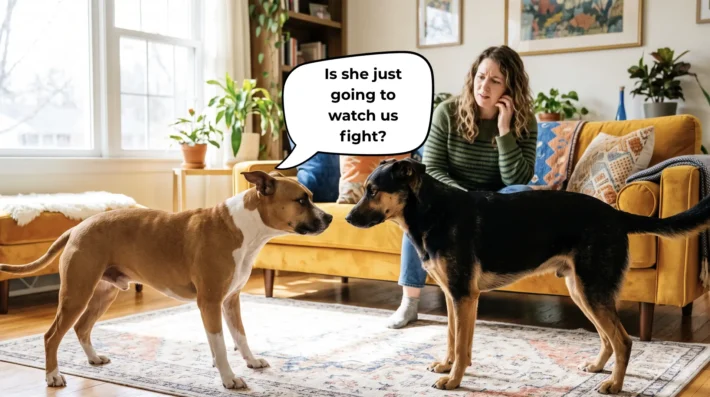
If you’ve just experienced the terror of watching two dogs you adore suddenly turn on each other, or if you’re holding onto the lingering stress of a recent fight in your home, pause for a moment and take a deep breath.
First, let’s clear away the shame and self-doubt: this does not mean you did something terrible, nor does it mean your dogs did it because they’re hopeless.
When tensions explode between dogs, it simply points to a gap in communication and dynamic. Think of it like a missing piece of the puzzle that you haven’t been shown yet.
The good news is that once you identify this missing link, restoring peace, safety, and trust in your household is completely within reach. You don’t have to navigate this alone, and there is a clear, proven path forward.
This is what I’m going to share with you today.
Let’s dive in!
Key Takeaways
- “Fighting it out” is a dangerous myth: Leaving dogs to resolve conflict on their own leads to escalating aggression, severe injury, and deeper trauma.
- Conflict stems from stress, not dominance: Dogs don’t fight to climb a pecking order. They fight when overwhelmed by anxiety and the heavy burden of feeling in charge.
- Intervention should never require force or pain: You can safely separate dogs using noise, physical sight barriers, or the two-person wheelbarrow method without risking bites or relying on shock collars and physical punishment.
- Long-term peace requires calm leadership: Managing individual fights won’t solve the core issue. True, lasting harmony comes from stepping up as a confident, reassuring guide so your dogs feel safe enough to relax.
The Short Answer: Should You Let Dogs Fight It Out?
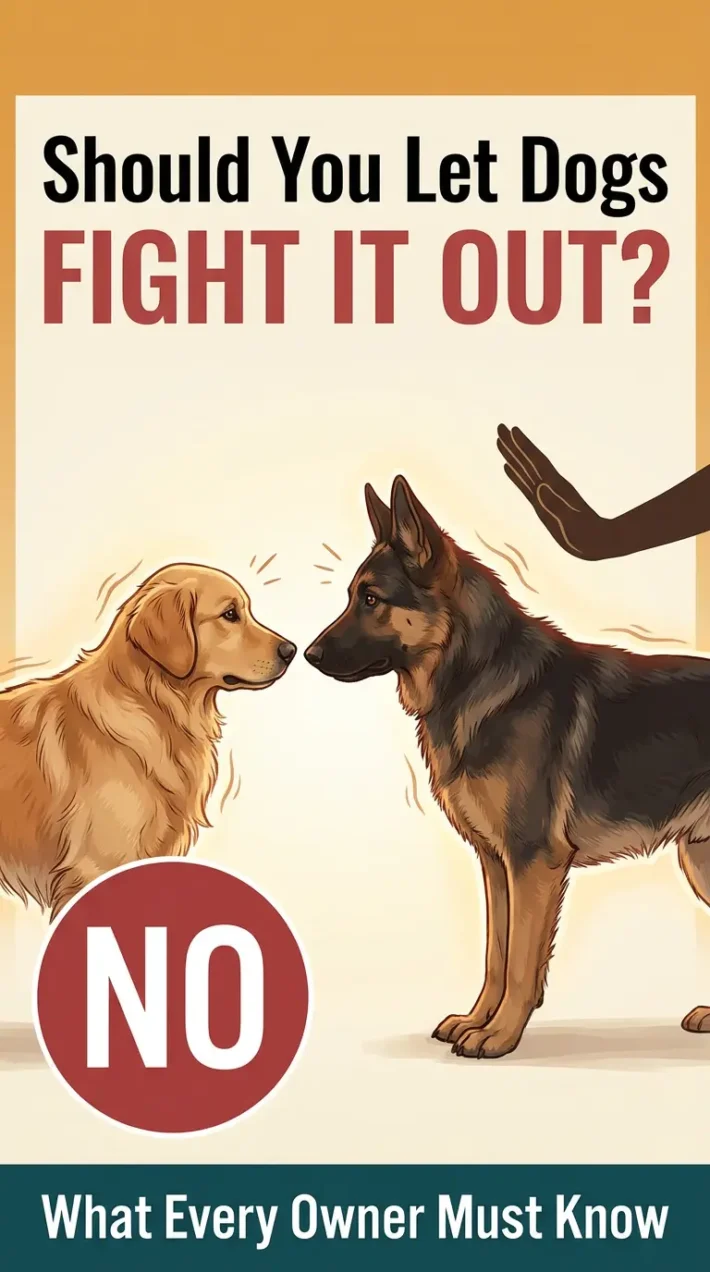
Here’s the answer from decades of doing this: it depends on what’s actually happening. The distinction is critical.
I draw a clear line between two very different things owners often confuse.
Squabbling, Growling Dogs
If you’re hearing a squabble, or a growl here and there, sometimes yes, let them sort it out. When you have the Five Golden Rules in place and you show your dogs that you are clearly in charge, a growl, a brief snap, one dog telling the other “that’s my space” are something you can pass off. You can often stay out of it. This is normal dog communication.
When Fights Are Serious
When it’s a genuine fight, absolutely step in.
When fights have become vicious, or escalate with neither one backing down, letting your dogs sort it out is dangerous and will not fix the problem.
Real fights between dogs in the same household are almost always about who is actually in charge. And here’s the part most owners never get told: no amount of fighting will resolve that if the position of pack leader is genuinely up for grabs. They’ll fight. One “wins” that round. Then it starts again. The cycle continues.
The real solution is never letting them fight it out. It’s removing the position they’re fighting over. It’s filling the leadership role that is so important for your dogs.
When you step into calm, clear leadership through the Five Golden Rules, there is no top spot left for the dogs to compete for.
FREE WEBINAR: WHAT STOPS DOG AGGRESSION FOR GOODPlay vs. Squabble vs. Real Aggression: Knowing If The Fight Is Serious
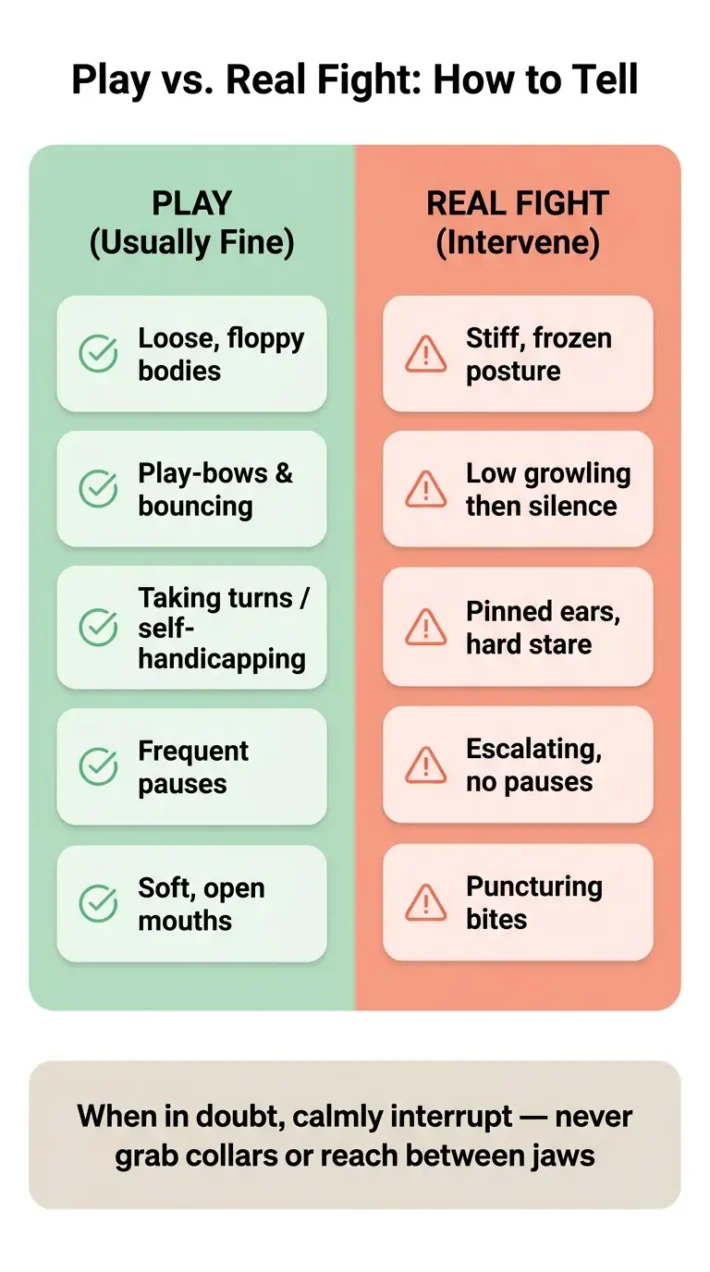
Before you do anything, take three seconds to read what’s actually happening. Not every noisy scuffle is a fight. Dogs are dramatic, and healthy play can look and sound alarming to us humans.
Here’s a simple way to tell the difference:
| Signal | Play (Leave It Be) | Real Fight (Intervene Calmly) |
| Body | Loose, bouncy, wiggly | Stiff, tense, hard |
| Play bow | Yes — bottom up, front down | No |
| Vocals | Silly growls, exaggerated | Deep, sustained snarling — or eerie silence |
| Turn-taking | Roles swap; both self-handicap | One dog relentlessly dominates the other |
| Mouth | Soft, “mouthing,” no pressure | Hard bites, holding, shaking |
| Breaks | Frequent pauses; dogs re-engage happily | No breaks; escalating intensity |
| Aftermath | Both shake off, come back for more | One dog trying to flee or freeze |
A squabble sits in the middle.
It’s a quick “back off!” snap over a bone or a doorway. It’s over in a second with no damage done. Those brief corrections are often normal doggy communication. What you never want to ignore is the stiff, silent, escalating, no-breaks pattern. These signs usually point to real fights. The warning signs are usually there beforehand; owners just haven’t always been taught to catch them.
If you’re unsure whether what you’re hearing is playful or serious, it’s worth spending time learning to understand dogs’ body language. It’s one of the most empowering skills any owner can build.
DISCOVER HOW CALM LEADERSHIP ENDS THE FIGHTING — FREE WEBINARWhy Letting Dogs Sort A Fight Out Is a Dangerous Myth
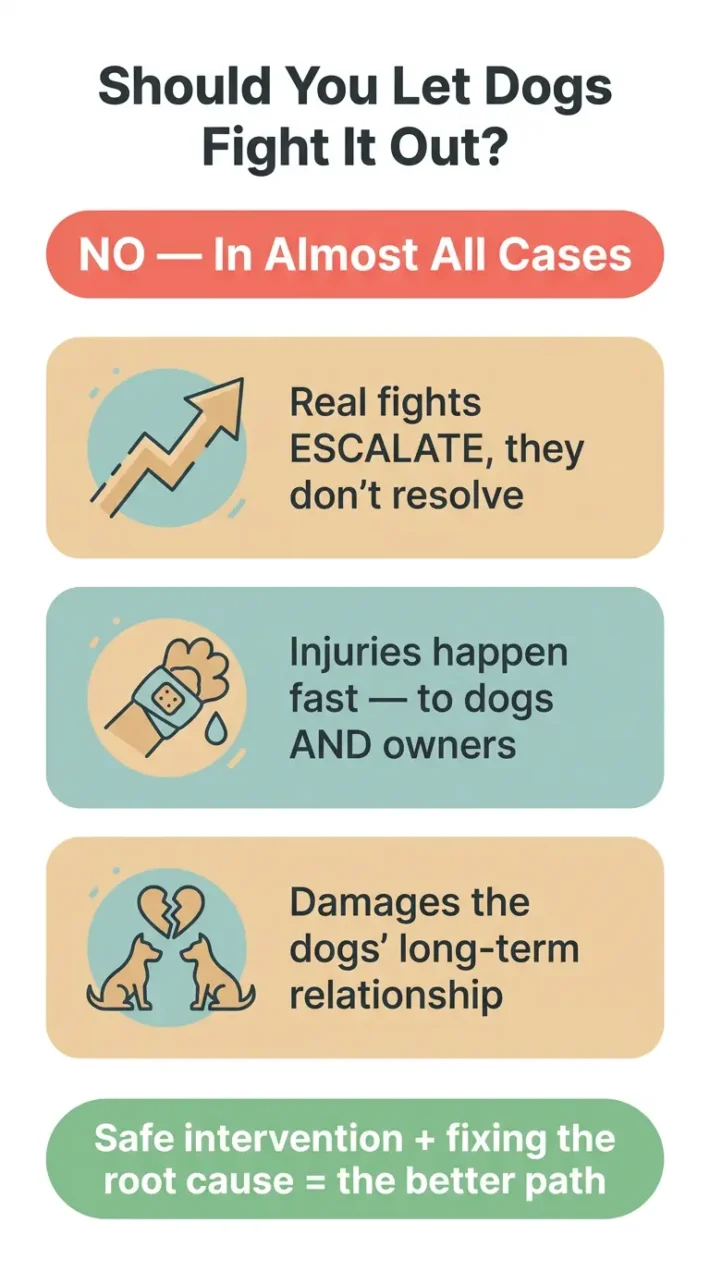
Perhaps you’ve heard this advice before: let your dogs fight it out and order will sort itself out in the home.
When there’s no clear leader in the home, dogs don’t fight because they’re power-hungry or trying to dominate for the sake of it. They fight because, from their point of view, the top job is standing empty and someone has to fill it. Every pack needs a leader making the calls. If no human steps into that role, the dogs feel compelled to sort it out between themselves.
But here’s where the story usually goes wrong: people assume a fight “settles things.” It doesn’t.
A fight can temporarily sort out the minor positions. The issue of who’s second, who’s third in the household can be settled. For a while, it can look as if you have achieved order. But the position that actually matters, the top spot, is still empty. No amount of fighting fills that vacancy.
So the dogs briefly settle the imbalance… and then the issue flares up again.
A puppy grows up. An older dog slows down. A new dog joins the family. Circumstances shift, and the same unanswered question resurfaces: who’s actually in charge here? When this is left unanswered, the fighting starts over.
Fights can create a temporary illusion of order, but they can never fill a leadership vacuum. Until dog owners step up with calm, loving leadership, the pressure cooker stays switched on, and the fights keep coming back.
JOIN OUR FREE WEBINAR AND LEARN WHAT REALLY STOPS DOG REACTIVITY!Why Dogs Actually Fight (The Real Root Cause)
Dogs don’t fight to win a pecking order. They fight from stress and the pressure of feeling they must lead. Calm, loving leadership dissolves that tension at the source.
Fights don’t happen because one has a “dominant personality” you need to referee into submission. In the overwhelming majority of cases, dogs, especially those fighting in the same household, fight because they are stressed and believe they are responsible for running the show.
Think about what that means for a dog.
If your dog believes they’re the leader of the household, they carry an enormous burden. They feel they must guard the resources, control the space, manage the other dog, and keep everyone safe. That’s an exhausting, impossible job that puts them permanently on edge. When two dogs in one home both feel they’re in charge, you have two anxious, overloaded animals constantly bumping into each other’s self-appointed authority.
The flashpoints (a bone, a doorway, a favorite spot on the sofa, the excitement of you coming home) aren’t the real problem. They’re just the moments where all that accumulated tension finally spills over.
Sometimes the tension is amplified by classic resource-guarding behaviour, which is really just another symptom of a dog who feels they must protect what’s theirs because no one else is managing it.
Here’s the liberating part: you don’t have to out-tough your dogs. You have to out-calm them.
When you step confidently into the leadership role through a kind, consistent manner, your dogs can finally put down the heavy burden they’ve been carrying. And when the stress goes, the reason to fight goes with it.
If you want to understand exactly why your dogs aren’t calm — and the simple leadership shift that changes it — I explain it in my free reactivity webinar, which has already helped over a million dog owners.
Will Dogs Stop Fighting on Their Own?
Let me be honest with you, because you deserve the truth rather than a comforting fairy tale.
Are your dogs having minor squabbles?
Sometimes, yes. A brief, low-level “that’s my spot” snap that’s over in a second and leaves no marks can be normal communication, and dogs often move past it without your help.
Are they getting into violent fights?
No. Dogs do not reliably resolve real fights on their own, and they will not simply “grow out of it.” Without a change in the underlying dynamic, real fights tend to get worse over time. Fights get more frequent, more intense, more dangerous because, as I said, dogs practice what they repeat.
So if you’re asking “do dogs resolve fights on their own?” The safe assumption is this: a serious, recurring fight is a signal that something in the home dynamic needs to change… and that change is your calm leadership, not the passage of time.
Here is the expanded guide with the requested header structure applied throughout.
How to Safely Break Up a Dog Fight (Without Getting Bitten)
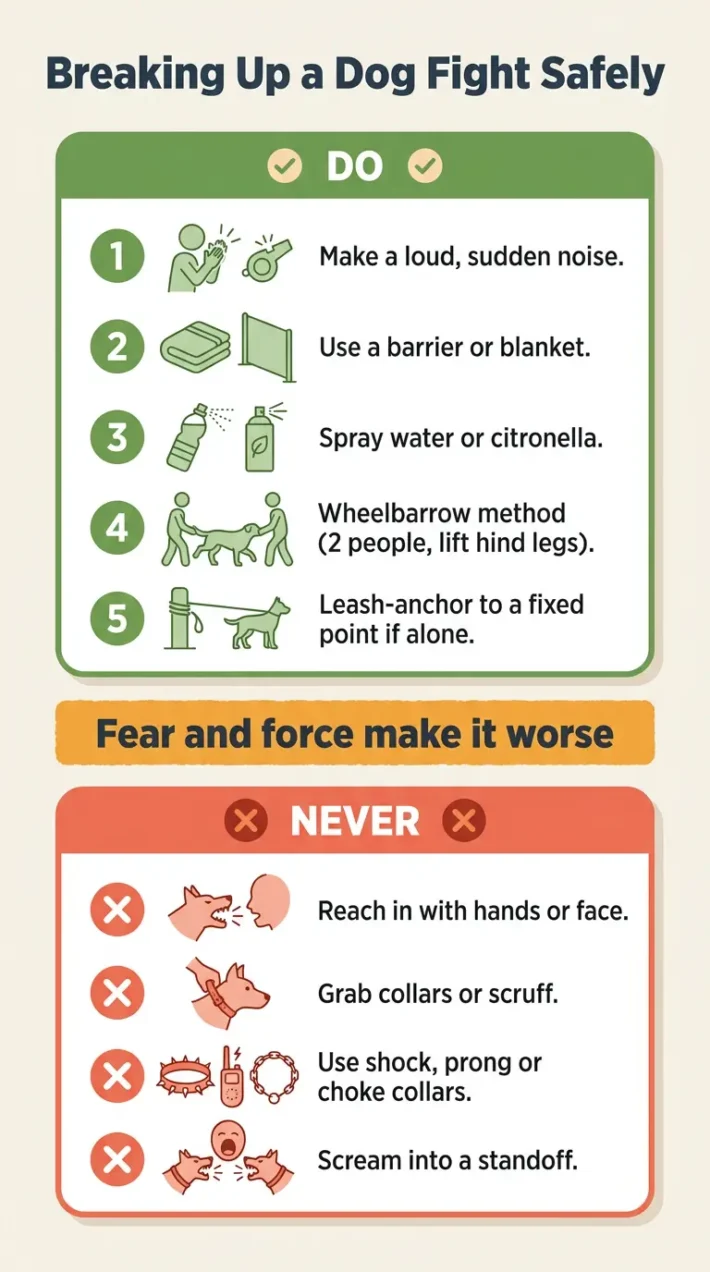
In the heat of a real fight, your instinct will scream at you to reach in and grab your dog. Please don’t. A dog in full fight-or-flight isn’t thinking because their brain is flooded with adrenaline, and they may bite the nearest thing—including your hands—before they even register it’s you. Reaching into a fight is the single fastest way to suffer a severe injury.
In the moment: use noise, barriers, water, or the two-person wheelbarrow method. Never reach in with your hands, grab collars, or use shock or prong collars, because force only escalates the danger.
Here’s how to break it up safely:
Stay As Calm As You Can
Screaming and panicking add fuel to the fire. Dogs feed off human emotion, and frantic shouting will sound to them like you are joining in on the battle. Your energy matters more than you think; taking a deep breath and remaining composed helps you make logical, split-second decisions rather than reactive ones.
Make A Sudden Loud Noise
A sudden, high-intensity sound can startle the dogs enough to break their hyper-focus for a split second, creating a window of opportunity to separate them. Try a loud clap, an air horn, banging two metal baking sheets or bowls together, or giving a deep, firm, authoritative shout. Avoid high-pitched screaming, which increases panic.
Use a Barrier
Physically blocking their line of sight often breaks the intensity of the engagement. Slide a large, flat object—a piece of plywood, a large baking tray, an open umbrella, a piece of cardboard, or a chair—directly between the dogs. Alternatively, throwing a heavy blanket or coat over both dogs disorients them by removing the visual trigger, giving you a safe moment to pull them apart.
Use Water
Dousing the dogs with water disrupts their sensory system and forces them to pause. A bucket of water dumped directly over their heads, a pressurized garden hose turned on them, or even a direct spray bottle to the face can interrupt many fights without anyone having to put their hands anywhere near the biting zone.
The Two-Person Wheelbarrow Method
If two people are available, this is the safest physical intervention method. Simultaneously, each person approaches one dog from behind, grabs the back legs up near the hips (never the paws or lower legs, which can cause injury), lifts the rear end off the ground, and moves backward in a slight arc—like pushing a wheelbarrow. Walking in a slight curve prevents the dog from twisting around to bite you, keeping your hands well away from their mouth until you can secure them behind a door or gate.
If You’re Alone: The Leash-Anchor Trick
Breaking up a fight solo is dangerous, but this method gives you leverage without putting your hands near the bites. Loop a sturdy leash around the hindquarters of one dog (around the waist, behind the ribs), feed the handle through the clip to create a cinch, and tie the other end tightly to a solid, fixed point like a fence post or heavy door handle. Once that dog is anchored and unable to advance, step behind the second dog and use the wheelbarrow method to pull them backward away from the anchored dog.
Once separated, keep the dogs completely apart and do not let them see or hear each other until everyone—including you—has fully calmed down.
FREE WEBINAR: STOP DOG REACTIVITY BEFORE IT GETS WORSEWhat NOT to Do
Just as important as knowing what to do is knowing what to never do during a high-arousal dog fight:
Never Reach In With Your Hands Or Face
This is how the majority of well-meaning dog owners end up in the emergency room with severe puncture wounds or nerve damage. When dogs are locked in a fight, bite inhibition disappears completely, and they will clamp down on whatever breaks their immediate space.
Never Grab Collars Or Reach Between The Dogs’ Heads
Grabbing a collar places your hands, wrists, and arms mere inches from open, snapping teeth. A dog turning to defend itself will instinctively redirect onto whatever is touching its neck before realizing it is your hand.
Never Grab A Dog’s Tail Or Scruff From The Front
Grabbing the scruff or tail gives you very little physical leverage over a dog’s core strength. More importantly, it leaves the dog’s head entirely free to swing back around and bite your arm or upper body.
Never Scream, Kick, Or Hit
Physical punishment or loud, erratic screaming during a fight escalates the arousal and panic level of both animals. It confirms to the dogs that the situation is a life-or-death emergency, making them fight harder, and it frequently causes redirected aggression toward you.
Never Reach For A Shock Collar Or Prong Collar
I want to be very clear here, because a lot of old-school advice still recommends these tools. Adding pain and fear to a dog who is already in a terrified, overwhelmed, fight-or-flight state doesn’t calm them down—it confirms that the world is dangerous and makes the underlying anxiety significantly worse. Applying electric shocks or physical pain while a dog is reacting reinforces a negative association with the other dog and the environment. Force is not leadership; it’s the opposite. Using shock collars or prong tools treats the outward symptom while deepening the internal cause.
What to Do After the Fight
Once the fight is broken up and the dogs are safely separated in different rooms, resist the natural urge to either punish or over-comfort them.
Let The Adrenaline Drain
It can take a long time—sometimes several hours or even a full day—for a dog’s elevated cortisol and adrenaline levels to return to baseline. Keep the dogs in separate, quiet, low-stimulation spaces where they can sleep and decompress completely without seeing or hearing one another.
Stay Calm And Neutral
Dogs look to your energy to gauge safety. Don’t shout or scold, but equally, don’t smother them with anxious cuddling, high-pitched voices, and frantic “there, there” reassurance. Frantic soothing tells your dog that something horrifying happened and that panic is justified. Calm, matter-of-fact, quiet energy communicates the exact opposite: the event is over, you are completely in control, and it is safe to relax.
Don’t Punish
Punishing a dog after a fight adds more fear, confusion, and stress to an already traumatized animal. Dogs associate punishment with whatever is happening in the exact second it occurs, not the fight that ended ten minutes ago. Scolding them after the fact teaches nothing useful and damages your bond.
Check For Injuries
Once the excitement has settled, carefully inspect both dogs for injuries. Puncture wounds can be deceptively small on the surface while masking deep tissue damage, infection risk, or tearing underneath the fur. Check ears, necks, chests, and leg joints thoroughly. When in any doubt, consult your veterinarian for a professional checkup and antibiotic evaluation.
Reintroduce Slowly And Only When Both Dogs Are Truly Calm
Do not rush to put the dogs back together to “see if they’re okay.” Reintroductions should only happen after a prolonged cooling-off period, ideally on neutral territory with both dogs on leashes, and only after you have begun adjusting the overall management and boundary dynamics in your home environment.
Will My Dogs Ever Get Along Again?
Here’s the reassuring truth: yes, in the vast majority of cases, dogs can absolutely live together peacefully again — often better than before — once the underlying stress and leadership confusion are resolved.
Dogs are wonderfully present creatures. They don’t hold grudges the way we imagine. They’re not lying awake plotting revenge. Once the tension that caused the conflict is removed, and once they both feel someone calm and trustworthy is in charge, they can relax around each other again. I’ve seen dogs who genuinely tried to hurt each other go on to nap side by side.
That said, let’s be honest and realistic: a small number of cases — particularly where there’s been serious injury or a deeply entrenched pattern — may require careful long-term management, professional support, and in rare situations, rehoming for everyone’s safety. That’s not failure. Sometimes it’s the kindest, most responsible choice. But it is the exception, not the rule.
The Real Solution: Calm, Loving Leadership
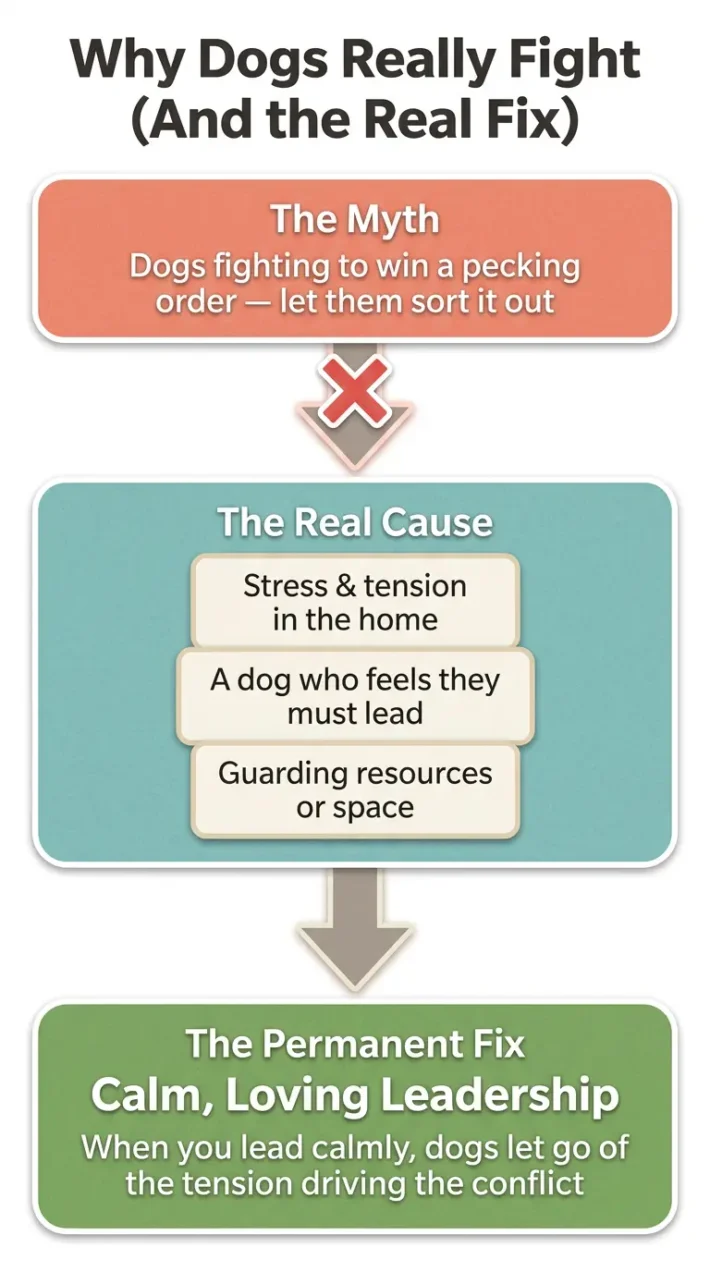
If you take one thing from this article, let it be this: the permanent fix for dogs fighting is not to referee their battles but to remove the reason they feel they need to battle at all.
That reason, almost always, is a leadership vacuum. When your dogs believe they have to run the household, protect the resources, and manage each other, they live in a constant state of low-grade stress that explodes into conflict.
The moment you step in and confidently take that responsibility off their shoulders, the whole atmosphere in your home changes. The dogs exhale, and the tension between them drains. The fighting stops, not because you forced it to, but because you removed its fuel.
This is the entire foundation of my Dog Calming Code™, a gentle, psychology-first method built on the Five Golden Rules that teach your dogs, in a language they instantly understand, that you’ve got this.
You don’t need shock collars, bribery, or drills. Just you, giving the confident leadership your dogs have been waiting for. It’s the same approach that has helped transform over 125,000 dogs worldwide, including many who arrived as households at war and became peaceful, happy families.
If your dogs are fighting, this is where real, lasting change begins. You can learn the exact method in my free training webinar on solving reactivity and aggression — it costs nothing, and for many owners it’s the moment everything finally clicks.
JOIN THE FREE WEBINAR & BRING CALM BACK TO YOUR HOMEWhen to Get Professional Help
Please reach out for expert, hands-on support if:
- A bite has broken skin on a person or dog.
- The dogs fight on sight, every time they’re together.
- You feel genuinely unsafe trying to manage or separate them.
- The fighting is escalating despite your best efforts.
There’s no shame in this because it’s the responsible thing to do. Having an expert help you every step of the way can not only remove the overwhelm, but ensure the solution you’re working for helps you be on the right track to fixing your dogs’ broken relationship.
The Dog Calming Code™ Will Stop Dog Fights For Good
Knowing how to handle a fight in the moment is crucial for safety, but the ultimate goal is creating a peaceful, stress-free home where conflict doesn’t happen in the first place. Fights and reactivity almost always stem from underlying anxiety, unclear boundaries, and heightened arousal states that build up long before a single growl is heard.
If you want to shift the dynamic in your household, help your dogs relax, and build a deep foundation of mutual trust without using force or tension, I invite you to join my free webinar on the Dog Calming Code™.
In the webinar, you’ll learn simple, powerful ways to communicate leadership, lower your dog’s daily stress levels, and transform their behavior from the inside out. Reserve your spot today to take the first step toward a calm, harmonious home!

— Doggy Dan
FREQUENTLY ASKED QUESTIONS
Is It Normal For Dogs In The Same Household To Fight?
Occasional minor squabbles over resources can be normal doggy communication, but repeated real fighting is not something to accept as “just how they are.” It’s a sign of underlying stress and a leadership vacuum in the home. Address the root cause (who your dogs believe is in charge) and the fighting almost always resolves.
What Is The 3-3-3 Rule For Dogs?
The 3-3-3 rule is a guide to how a rescue or newly adopted dog decompresses: roughly 3 days to feel overwhelmed and cautious, 3 weeks to start settling and showing their real personality, and 3 months to feel fully at home. It’s a reminder to be patient; many early tensions between dogs ease as a new dog decompresses and clear leadership is established.
Do Dogs Forgive Each Other After A Fight?
Yes. Dogs live in the present and don’t hold grudges the way humans do. Once the stress driving the conflict is removed and both dogs feel safe under calm leadership, they can typically move past a fight and coexist peacefully, often side by side within days.
How Long Should You Separate Dogs After A Fight?
Immediately after a fight, keep them separated for several hours so adrenaline and stress hormones return to baseline. Beyond that, keep them apart until both dogs are genuinely calm and, ideally, until you’ve begun changing the home dynamic through leadership. Reintroduce gradually, in a neutral, controlled way, and never rush the process.
Will My Dogs Fight To The Death If I Don’t Intervene?
It’s rare, but serious injury or death can happen, especially with a size mismatch, in an enclosed space, or when a dog can’t escape. You should never gamble on it. The safe, responsible answer is always to intervene calmly using the non-contact techniques above, then address the underlying cause so it doesn’t happen again.
Should I Rehome My Dog After A Fight?
Almost never as a first step. The vast majority of household fighting resolves once you address the real cause (stress and leadership confusion) using gentle, force-free methods. Rehoming is a last resort reserved for rare cases involving serious injury and safety risks that can’t be safely managed. Get expert support first; most families find a way through.
My Dogs Only Fight When I’m Around: Why?
This is very common and very telling. Dogs who feel responsible for you often become tense and competitive specifically around you over your attention, your presence, or the excitement of your arrival. It’s another sign the fighting is about a leadership burden, not a personality clash. When you take charge calmly, that trigger disappears.