The real reason for the question “Why are my dogs fighting all of a sudden?” is this: when no clear leader exists in the household, your dogs fight for the role. Two dogs who both believe they are in charge will always inevitably clash.
It looks sudden, but it’s always brewing without you knowing. It is a dispute over pack hierarchy that has finally boiled over.
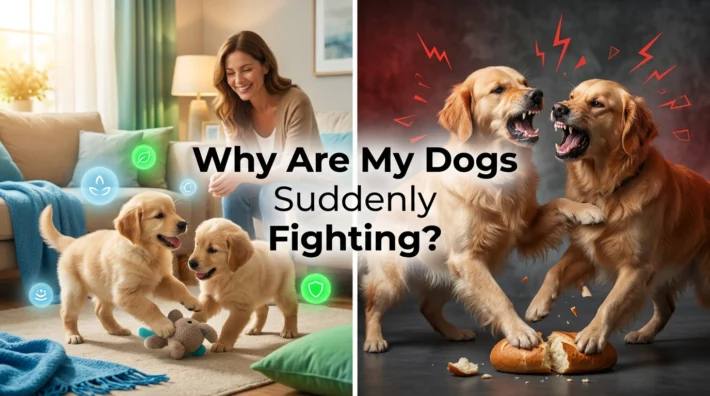
“Why are my dogs fighting all of a sudden? They were best friends yesterday…”
When your dogs suddenly start fighting, your home feels like a warzone. You’re tiptoeing through doorways, heart racing every time they’re in the same room, wondering how your once-peaceful pack changed.
What you are witnessing is rarely as sudden as it seems. Think of it like a pressure cooker! The tension has been building silently beneath the surface for weeks or even months, growing more intense every day. Eventually, that mounting pressure reaches a breaking point, and it only takes one small trigger to cause everything to finally erupt.
I’m Doggy Dan, and over the past two decades, I’ve helped transform the lives of more than 125,000 dogs and their families worldwide. I’ve seen this exact scenario play out in living rooms across every continent, and I’m here to tell you something that might surprise you: the fighting isn’t really about the dogs. It’s about the leadership vacuum in your home.
Key Takeaways
- A “sudden” aggression is rarely sudden. Most cases of dogs suddenly fighting each other are the culmination of mounting tension, unresolved pack hierarchy confusion, and trigger stacking, small stressors that accumulate until your dog’s nervous system can’t take anymore.
- Safety first, always. Separate the dogs immediately and implement a strict 48-hour separation period. This allows stress hormones (cortisol) to dissipate and prevents rehearsal of the dog aggression while you address the root cause.
- It’s a leadership problem, not a dog problem. When no one is clearly “driving the bus” in your home, your dogs are forced to sort out the pack dynamics themselves, and they do it violently. Becoming a calm, consistent leader removes their need to fight.
- Medical issues must be ruled out first. Pain, illness, or hormonal changes can trigger sudden aggression. Always consult your veterinarian before assuming it’s purely behavioural.
- Same-sex aggression (especially female-female) is real, and fixable. While it can be more intense, the solution remains the same: establish loving leadership and remove the competition for control.
Bridget Persisted Despite Her Fear, And Now Her Dogs Have Stopped Fighting
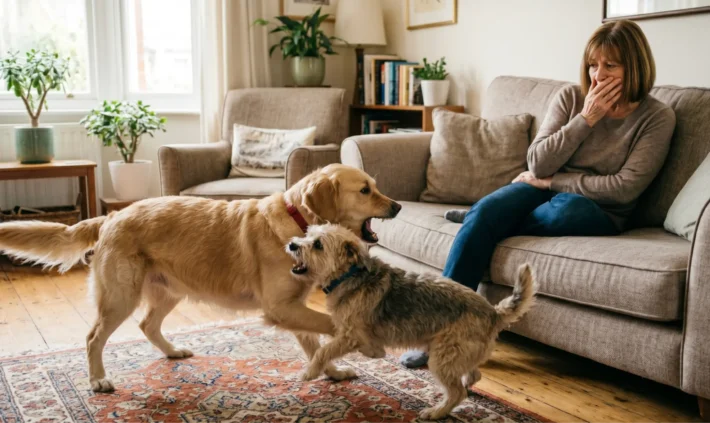
Bridget’s home was once a space filled with the quiet companionship of two adorable dogs. Over time, she noticed that her dogs started getting into squabbles. She thought “Oh, they’re the best of friends. They’d get back to their dynamic in no time.” Unfortunately, that nerve-wracking tension only got bigger.
As her dogs aged, their bond didn’t just fade… it fractured, replaced by a cycle of aggression that grew more severe with every passing day.
By the time Bridget reached out for guidance, she was exhausted.
The atmosphere in her home had become so unpredictable that a simple, everyday sound, like a stray paw scratching against the floor, would trigger a sudden, full-scale fight.
“Every day, I’m so scared, Dan,” she shared, her voice heavy with the weight of her worry. “I don’t know what will happen next.”
Bridget felt completely drained, having stepped back from the joy of dog ownership just to stay on guard, waiting for the next conflict to erupt.
“I can’t believe I now fear my dogs. They used to be so lovely.”
I told Bridget that she had a difficult but important assignment. Yes, she may be scared, but she was the only one capable of putting a stop to dog fights in her home.
During our consultations, I reminded her that she’s not her dogs’ referee. I explained to her that stopping the fight was simply a band-aid solution. Solving the issue that actually causes the fight is what mattered more.
I recommended The Dog Calming Code™ to her, and that’s when the transformation started.
As Bridget confidently settled into her role as a calm, steady leader, (as taught by The Dog Calming Code™) the atmosphere in her home began to soften. Her dogs, no longer feeling the exhausting pressure to protect the pack or figure out who was in charge, were finally able to set that burden down and just be dogs again. The hair-trigger fighting faded, and in its place, Bridget finally found the peace and security she had been searching for.
What Is The Real Reason For Sudden Dog Aggression?
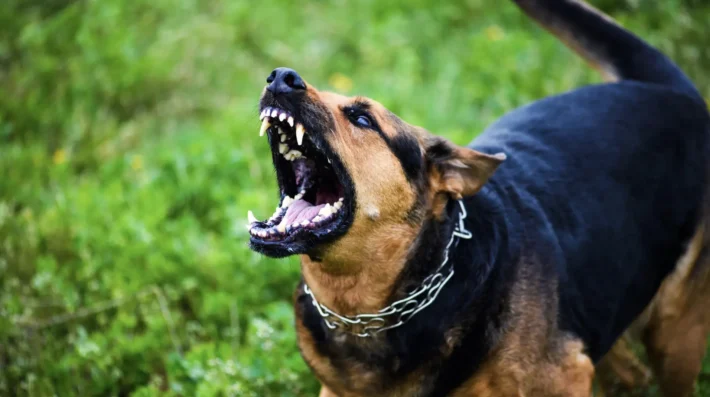
When dog fights become a recurring challenge, it is often a gentle, yet firm, invitation to reflect on the balance of leadership within your home.
Rather than seeing this as a sign of failure, view it as a meaningful opportunity to provide your beloved companions with the calm, consistent guidance they crave to feel secure.
Your Dogs Are Fighting For The Leadership Role
When dogs living in the same home begin to fight, it rarely happens without cause. More often than not, this behavior is a direct response to uncertainty regarding the “chain of command” within your household.
In my experience, the root of most in-home aggression is a fundamental, unresolved question: Who is leading the pack?
When the social structure of your home feels ambiguous to your dogs, they feel a natural, instinctual pressure to settle the matter themselves. One (or both!) of your dogs is essentially asking, “Who holds the top position?”
Without a clear, established authority, they are forced to negotiate this hierarchy through conflict. They aren’t fighting to be difficult; they are fighting because they are attempting to restore order in the only language they understand.
The shift happens when you step in.
The good news is that you have the power to resolve this tension immediately. When you confidently assume the role of the pack leader, you remove the burden of responsibility from their shoulders. You provide the clear, consistent direction they have been seeking. Once your dogs realize that you are firmly and fairly in charge, the fighting naturally dissipates—they no longer feel the need to compete for the leadership spot because they know, with total confidence, that you already hold it.
What Triggers Sudden Dog Fights?
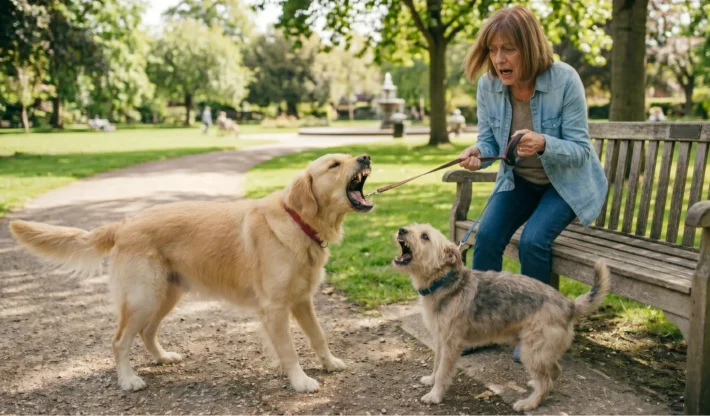
It is important to understand that when dogs who once lived peacefully together suddenly begin to fight, it is almost always a sign of underlying confusion about leadership.
Think of this leadership issue as a strong, invisible current moving deep beneath the surface of the water. On the surface, things might look calm for a while, but that current is constantly creating quiet ripples and tension within your home.
While the lack of clear leadership is the true cause, there will always be “triggers”—specific events that tip the scale. These triggers are what cause the tension to boil over and turn those small, quiet ripples into a full-blown explosion of conflict. Identifying both the hidden leadership struggle and the specific things that trigger these outbursts is the key to bringing peace back to your home.
Here are some common triggers.
Resource Guarding
Resource guarding is a major driver of conflict, but the truth is, it is rarely about the object itself. Whether it’s a bone, a toy, or a bowl of food, the fight is really about status. When a dog guards a resource, they are effectively claiming, “I am the provider; I decide who gets what.” If you haven’t firmly established that you control the resources, your dogs will fight to claim that authority.
The Leadership Fix:
To take control of resources, you must establish yourself as the clear provider: begin by managing food intake by deciding when mealtime happens, requiring your dogs to wait calmly, and using a clear release signal before they eat.
Moreover, manage their environment by treating toys as tools for structured, supervised play rather than items left out 24/7, which effectively eliminates the competitive “free-for-all” atmosphere.
Finally, ensure that any high-value items—like bones or chews—are treated as earned privileges rather than constant rights, ensuring your dogs look to you to authorize access to everything they value.
Owning or Taking Over Spaces
Doorways, hallways, and narrow passages are “choke points.” If your dogs are constantly jostling to get through first, they are testing boundaries. When neither dog is willing to yield, a fight is often the result.
The Leadership Fix:
When you move through the house, you should always walk through doorways, up the stairs, and into rooms before your dogs do. It might seem like a small habit, but to a dog, the one who leads the way is the one in charge of the space.
Along with this, start using a simple “wait” rule. Before your dogs are allowed to cross any threshold—like leaving the house or entering a new room—make them pause and wait for your signal before they move. This teaches them to practice patience and reminds them that you are the one deciding where the pack goes and when.
Owner Attention: Jealousy and Alliance Aggression
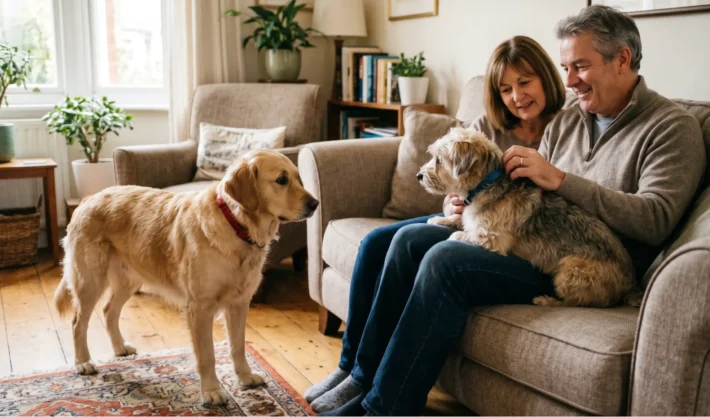
It is heartbreaking to see, but your own affection can sometimes spark a fight.
If your dogs aren’t sure who is in charge, they will view your attention as a high-value resource. When you pet one, the other may perceive it as a threat, or a slight against their rank. If you then step in to defend one dog, you inadvertently create an “alliance,” which forces the other dog to view their housemate as an even greater rival.
The Leadership Fix:
If your dogs start acting out to compete for your attention, the best thing you can do is step back and stay neutral. If they push for your focus, simply stand up, turn your back, and ignore them until they are calm. Remember, affection should be something you choose to give, not something they demand. By waiting for them to settle down before you pet or praise them, you teach them that you are in control of the interaction, not them.
High-Arousal Moments: Guests, Play, and Walks
Fights frequently occur when adrenaline is high, such as when the doorbell rings, when you get home, or during intense play. In these moments, your dogs’ brains are flooded with chemicals, which lowers their impulse control. They are no longer thinking; they are reacting.
The Leadership Fix:
To keep things calm, avoid high-energy greetings.
If your dogs get too excited when you come home or when visitors arrive, use baby gates or The Calm Freeze technique to help them settle down before you let them interact. Think of the walk the same way: it should be a quiet, focused activity. If your dog is pulling on the leash or hyper-fixated on everything around them, they are acting as the leader of the walk. To reclaim your role, simply bring their focus back to you, ensuring you are the one guiding the way.
Same-Sex Aggression: The Intensity Factor
Conflicts between two dogs of the same sex, especially females, can be some of the most intense and dangerous interactions in a home. Because this is often tied to deep-seated instincts regarding resources and rank, these fights can escalate faster and last longer than others.
The Leadership Fix:
The approach still focuses on you being a calm, consistent referee. By taking control of the daily resources, space, and movement, you remove the vacuum that causes them to feel they must compete for the top spot. When you show them that you are already the leader, the exhausting burden of running the pack is lifted off their shoulders, allowing them to finally relax.
Triggers Are Not the Cause
Here’s something I really want you to understand. You might notice the fighting flares up around food, toys, a favorite resting spot, or when you walk into the room, maybe even when guests arrive or a dog barks outside. These things look like the cause, but they’re really just the spark.
The fuel underneath is the unresolved question of who’s in charge. The behavioral triggers are just the match. The pack hierarchy confusion is the gasoline. This is why simply removing one trigger never solves the problem. You address the food bowl, and suddenly they’re fighting over the couch instead. Until you resolve the leadership question, the stress triggers will keep finding new forms.
What Causes Dog Fights To Be Worse?
While a lack of clear leadership is the root of the problem, you may be wondering why the conflicts seem to escalate. Apart from checking your dogs’ triggers, consider these factors that make dog aggression worse.
Medical Check: Always Rule Out Pain First
Before you assume this is purely behavioral, schedule a veterinary exam for both dogs. Pain, illness, thyroid imbalances, and neurological issues can all trigger sudden aggression.
Common medical culprits include:
- Arthritis or joint pain
- Dental disease
- Ear infections
- Hormonal imbalances (especially in females who aren’t spayed)
- Cognitive dysfunction (in senior dogs)
If one dog has suddenly become defensive, it’s often because they’re hurting, and the other dog got too close. Watch their body language closely, a dog in pain will often stiffen, freeze, or give clear stress signals before they protect themselves, sometimes violently.
Social Maturity: The 1-3 Year Window
If your dogs are between 1 and 3 years old, you’re in the prime window for what I call “the expiration of the puppy pass.” When dogs are puppies, they receive social immunity from adult dogs. Other dogs tolerate behaviors they wouldn’t accept from an adult.
But as your dog matures, that pass expires. What was once playful is now perceived as pushy. What was once cute is now disrespectful. If your pack hierarchy was never clearly established, this is when the fighting begins, and it is one of the most common reasons people ask, “My dogs keep fighting, what should I do?”
What happens during social maturity:
- Confidence increases dramatically
- Drive and energy surge
- Dogs start “testing” their place in the hierarchy, often a more dominant dog emerges
- Behavior that were tolerated are no longer acceptable
Trigger Stacking
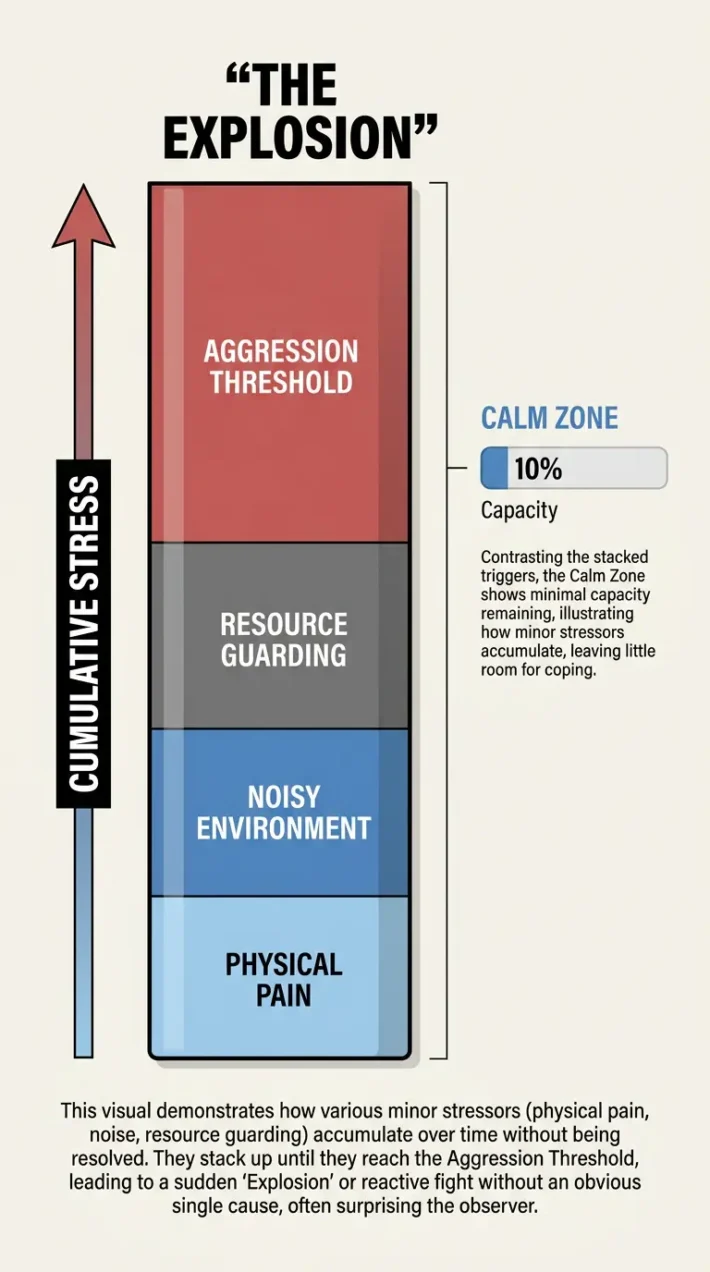
Most cases of dogs suddenly fighting each other aren’t caused by a single event. They’re the result of trigger stacking, when multiple small stressors and behavioral triggers accumulate throughout the day (or week) until your dog finally reaches their breaking point.
Here’s how it works:
Imagine your dog’s stress as a bucket. Every time something mildly stressful happens, a drop goes into the bucket. A loud noise. A visitor at the door. Another dog getting too close. A toy being picked up. By itself, each drop is manageable. But when the bucket is full, when there’s no more room, the next drop causes an overflow. That’s when the fight erupts.
Sudden aggression is often the result of ‘trigger stacking,’ where multiple minor stress triggers accumulate until the dog reaches a breaking point and reacts with unexpected physical confrontation.
Common stress triggers that “stack”:
- Changes in routine
- New people or animals in the home
- Construction noise or renovations
- Illness or pain
- Disrupted sleep
- Resource guarding situations (food, toys, attention)
What Are The Signs That Your Dog Doesn’t See You As Their Leader?
It is a common misconception that providing your dogs with love, food, and a comfortable home is the same thing as being their leader. It is entirely possible and actually quite common for a dog to deeply love their owner while still viewing them as a follower.
The reason for this is simple: Dogs do not view the world through a human lens.
Acts of kindness that signal leadership to a human often mean nothing to a dog. They require a different type of communication to recognize you as the one in charge.
Recognizing the Leadership Vacuum
When there is a lack of clear guidance, your dogs will naturally step up to fill the void. This isn’t because they want to be bossy; it’s because they believe it is their job to protect the pack. This is an immense, stressful burden for a dog to carry, and it is usually the root cause of the anxiety that leads to fighting.
You might be living in a leadership vacuum if your dogs frequently:
- Push through doorways ahead of you.
- Demand attention on their terms, and receive it immediately.
- Control the schedule of your walks, deciding when they start and end.
- Guard resources like toys, food, furniture, or even your personal space.
- React to perceived threats such as visitors, noises, or other dogs before you have the chance to assess the situation.
When your dogs take on these responsibilities, they are acting on the belief that everyone’s safety is in their paws. That responsibility is exhausting for them, and it often creates the tension that results in household conflict. By reclaiming your role as the leader, you are giving your dogs the gift of being able to let go of all the protective burden.
What Can You Do Right Now If Your Dogs Are Fighting?
First, safety has to come first here. If your dogs are having serious fights, please be careful about getting physically between them. Keep yourself safe immediately.
Is It Safe To Stop Dogs From Fighting Mid-Fight?
I know your instinct is to grab collars, pull them apart, or physically intervene. Please don’t. You will get bitten, not because your dog intends to do so, but because when dogs are in a fight, their brains are in full survival mode. They cannot distinguish your hand from the other dog’s body. Their body language has shifted completely into fight mode, and they are not reading you the way they normally would.
Instead, try these methods to safely separate the dogs:
- If two people are present, each person grabs the hind legs of one dog and pulls backward, creating distance. Move in a circular motion to prevent the dogs from turning and redirecting onto you.
- A sharp, startling sound (air horn, banging pots, stomping feet) can sometimes interrupt the fight long enough for you to separate them safely.
- Throwing water on the dogs or tossing a blanket over them can break their focus momentarily.
Safety Tools You Need Immediately
- Baby gates are non-negotiable. Install them throughout your home to create physical barriers.
- Get some crates. If your dogs are crate-trained, use them. Crates provide safe, separate spaces.
- Use a leash indoors. Keep drag leashes on both dogs (only when supervised) so you can quickly and safely create distance without reaching for collars.
The 48-Hour Cool-Down Period
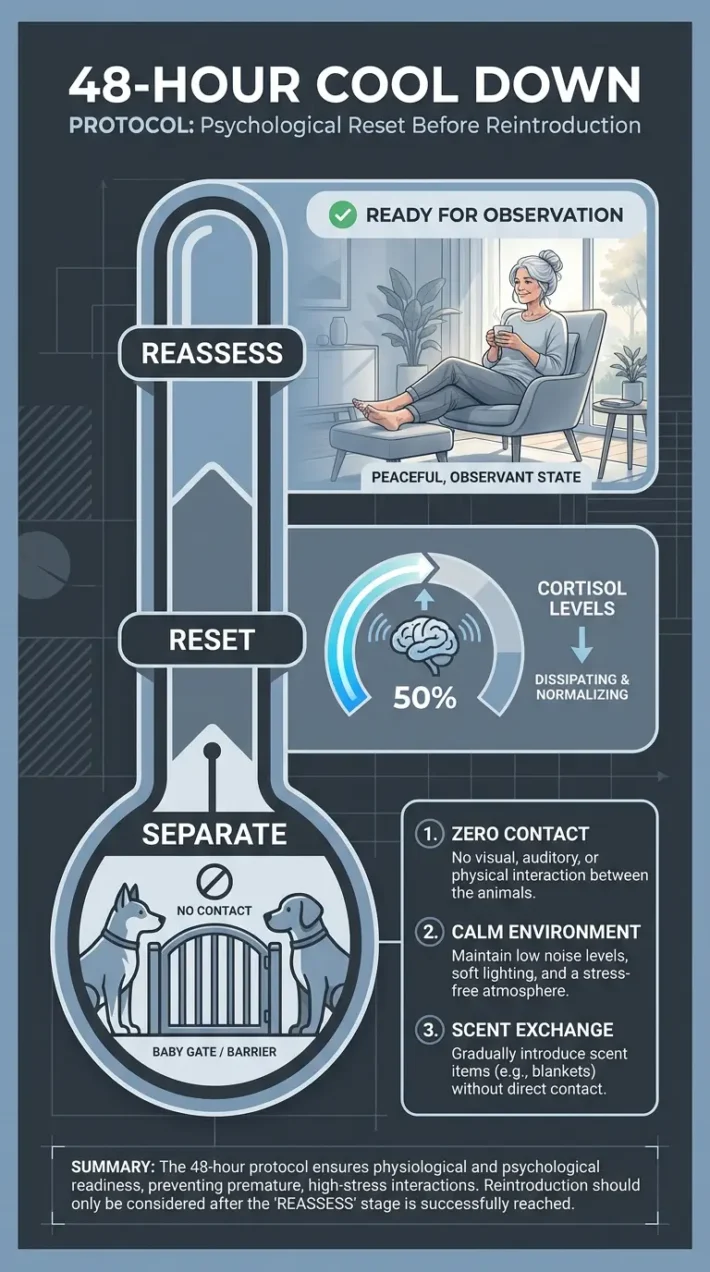
This is absolutely critical. After a fight, your dogs’ cortisol levels are sky-high. Cortisol is the stress hormone, and it takes 48 to 72 hours to return to baseline. During this time, even the smallest of behavioral triggers (a look, a toy, a doorway) can reignite a dog’s aggression.
What this means:
- 100% separation for at least 48 hours. They should not see, smell, or interact with each other.
- Use baby gates, separate rooms, or crate-and-rotate schedules to fully separate the dogs.
- No testing to see if they’re okay. You’re not ready to reintroduce them yet.
Implementing a 48-hour separation period is critical for allowing stress hormones to dissipate, ensuring both dogs can return to a neutral state before any reintroduction is attempted.
Is Obedience Training Enough To Stop Dogs From Fighting?
This is the part a lot of people don’t realize, and it’s so important I want to give it its own section. No amount of obedience training or treats will solve dog-on-dog aggression in the home because this is not a training problem but a pack psychology problem.
You can teach a perfect “sit,” a flawless “stay,” and a beautiful recall, and your dogs can still fight the moment your back is turned. Why? Because positive reinforcement and obedience drills address behaviors, not the underlying relationship dynamic. They don’t answer the one question your dogs are actually asking: who is in charge here?
The real solution is for you to step into the role of calm leader for both dogs. When they both recognize that you’re in charge, not each other, the thing they’re fighting over simply disappears. The competition ends because there’s no longer anything to compete for.
This doesn’t mean training tools have no place. Desensitization and counter-conditioning can absolutely help during the reintroduction phase, and positive reinforcement is wonderful for building calm associations once the leadership foundation is in place. But they are supporting players, not the solution itself.
Why Establishing Your Leadership Will Make It Easier to Solve Dog-on-Dog Aggression
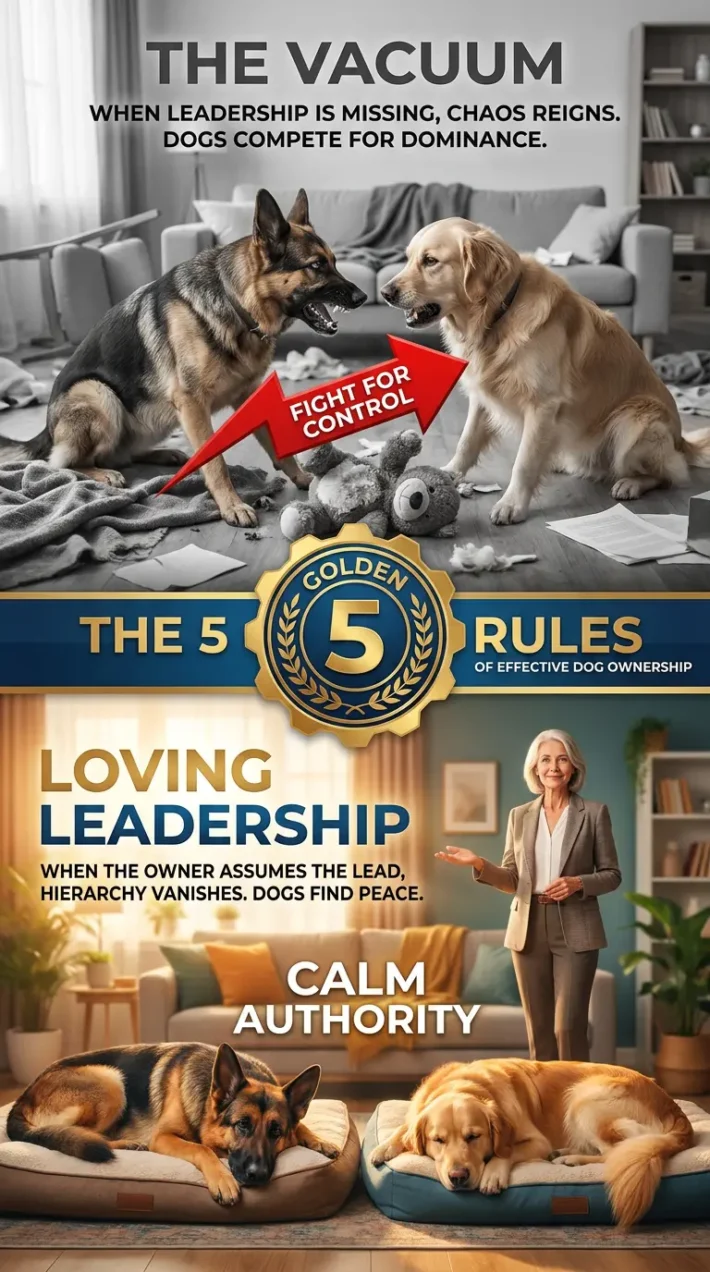
Trying to be the dominant one through intimidation only adds more tension to an already volatile situation. That approach is not only ineffective, it’s dangerous. It erodes trust, increases anxiety, and often makes dog aggression worse.
When it comes to helping your dogs go back to their calm, loving relationship, I am 100% suggesting showing loving leadership.
Loving Leadership means:
- Being calm, not controlling. Your energy sets the tone.
- Being consistent, not confrontational. Your dogs need to know what to expect.
- Being the decision-maker, not the dictator. You guide, protect, and provide.
When your dogs trust that you are handling the big decisions, when to eat, where to go, how to respond to threats, they can finally relax. They don’t need to fight anymore, because they’re no longer responsible for keeping the pack safe. Even a naturally more dominant dog will happily step back once they trust that you’ve got it covered.
When a leadership vacuum exists, dogs feel compelled to compete for control; establishing yourself as a calm leader allows them to relax and relinquish the urge to fight.
What Is The Best Training Program For Aggressive Dogs? The Dog Calming Code™
If you’ve read this far, you understand that your dogs aren’t fighting just for the thrill of it. They’re fighting because they’re stressed, anxious, and unclear about who’s in charge.
The foundation for fixing all of this is the Dog Calming Code™, my signature methodology that has transformed the lives of over 125,000 dogs worldwide. Getting the Five Golden Rules in place, consistently, for both dogs, is what shifts the dynamic.
The Dog Calming Code™ is built on Five Golden Rules that teach you how to communicate with your dogs in a language they instinctively understand:
- Control the Food – Establish yourself as the provider and decision-maker
- Delayed Acknowledgement – Remove the desperation and demand for attention
- Control the Space – Own the doorways, furniture, and movement in your home
- Handle the “Danger” – Show your dogs that YOU deal with threats (visitors, noises, other dogs)
- Control the Walk – Lead with calm confidence, not tension and reactivity
Once you’re clearly the decision-maker in their eyes, the tension between them typically eases significantly. The competition ends. The household becomes peaceful again.
Now here’s the best part: it doesn’t require force, fear, or endless bribes using treats. It requires you to step into the calm, loving leadership role your dogs have been desperately waiting for. This is the real answer when you’re lying awake thinking, “my dogs keep fighting, what should I do?”
Ready to learn more?
Join my free webinar, where I walk you through the exact steps for how to stop dogs from fighting and bring peace back to your home.
Or, if you’re ready to dive deep into the complete methodology, explore the Dog Calming Code™ program, the same system that’s helped over 125,000 dogs and their families worldwide.
Bringing Peace Back to Your Home
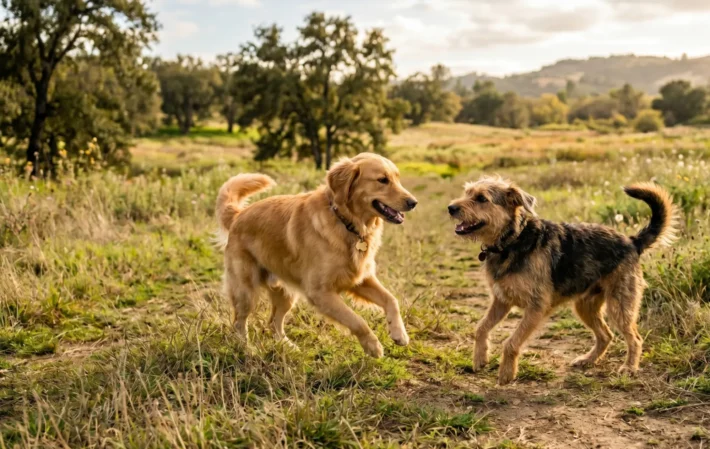
If you are the owner of two very feisty dogs at the moment, your job isn’t to punish, dominate, or control. Your job is to become the calm, loving leader they’ve been desperately waiting for. When you do that, when you step into that role with consistency and compassion, the fighting stops. The anxiety dissolves. The peace returns.
And your dogs? They finally can go back to being the best of friends again.
Take the first step today.
Join my free webinar and discover exactly how to bring harmony back to your home: Register here for the FREE webinar that also explores the Dog Calming Code™.
Your dogs are counting on you, and I’m here to help every step of the way.

— Doggy Dan