“Doggy Dan, what is redirected aggression in dogs?” Redirected aggression in dogs occurs when stress or arousal from a trigger, like another dog or a loud noise, pushes them past their threshold. This behavior is very common among dogs that are always stressed and on guard because they think they’re in charge. True resolution rests on leadership. Without a clear leader, a dog feels forced to take charge, causing chronic anxiety and reactivity.
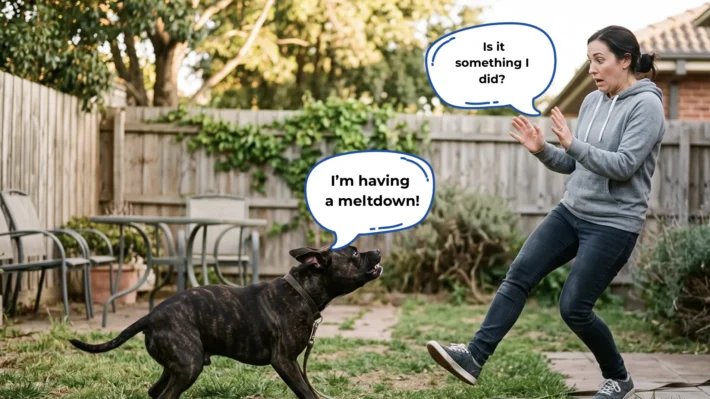
If your normally loving dog has just spun around and snapped at you, or lunged at another dog in the house seemingly out of nowhere, you’re probably shaken, confused, and asking yourself what on earth just happened.
What you witnessed is called redirected aggression, and it wasn’t your dog turning on you. It was an overflow, a sudden wave of arousal and stress that had nowhere else to go, and it spilled onto whoever happened to be standing closest.
In this guide, I’ll walk you through exactly what redirected aggression is, why it happens, how to handle it safely in the moment, and, most importantly, how to stop it from happening again by getting to the real root cause: leadership.
Read on, because this is going to change how you see your dogs forever.
Key Takeaways
- When a dog is highly aroused by a trigger it can’t reach, that frustration spills onto whoever’s nearest. It could be you, another person, or another dog, even though they had nothing to do with it.
- A dog who feels responsible for protecting the household lives with a stress bucket permanently near full, so any trigger tips them over..
- Lasting change comes from becoming the calm, consistent leader your dog can relax around. This raises their threshold so the redirection stops for good.
What Is Redirected Aggression in Dogs?
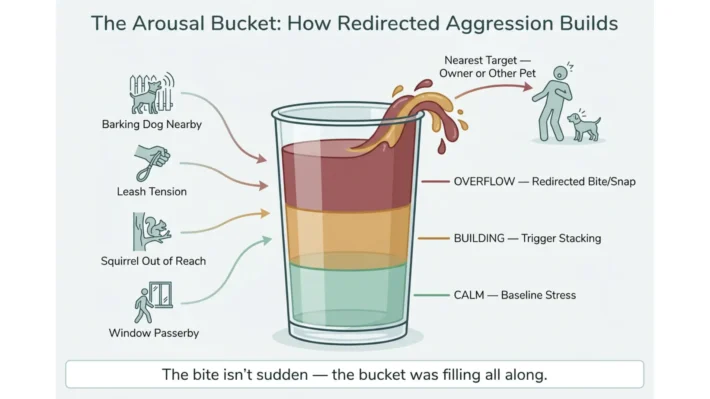
When your dog is suddenly becoming aggressive toward you (or another pet), chances are they’re highly aroused or frustrated by one trigger they cannot reach. Because of overwhelming frustration, all their emotions create an energy that fires onto whoever or whatever happens to be nearest, whether that’s you, another dog, or another pet in the home. This is redirected aggression.
Think of it like a shaken bottle of soda. The pressure builds and builds because your dog is fixated on something they desperately want to reach (a dog across the street, a cat behind a fence, or a knock at the door are some of the common examples), but that target stays out of reach.
The pressure has to go somewhere. And when you reach in to hold the collar, or the second dog in the house wanders too close, the cap comes off, and the aggression fires onto you instead of the original trigger.
The sequence is almost always the same:
- Arousal builds. Your dog spots or hears a trigger and becomes intensely fixated.
- The target is blocked. A leash, a window, a fence, or simple distance keeps them from reaching it.
- The frustration overflows. With no outlet, the aggression redirects onto the closest available being.
Understanding this mechanism is genuinely liberating for most owners I work with. Once you see it as a predictable overflow of arousal, rather than a random, terrifying character flaw, the behavior stops feeling like a puzzle, and starts looking like a problem you can actually solve.
Real Examples of Redirected Aggression
Redirected aggression looks different depending on the situation, but the underlying pattern is identical. Here are the most common examples owners describe to me.
Breaking Up A Dog Fight
This is the single, most common reason dogs bite their owners.
Two dogs are in a heightened confrontation, an owner reaches in with their hands to separate them, and one dog, flooded with adrenaline, whips around and bites the hand that grabbed it. From your dog’s perspective, they aren’t attacking you. In that split second, its brain simply registers “something grabbed me” and reacts.
Leash Reactivity That Turns On The Owner
You’re on a walk, your dog spots another dog and starts lunging and barking. You tighten the leash or try to pull them back, and suddenly your dog spins and snaps at your leg or hand. This is redirected aggression toward owners in its most heartbreaking form, and it’s far more common than most people realize.
Window, Fence, and Barrier Frustration
A dog barking furiously at a passing dog through the window or fence line becomes so wound up that it turns and bites the other family dog standing beside it, or even the owner who came to see what the fuss was about.
Two Dogs In The Same Home
When two dogs living together suddenly go from calm to a full-blown fight, it’s usually not the same overflow mechanism I’ve described above.
In my experience, it’s rarely about fear of each other at all; they can have a genuine scrap and be lying on the sofa together two hours later. This is almost always about pack hierarchy, not arousal spilling over.
Common triggers include food, toys, beds, overexcitement when you’re getting ready for a walk, someone arriving home, or a dog barking on the other side of the fence. There’s one that catches owners off guard every time, and that is simply a person walking into the room. Two dogs can be perfectly settled on their own, and the moment someone enters, tension flares between them.
Rough Play That Tips Over The Edge
Rough play itself is healthy and normal, as long as both dogs are genuinely willing and enjoying it. The real issue isn’t play turning into redirected aggression; it’s excitement climbing past a threshold before anyone notices. Think of kids playing: a child calmly reading a book won’t suddenly hit you, but a child running around at full tilt, wound up and overexcited, might lash out without meaning to.
It’s the same with dogs; your job is to step in and bring the energy back down before it tips over, not after.
All of the above describes the moment things spill over. But none of it explains why a dog is carrying that much tension to begin with. And the answer, almost every time, comes back to leadership. A dog who trusts that you’re handling things doesn’t run at that chronic level of arousal in the first place. The bottle keeps getting shaken because nobody has stepped up to carry the weight, and until that changes, you’re just managing overflow instead of solving it.
FREE WEBINAR: WHAT STOPS DOG AGGRESSION FOR GOODWhat Are The Warning Signs of Redirected Aggression In Dogs Towards Other Dogs and People?
The good news is that redirected aggression rarely arrives with zero warning. There is almost always a build-up of body language before the explosion. Learning to read these signals gives you precious seconds to create distance and defuse the situation before your dog tips over the threshold.
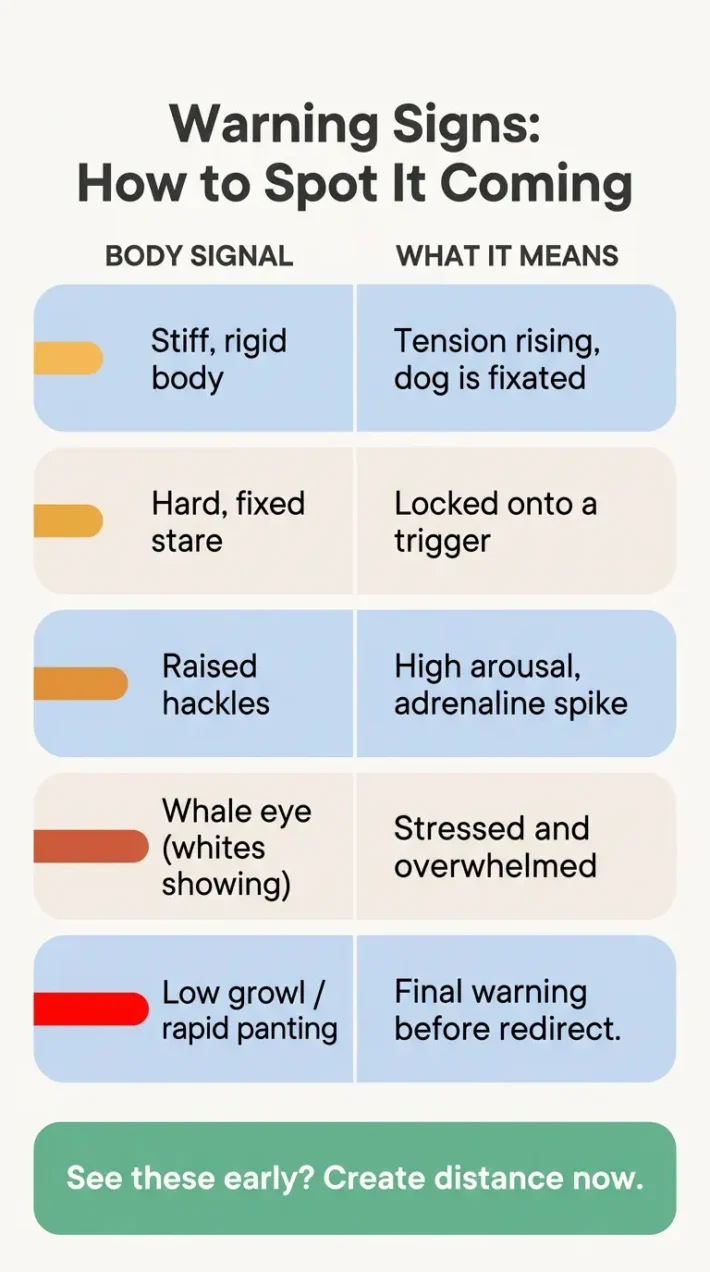
Learn to read the early warning signs — from a hard stare to raised hackles — so you can create distance before your dog tips over threshold.
| Warning Sign | What It Means |
| Stiff, rigid body | The dog has locked onto a trigger and is bracing — a sign arousal is climbing fast. |
| Hard stare / fixation | Intense, unblinking focus on the trigger. The dog has “checked out” mentally. |
| Raised hackles | The fur along the spine lifts — a clear signal of high arousal and adrenaline. |
| Whale eye | The whites of the eyes show as the dog stares sideways — a stress signal. |
| Rapid panting or sudden closed mouth | An abrupt shift in breathing indicates the nervous system flipping into fight-or-flight. |
| Low growl | A warning, not defiance. The dog is telling you it’s near its limit. |
Once you spot these signs, the priority is not to correct or comfort — it’s to interrupt the fixation and create distance before the pressure boils over. Learning to read your dog’s body language is one of the most valuable skills any owner can develop.
Why Your Dog Is Showing Redirected Aggression: The Real Cause
Almost every guide will explain the surface trigger: frustration, blocked access, high arousal. And that’s all true. But it doesn’t answer the deeper question: why is your dog living so close to the edge that a passing dog or a knock at the door is enough to make them explode?
I want every dog owner to know that dealing with the trigger is not going to solve the problem. I almost guarantee the dogs will find another trigger. The surface answer, “manage the arousal, avoid the triggers,” leaves you feeling like you have to tiptoe around your own life forever. That’s not a feasible solution.
The deeper driver is this: many dogs are living in a state of chronic, low-grade stress because they believe they are responsible for the entire household.
In their mind, they are the leader, the one who must scan for threats, guard the family, and make the big decisions about what’s dangerous. Being the pack leader is often far more tiring than most owners would ever imagine, leaving a dog irritable and intolerant long before anything even happens!
I like to think of it using an energy scale from one to ten.
A dog sitting at a two or three has plenty of headroom, plenty of calm reserves to draw on before they get overwhelmed.
But a dog carrying the weight of leadership is often already sitting at a seven or eight before the front door even opens. That is an exhausting, relentless job for any dog to hold, and it leaves them permanently on a hair-trigger, with almost no room left before they tip over.
So when a trigger appears, they don’t have the calm reserves a settled dog would. Their threshold is already low. The bucket overflows in seconds, and that overflow becomes redirected aggression.
This is not a training issue; it’s a leadership issue, and that distinction changes everything about how you fix it. This is the foundation of everything I teach through The Dog Calming Code™.
The Power Of The Dog Calming Code™
When you step into calm, confident leadership and gently show your dog, “I’ve got this, you can relax, you don’t need to be in charge,” you lower their baseline stress. A dog with an empty stress bucket has a much higher threshold. Triggers that used to cause a meltdown barely register. This is why The Dog Calming Code™ works from the inside out, because it removes the burden your dog has been carrying, rather than just managing the moments when it spills over.
Before assuming the cause is purely behavioral, always rule out pain or illness. A dog in discomfort has a dramatically lowered threshold and may snap at the nearest being when a painful area is touched or jostled. If your dog’s behavior has changed suddenly and out of character, a vet check is a responsible first step.
DISCOVER HOW CALM LEADERSHIP ENDS THE FIGHTING — FREE WEBINARRedirection vs. Reactivity vs. Rage Syndrome
One of the biggest sources of fear I see is owners confusing redirected aggression with something far scarier they’ve read about online: rage syndrome. Let’s clear up the confusion so you will know a better way of managing your dog.
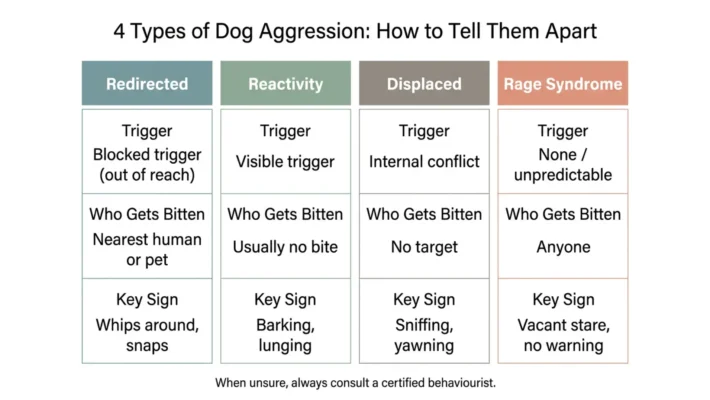
Confused about the terms? This side-by-side comparison clears up redirected aggression, reactivity, and rage syndrome, and shows why most owners’ fears are unfounded.
| Term | What It Is | Predictable? | Fixable? |
| Redirected aggression | Arousal aimed at a blocked trigger overflows onto the nearest being. Frustration expressed sideways, sometimes as spinning or snapping at whoever’s closest, is part of this same overflow, not a separate category. | Yes, there’s always a trigger and a build-up. | Yes, very. |
| Reactivity | An over-the-top emotional response to a trigger (barking, lunging), usually directed at the trigger itself. | Yes, trigger-driven. | Yes, very. |
| “Rage syndrome” (idiopathic aggression) | A genuinely rare neurological condition with sudden, triggerless aggression. | No, appears without warning. | Rare, and requires veterinary neurology. |
There’s no reason to panic; rage syndrome is extraordinarily rare. It appears with no trigger, no warning, and no build-up; the dog switches from calm to explosive in an instant, then back again as if nothing happened. Redirected aggression is the opposite. There is always a trigger and always a build-up of arousal, if you know what to look for.
The Build Up Of Stress
I teach my clients to think of it as an energy meter running from zero to ten. Zero is asleep. Ten is a full-blown explosion. Somewhere around six or seven, adrenaline takes over, and your dog stops thinking clearly; they’re simply reacting.
As I often say when I’m working through a case like this, at six, seven, eight, it all starts to go murky; he’s just swinging. The explosion at nine or ten didn’t come out of nowhere; your dog was climbing that scale from the moment something set them off.
If you learn what a three, a four, and a five look like on your own dog- ears, posture, breathing, the set of the tail- you can step in long before things tip past the point of no return.
This is also where owners need to understand who they’re actually dealing with, because it changes how you read every situation.

A dominant dog carries their tail up, chest forward, and approaches confidently; they’re choosing to engage because, in the absence of clear leadership, they believe it’s their job to make the big decisions.
A fearful dog looks completely different, tail tucked, staying close to you, only going for it when they feel cornered. They don’t want a fight; they feel they have no choice. The dog that charges forward looks terrifying, but that’s often a dominant dog doing what they believe is their leadership duty.
The dog that suddenly snaps at a stranger looks unpredictable, but that fearful dog has usually been sending warning signals for a long time that nobody reads. Both types trace back to the same root cause, the leadership vacuum, but knowing which one you’re looking at changes how you respond in the moment.
And here’s something worth saying plainly: it’s never truly random. Owners tell me “it came out of nowhere,” but there are always factors at play: breed tendencies, how close the other dog got, how fast something approached, body posture, how aroused your dog already was before the moment even started. It felt random because you didn’t see the factors, not because there weren’t any.
Your Dog’s Response To Threats
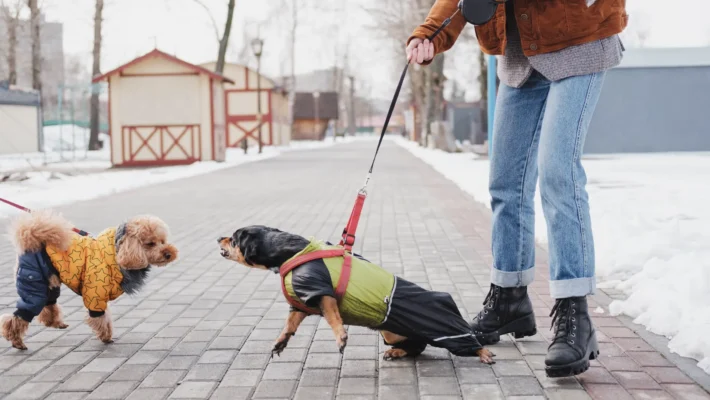
There’s one more piece that ties this all together, and it explains why so much of this happens specifically on the lead. When a dog feels threatened, their instinct runs through a sequence: flight, freeze, fight, submission.
Aggression, the fight response, is almost always what shows up when flight isn’t an option. A dog on a leash cannot run. So when arousal builds, and there’s nowhere to flee to, that energy redirects sideways instead, onto you, onto the leash, onto whoever’s nearest. That’s a big part of why lead situations are such common flashpoints for redirected aggression.
If you can identify what set your dog off, and now you know what to look for, you are almost certainly dealing with something entirely manageable. For a deeper look, my article on the difference between a reactive and aggressive dog is well worth a read.
JOIN OUR FREE WEBINAR AND LEARN WHAT REALLY STOPS DOG REACTIVITY!What to Do In The Moment: When Your Dog Is Aggressive With You
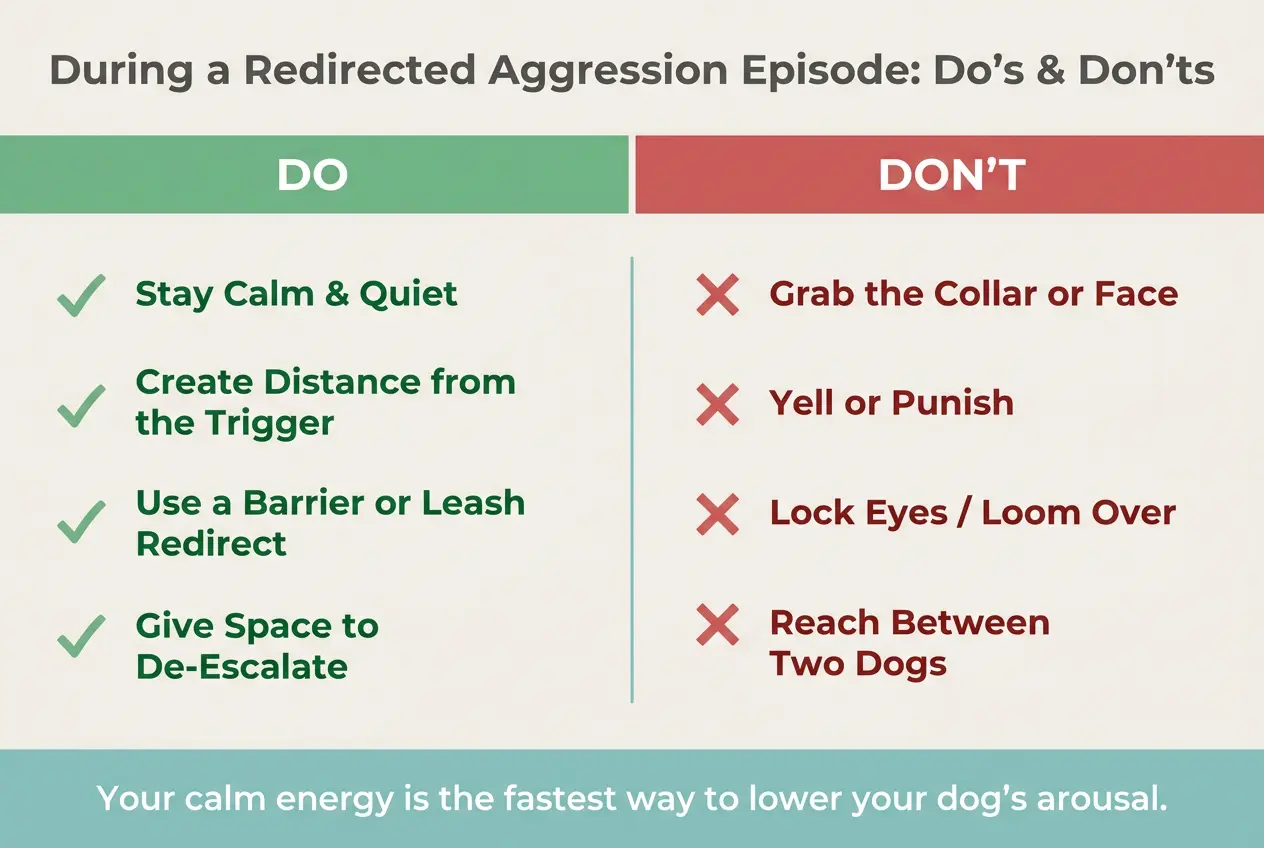
When your dog is over threshold, your only job is to stay safe and help them come back down. This is not the moment for training or correction; the thinking part of your dog’s brain is offline, and no amount of “no” or a firm voice is going to reach them right now.
The golden in-the-moment rules: create distance and interrupt calmly, but never grab the collar or reach in with your hands. Safety first, always.
Never grab the collar or reach in with your hands. This is how the majority of owner bites happen. A flooded dog cannot tell the difference between your loving hand and the source of its frustration. At that moment, a hand is just a hand.
What To Do: Ensure Your Safety
- Create distance. Calmly move yourself, your dog, or the trigger apart. Distance lowers arousal faster than anything else.
- Block the line of sight. Step behind a car, a wall, a bin, or a door. If your dog can’t see the trigger, the pressure drops fast.
- Use a barrier. A baby gate, an open umbrella, a piece of board, or a closed door between two fighting dogs is infinitely safer than your hands.
- Stay calm yourself. Your dog reads your energy constantly. Shouting and panic only add fuel to a fire that’s already burning.
What NOT To Do
- Don’t grab the collar, scruff, or reach in between fighting dogs.
- Don’t punish, yell, or hit; this raises fear and arousal and can make the aggression worse.
- Don’t corner your dog; always give them an exit route.
- Don’t stare or lean over your dog.
If two dogs are locked in a fight, the safest method I teach is the “wheelbarrow” technique where two people each grab the back legs of a dog and lift, walking backward in a circle.
A sudden loud noise, a blast of water, or throwing a blanket over both dogs can also break the fixation. Never, ever put your hands near their heads. For more on this, see my full guide on how to stop dogs fighting in the same house.
How to Stop Redirected Aggression for Good
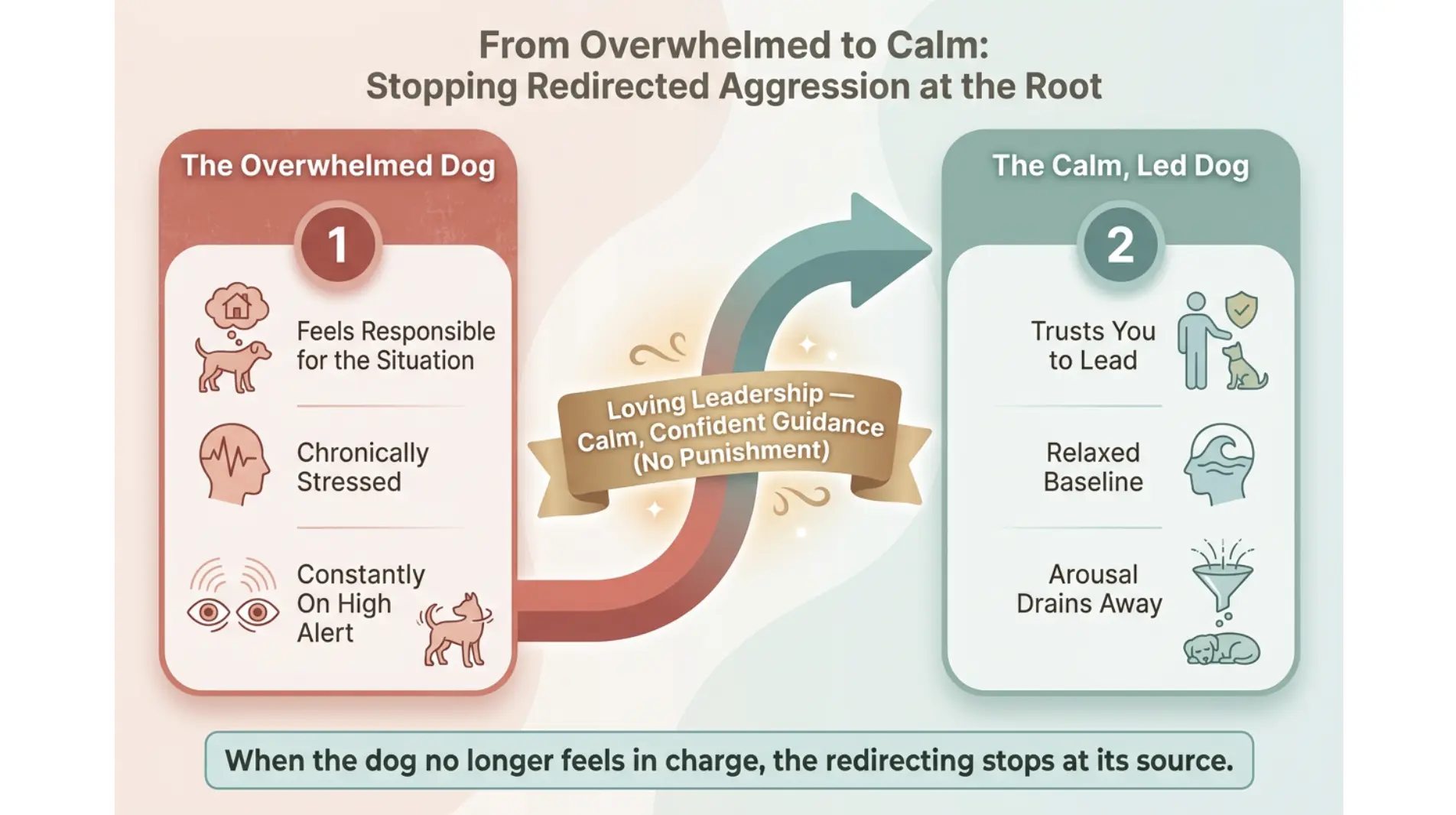
Staying safe in the moment matters, but I want to be real with you: it’s damage control, not a cure. To truly stop redirected aggression, you need both layers of short-term management and long-term transformation.
Short-term Management Of Your Dog’s Redirected Aggression
- Avoid trigger stacking. Multiple stressors in a short window fill the bucket fast, so space out potentially arousing events where you can.
- Use the right equipment. A well-fitted no-pull harness gives you gentle, humane control on walks without adding pain or fear. For dogs with a bite history, a properly conditioned basket muzzle can keep everyone safe during the training process.
- Manage distance and the environment. Frost the bottom of windows, block fence-line access, and walk at quieter times while you rebuild your dog’s threshold.
Long-term Transformation: Your Leadership
Establishing your leadership can make permanent change happen. Instead of forever avoiding life, you lower your dog’s overall stress so that triggers stop tipping them over the edge.
You do this by becoming the calm, consistent leader your dog is desperate for, so they can finally hand over the exhausting job of protecting the family and simply relax.
This is the entire philosophy behind the loving leadership taught in the Five Golden Rules of dog leadership (which you can learn through my best-selling training program, The Dog Calming Code™).
When your dog genuinely believes you are handling the decisions, their baseline stress drops, their threshold rises, and the redirection simply stops happening, because there’s no longer a full bucket waiting to overflow.
I say this with love… please don’t be tempted by shock collars, prong collars, alpha rolls, or “send the dog to boot camp” approaches. These suppress the symptom while adding fear to an already over-aroused dog, which frequently makes aggression worse over time. You cannot punish a full stress bucket empty. The kind, force-free path isn’t just nicer; it’s genuinely more effective and more permanent.
JFREE WEBINAR: STOP DOG REACTIVITY BEFORE IT GETS WORSEWhen to Get Professional Help
Most cases of redirected aggression can be turned around at home with the right knowledge and consistency. But some situations warrant expert support sooner rather than later. Please seek professional help if:
- Your dog’s bites are breaking skin.
- The frequency or intensity of episodes is escalating.
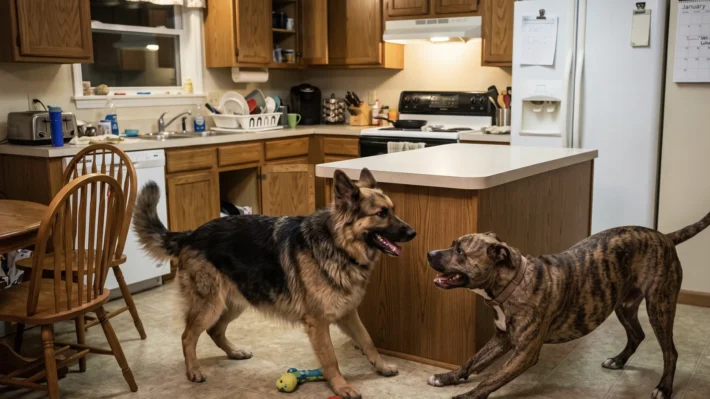
- Multiple dogs in your home are in ongoing conflict.
- There are children or vulnerable people at risk.
- The behavior appeared suddenly with no identifiable trigger (rule out a medical cause first).
Your Leadership Calms A Reactive Dog
Reaching out for help is proof of your responsible, loving ownership.
If you are feeling overwhelmed, shaken, or exhausted by these sudden outbursts, please know that you are not alone. Countless loving dog owners find themselves in this exact same spot, feeling confused and helpless—but there is a clear path forward. The Doggy Dan dog training program is specifically designed to help dog owners overcome redirected aggression by addressing the root cause rather than just masking the symptoms.
You can start changing things today by registering for our free webinar to discover how simple, calm leadership can transform your dog’s behavior. And if you are curious for more or have specific questions about your dog’s situation, don’t hesitate to send us a message—we are here to help!
JOIN THE FREE WEBINAR & BRING CALM BACK TO YOUR HOME
— Doggy Dan
FREQUENTLY ASKED QUESTIONS
What does it mean when a dog’s aggression redirects on you?
It means your dog was highly aroused by a trigger it couldn’t reach, like another dog on a walk, and, unable to release that frustration on the actual target, it turned and directed the aggression onto you instead.
It’s an accidental overflow of adrenaline, not a personal attack, and certainly not a sign your dog dislikes you.
Is redirected aggression common in dogs?
Yes, it’s very common, especially in leash situations, multi-dog homes, and barrier-frustration scenarios.
Interestingly, research shows this happens even more frequently in cats, but any aroused animal that can’t reach its trigger is capable of redirecting. It’s a normal, understandable response, not a rare disorder.
How do you fix or stop redirected aggression?
Short term, you manage triggers and distance to keep everyone safe. Long term, you lower your dog’s overall stress by stepping into calm, confident leadership so they no longer live on a hair-trigger. When their baseline stress drops, their threshold rises and the redirection stops. Avoid punishment because it only worsens arousal.
How do you snap a dog out of aggression?
Here’s the honest truth: you don’t really “snap them out” of it once they’re over threshold. When the energy is tense, their thinking brain goes offline. The goal is to prevent the explosion by reading early warning signs and creating distance before your dog tips over. Calmly blocking line of sight and lowering arousal works far better than any correction ever could.
What causes redirected aggression?
The surface cause is frustration from a blocked trigger combined with high arousal. But the deeper cause is chronic stress from a dog who feels responsible for protecting the household because they think they’re the pack leader. This keeps their stress bucket permanently near full, so any trigger tips them over the edge and the aggression spills onto whoever’s nearest.
Is redirected aggression the same as reactivity?
They’re related but not identical. Reactivity is an over-the-top response usually aimed at the trigger, barking and lunging at another dog. Redirected aggression is when that aroused energy gets aimed at a different being, you or another dog, because the real target is out of reach. Both stem from the same root of excess arousal.
Can pain or illness cause redirected aggression?
Absolutely. Pain dramatically lowers a dog’s threshold and can make them snap at the nearest person or animal when a sore area is touched or when they’re already stressed. If your dog’s aggression is new or out of character, a vet check to rule out a medical cause should always come first.
What are the first signs of rage syndrome, and is my dog’s behavior that?
True rage syndrome (idiopathic aggression) is extremely rare, and it features sudden, explosive aggression with no trigger and no warning, then an instant return to calm. If you can identify what set your dog off, and you saw any build-up of arousal, you’re almost certainly dealing with ordinary, and very fixable, redirected aggression, not rage syndrome.