
Wondering how to deal with your bossy furry friend, or how to introduce a new dog to a dominant dog? Don't fret — these problems CAN be solved, and quickly, too…let's get into it!
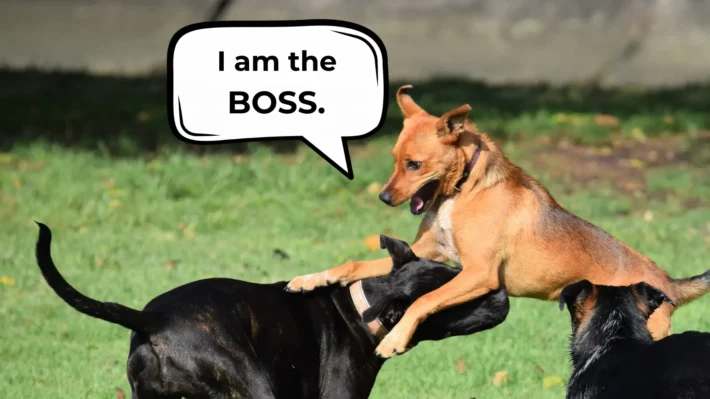
The question of how to handle a bossy, dominant dog is common among dog owners who are exhausted, frustrated, and overwhelmed by their bossy dogs.
These bossy dogs always want to be in charge of every familiar or strange dog they encounter.
They love challenging authority, display brute strength, and don't hesitate to show aggression through barking, growling, or threatening their owners or other pets through the famous “dog aggressive stance”.
Other pet owners say, “Oh, but that's just a dog's personality!”
Though it can be true, dominant behavior not corrected can lead to more serious challenges including your dog dominating you.
Stopping aggression in dogs is crucial to avoid other problems including your dog hurting another dog, a disorganized home, and having a dog that just doesn’t listen to you.
If you need help training dogs that are aggressive and dominant, you're in the right place.
In this blog we're going to talk about the dog psychology behind aggression, and what to do if your dog is starting to show signs of asserting dominance through aggression.
Key Takeaways
- Dominant aggression in dogs is driven by their strong need to be perceived as “in charge,” not necessarily by fear or resource guarding.
- Dogs assert dominance over owners through subtle acts like invading personal space and ignoring commands, emphasizing the owner's loss of control.
- When introducing a new dog, especially to a dominant resident dog, always begin on neutral territory, supervise all interactions closely, establish separate safe zones, and reinforce calm behavior through consistent routines.
Common FAQs And Misconceptions About Dominant Dogs
Navigating the world of dog behavior can feel overwhelming, especially when you're just trying to build a loving bond with your companion. It’s easy to get confused by conflicting advice or to misinterpret what your dog is trying to tell you. Let's gently clear up some common and completely understandable misunderstandings about “dominance” that can cause so much stress for caring owners like you.
## Misconception 1: “My dog is just being mean or aggressive.”
It's heartbreaking to see your dog act out, and it's natural to label it as simple aggression or think your dog is being “bad.” It can feel personal and upsetting.
A Kinder Perspective: Most of the time, this behavior isn't coming from a place of malice. It often comes from a deep-seated need to feel in charge because your dog believes that's their job. Imagine feeling like you have to be the security guard for your entire family, 24/7. It's a stressful role! This “bossy” aggression is often their misguided way of trying to control situations because they don't yet see you as the calm, confident leader they can trust to handle things. By showing them you're in charge, you're not punishing them; you're giving them the greatest gift of all: the freedom to finally relax. 😌
Misconception 2: “He's just showing affection when he climbs all over me.”
We all love when our dogs want to be close to us! When your dog climbs into your lap, lies on your feet, or snuggles onto your couch, it feels like pure love and connection.
The Deeper Truth: While our dogs absolutely love us, it's important to understand their language. In the dog world, controlling space is a quiet way of showing leadership. When a dog decides when and how to enter your personal bubble without invitation, it can be a subtle way of reinforcing to themselves that they “own” you and the space around you. Recognizing this isn't about rejecting their affection; it's about ensuring the relationship is balanced, where cuddles and attention happen on your terms, reinforcing you as the gentle leader.
Misconception 3: “It's just a phase; they'll grow out of it.”
It's so hopeful to think that challenging behaviors are just a temporary phase, especially with puppies. We want to believe that with a little time, things will naturally get better on their own.
The Gentle Reality: Unfortunately, dominance is a behavior that rarely fixes itself. In fact, every day that it goes unaddressed, your dog gets more confirmation that their behavior is correct and that they are the one who has to make the decisions. Addressing these patterns with calm and consistent guidance isn't about being strict; it's an act of love that prevents the behavior from escalating into a much bigger, more stressful problem down the road.
Misconception 4: “I need to be a harsh ‘alpha' to stop it.”
A lot of old training advice focused on being a forceful, intimidating, feared “alpha,” and it's easy to think you need to meet aggression with aggression to regain control.
The More Effective Path: Your dog isn't looking for a dictator; they're looking for a dependable, trustworthy leader. The source of true leadership isn't force—it's calmness and consistency. When you remain confident and are clear with your rules and boundaries, your dog senses that security. They see you as someone who can handle danger and make decisions, which allows them to let go of that burden. True leadership is built on mutual respect and understanding, not fear.
How to Handle Dominant Dog Behavior: What's Going on In a Bossy Dog's Mind?
What truly drives your dog's need to assert dominance and display aggression?
Let me give the explanation through a common scenario often encountered by dog owners with aggressive and bossy dogs.
Picture this: when you take your bossy pet to the park, they tend to gravitate towards other dogs, sizing them up.
Dogs typically approach each other with erect ears, engaging in a circling ritual as they assess one another.
Soon enough, you might hear a chorus of barks, each dog unrelenting! The next thing you know, they will be in an aggressive stance, ready to attack each other.
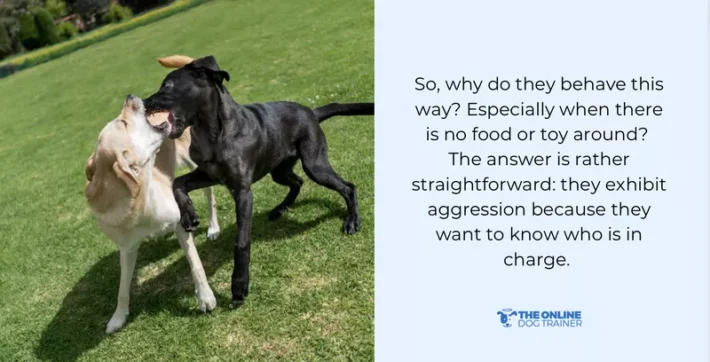
So, why do they behave this way? Especially when there is no So, why do they behave this way? Especially when there is no food or toy around? Are they just insecure dogs, or is something else happening?or toys around?
The answer is rather straightforward: they exhibit aggression because they want to know who is in charge.
The bossy aggression happens when your dog perceives themselves as the one in charge, so to speak.
They have this HUGE need to assert themselves, and if either you or another dog fails to comply with their desires, they resort to aggressive behaviors to assert their dominance.
THIS WEB CLASS TEACHES PROVEN STRATEGIES THAT STOP DOG DOMINANCE FAST!Aggressive Dominant Behavior In Dogs: What to Watch For
Signs of aggression in a dominant dog are different from those of a dog with aggression driven by fear. The aggressive behavior of bossy dogs comes from their want to assert authority and put other dogs in their place.
Dog owners, knowing these signs by heart, can protect you and your other pets from the aggressive outbursts of your bossy dog.
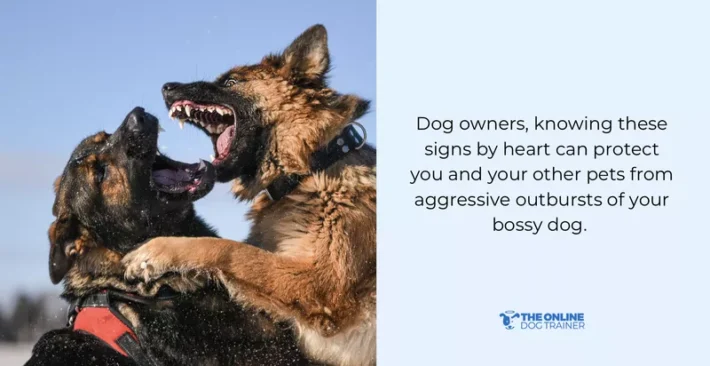
Here are aggressive dog signs that assert control.
Barking and Growling
Is your bossy dog the king of non-stop barking? Are they growling at you all the time?
Dogs use barking as a means to assert themselves as the one in charge. It's their way of commanding attention, demanding resources, or forcing compliance from other dogs or humans.
It's a vocal display of their perceived authority.
Growling is another sign you can't simply brush off!
When a bossy dog growls, it's a clear warning that says, “You are pushing the boundaries!”
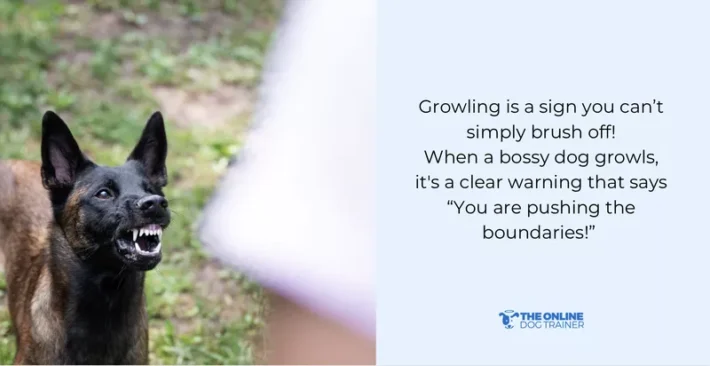
A bossy dog can resort to growling in instances such as:
The growling can escalate to aggression if the perceived threat persists.
It's a signal that the bossy dog believes they have the right to control the situation and is willing to use force if necessary.
Stance That Says “I'm Ready to Fight”
You've probably seen this if you have a bossy dog: the dominant stance, which includes standing tall with their head held high and a stiff body posture.
It's a serious way of saying, “I'm in charge, and I'm prepared to defend my position.”
Bumping Heads
In the dog kingdom, head bumping is a show of dominance.
One dog asserts dominance by positioning its head above the other's, signaling its victory in the hierarchy struggle. The opposing dog resists and attempts to gain the upper position, leading to occasional head collisions.
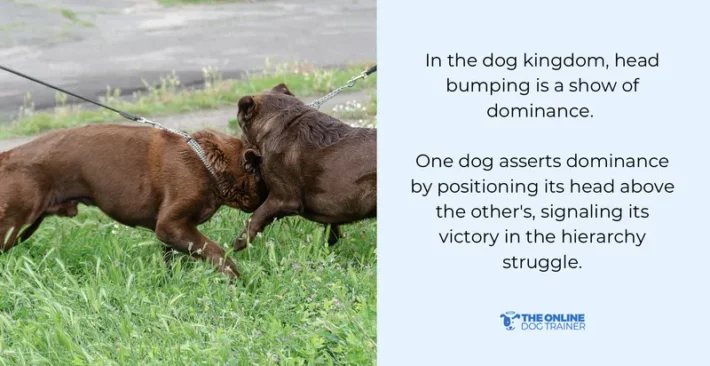
The more they push back, the more they're communicating “No, I AM THE BOSS not you.”
Circling Around and Attacking Forward
When a dog circles another, it's an act of assessing their opponent.
Circling allows them to size up the competition, anticipate movements, and potentially find an advantage in a confrontation.
A dog who circles around strategizes on how they can completely cement their position as the leader.
When a bossy dog attacks forward, it usually occurs when they feel their authority or dominance is being questioned or threatened.
FREE WEB CLASS TO REVERSE REACTIVITY IN YOUR DOG IN JUST A WEEKDog Body Language: When A Dog Or a Puppy is Being Dominant
Dog owners, do you wonder if your dog is capable of asserting their dominance over you?
They can and do!
Some of the signs that your dog is showing dominance over you include them refusing to come when called, persistently climbing onto your bed and couch despite your objections, or displaying aggression towards you or a family member.
Recognizing these signs is crucial because they show that you have potentially lost control of your dog.
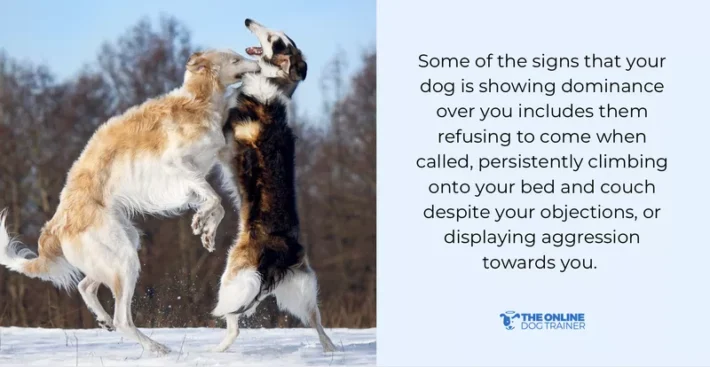
And when you lose control over a dominant dog, it can be the start of difficult behavior issues.
So, how can you prevent these issues from escalating?
There are four signs that you should 100% watch out for.
#1: Invading Your Space
Picture this: dogs encroached upon your personal space, freely climbing onto your bed without an invitation, perching on your head, or occupying your lap without consent.
It might sound sweet at first (“Yay, my dog wants me!”), but they are actually very subtle ways of dogs taking over the leadership. Even a dog lying on your feet is actively expressing dominance. (This shocks a lot of pet owners!)
And the more your dog invades your space, the more they start to think, “I can do anything because I'm the one in charge here.”
#2: Growling at You
When dogs growl at you, it's a significant sign. This is because growling can be a precursor to an attack.
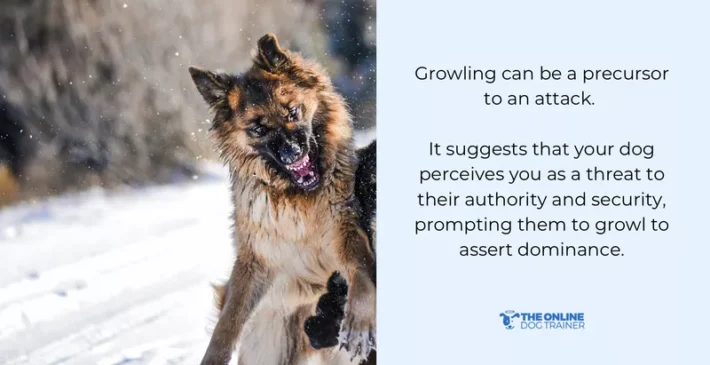
It suggests that your dog perceives you as a threat to their authority and security, prompting them to growl to assert dominance. Whether you have a territorial dog or a fearful dog, growling should be taken seriously.
#3: Ignoring Your Commands and Making The Decisions
You call your dog, but there's no response.
You command them to stop, but they disregard your instructions.
Regardless of how loudly you may shout, they simply do not heed your words.
It's a silent but powerful way of letting you know, “Why should I listen to you?”
Dogs take matters into THEIR OWN PAWS, making decisions without waiting for your input.
They decide when to eat food, nudge you for cuddles, or fetch their leash to signal their desire for a walk. These actions may seem harmless, but they slowly build into a wrecking ball that eventually crushes your control.
Once these signs become evident, it's essential to regain control. I am sharing the powerful strategies for training bossy dogs I've learned from my experience. Read on below.
FINALLY… A FREE WEB CLASS THAT ENDS THE STRESS OF OWNING A DOMINANT DOGTraining a Dominant Dog: 6 Best Strategies to Stop Dominant Dog Aggression
#1: Start in the Home
The journey of teaching your dog essential lessons begins right at home, and it's an indispensable starting point. Your dog's environment greatly influences their success at overcoming aggression.
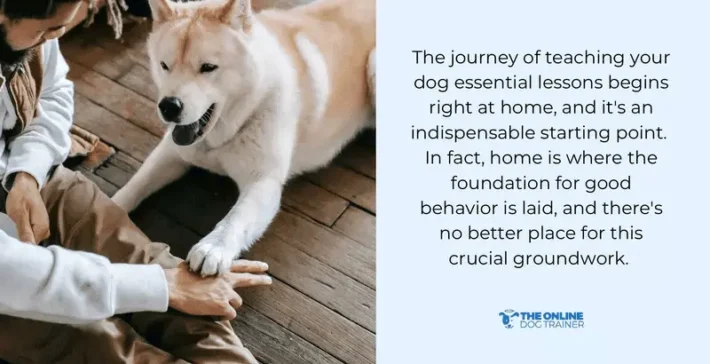
In fact, home is where the foundation for good behavior is laid, and there's no better place for this crucial groundwork.
By focusing on your dog's behavior within the home environment, you'll be better equipped to help them become less aggressive when they venture outdoors.
#2: Learn the Five Golden Rules of Doggy Dan Through the Dog Calming Code™️ Program
In my years as a dog trainer, I have seen how even the most bossy, authoritarian dogs turn into calm dogs who learn how to listen and chill.
These transformations inspired me to make the Dog Calming Code program featuring the Doggy Dan Five Golden Rules.
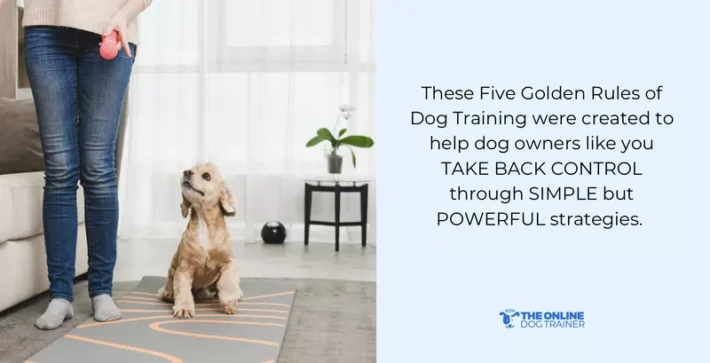
These Five Golden Rules of Dog Training were created to help dog owners like you TAKE BACK CONTROL through SIMPLE but POWERFUL strategies around gentle, and calm leadership.
Here's a quick preview of how you're going to achieve leadership in your bossy dog's eyes through the Dog Calming Code.
Doggy Dan Golden Rule #1: Control the Food
Your bossy dog has to know that you control the food and everything that comes with eating: mealtimes, scraps, eating habits.
Food is HUGE for dogs, and the one who controls the food is the one who is in charge.
Doggy Dan Golden Rule #2: Delay Attention
After separation, your dog will challenge your leadership by going to you. This rule teaches dog owners the power of delaying acknowledgement to establish leadership, just like leader of the pack would.
Doggy Dan Golden Rule #3: Doing Things On Your Own Terms
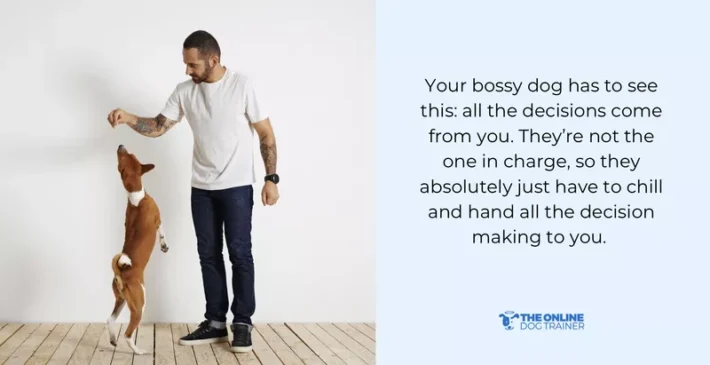
Your bossy dog has to see this: all the decisions come from you. They're not the one in charge, so they absolutely just have to chill and hand all the decision making to you.
Doggy Dan Golden Rule #4: Deal with Danger
A dominant dog who thinks they're in charge will always call out danger (thus the barking!). Rule #4 is about helping you become that calm, confident, CAPABLE leader who knows how to say to dogs “I am the one in charge here, so I take care of danger.”
Doggy Dan Golden Rule #5: Take Control of the Walk
Controlling dog aggression should not just stop at home. Even while you are outdoors, your dog has to know you're in charge. This keeps them from challenging other dogs because they know it's you who is the leader. Rule #5 makes this possible.
JOIN OUR FREE CLASS AND CALM YOUR DOMINANT DOG FOR GOOD#3: Be Calm
No one earns a dog's affection even more than a caring dog owner who's also sure and firm in their role as the pack leader.
A dog who knows their owner isn't one to chicken out easily, they'll see your authority.
However, if you're not taking control, they will sense your emotions, including fear and worry about them.
By remaining confident and not easily fazed, you establish yourself as the dependable leader your dog can trust and follow.
#4: Protect Your Space and Don't Let Your Dog Make The Decisions
Your personal space is important, and your dog understands that. When they invade your space without invitation, it sends a clear message that they can boss you around.
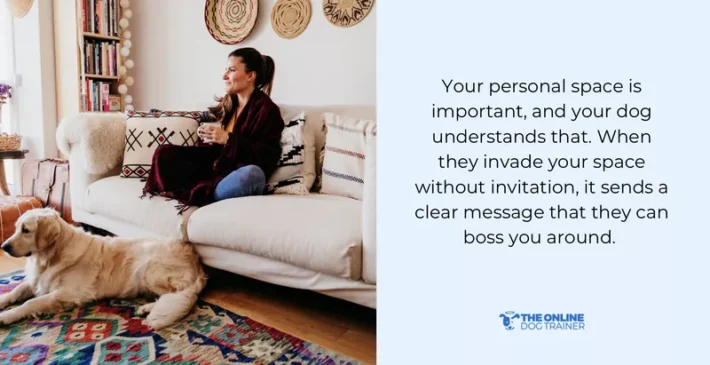
To maintain your authority, protect your space by only giving attention on your terms. This reinforces the idea that your dog has no power over you because YOU are the leader.
Dogs that are given too much freedom to make decisions may start to believe they are in control.
Be resolute in not granting your dog decision-making privileges. It's you who leads them, and you have the final say in matters.
#5: Be Firm With Your Rules and Boundaries, But Practice Calm, Consistent Corrections
Dogs may test your authority from time to time, probing to see if you'll bend the rules. Stay steadfast and unwavering in your boundaries.
Consistency is vital in reinforcing the rules you've set.
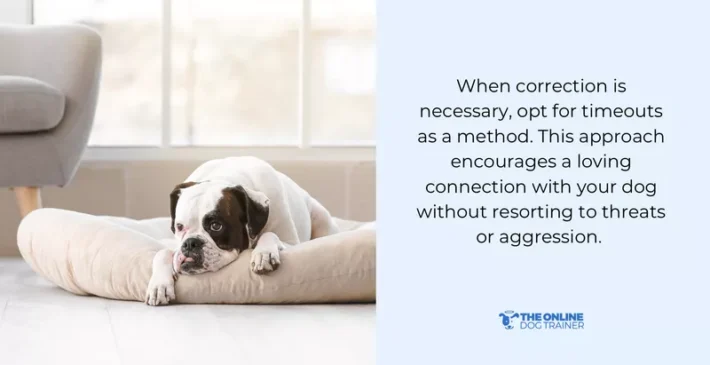
When correction is necessary, opt for timeouts as a method. This approach encourages a loving connection with your dog without resorting to threats or aggression. It reinforces the idea that your relationship is built on mutual respect and understanding.
#6: Socialize Your Dogs and Use Positive Reinforcement Training
One of the most important parts of obedience training is exposing your dogs to proper socialization experiences.
Once you've started letting your dog know they're not the boss, you can start to slowly socialize them with other dogs.
My recommendation as a dog trainer is to start in a place where your dog is comfortable and where they can meet other dogs as their equals.
Dogs are also fast learners. Rewarding good behavior helps your dog understand which behavior to follow. Once they associate rewards good behavior, a pattern will be established.
How To Introduce A New Dog To A Dominant Dog: Observe Neutral Territory For The First Few Weeks

Introducing a new dog to a household with an existing dominant dog requires careful, supervised steps. Begin introductions on neutral location to minimize territorial aggression. Allow the new dog and resident dog to meet one at a time, preferably focusing on the one with territorial behaviors, as they are more likely to fight for hierarchy.
Upon bringing the new dog home, establish separate safe zones (crates or different rooms) for them and the present dog to retreat to, rotating their time in shared spaces. Closely supervise all interactions between the two dogs and intervene immediately at the first sign of tension. Keep play sessions short and within a controlled environment. Maintain consistent routines for feeding, walking, and playtime, reinforcing calm behavior with positive reinforcement. If severe aggression arises, consider consulting a professional dog trainer to ensure a smooth, safe transition for all.
How about adult dogs?
Successfully introducing two adult dogs into your fur family takes patience and a thoughtful approach. Start the first meeting on neutral territory, like a park or a quiet street, for parallel walks. Keep both dogs on leashes, walking them side-by-side but far enough apart that they don't feel threatened. As they become more comfortable, gradually decrease the distance between them. Rushing both dogs is always a bad idea.
During these walks, reinforce positive behavior with treats and praise. Observe how the dogs interact. If they seem relaxed, allow for brief, supervised sniffing sessions. Keep these initial interactions short and positive.
If these meetings go well, you can let dogs loose and move to a securely fenced area (or one with a tall baby gate!) for supervised playtime.
Body language signs to look out for when introducing two dogs:
- stiff-legged gait
- raised fur
- overly excited jumping
- prolonged stare
- growling
Five Mistakes Dog Owners Make That Cause Dog Dominance
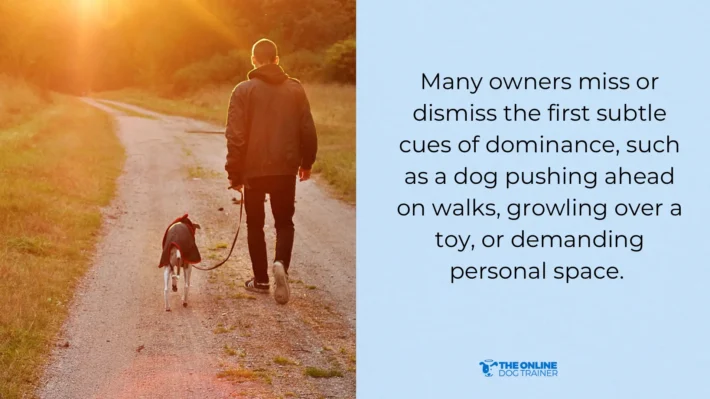
- Ignoring Early Warning Signs: Many owners miss or dismiss the first subtle cues of dominance, such as a dog pushing ahead on walks, growling over a toy, or demanding personal space. Failing to correct these behaviors promptly allows them to escalate and become ingrained.
- Believing Dominance Will Self-Correct: It's a misconception that dominance aggression will just fade with time or that a dog will “grow out of it.” This behavior rarely resolves on its own and often worsens, making it harder to address later.
- Allowing the Dog to Dictate Terms: Letting your dog control household dynamics—like claiming prime spots, deciding meal times, or demanding attention—can lead to them believing they're in charge. This can result in problems like aggression, excessive barking, and leash reactivity.
- Inconsistent Rules and Boundaries: When rules aren't consistently enforced, dogs receive mixed signals. If dominant behaviors are sometimes allowed, it undermines training efforts and reinforces the dog's perception of being the boss.
- Lack of Proper Training: Not establishing a clear and consistent training routine from the outset is a major oversight. Owners often realize too late the importance of being perceived as the leader. A well-structured training program, ideally started early, is crucial to prevent dominant behaviors.
Learn How to Handle Dominant Dog Dominance Issues with the Dog Calming Code
Training your dog to see you as the gentle, trustworthy of your pack requires you to do things right.
Why? Because there are so many small, seemingly insignificant mistakes that can mess up your training.
If you want a training guide for dominant dogs, I encourage you to check out The Dog Calming Code.
I made sure the training instructions are simple for even new dog owners to understand but POWERFUL enough to cover the issues that lead to dog aggression.
Because I believe that dominant, bossy dogs — when trained right — will happily switch off and pass the baton of leadership to you.
And every dog deserves to switch off, relax, and feel “I am not the leader here. I don't need to fight with other dogs. I don't need to be brave and alert all the time. I can absolutely chill!”
That's an absolute gift to your pet.
If you want to learn about the Dog Calming Code, you can check it out here.

~Doggy Dan 🙂




8 Responses
Need help in an aggressive dominant minpin
Check out the free webinar, you’ll love it!
The Reactivity Webinar happens weekly on Wednesday and Sunday at 3pm EST (USA time). The link for the webinar is here, and you can choose this week or the following week: https://theonlinedogtrainer.com/reactivity-ewebinar-register/
If you register, you’ll get the recording via email after the webinar
I have a 7 month old pup who is dominant over my 3 year old dog. Both bitches. My 3 year old is now wary of pup. They play lovely, chase each other round and pretend fight, but then it can turn nasty. Sometimes over nothing but mainly over a toy or a scrap of something. Thinking might have to rehome pup which will break my heart. Have to consider my 3 year old dog as she is now, at times, scared
Check out the free webinar, you’ll love it!
The Reactivity Webinar happens weekly on Wednesday and Sunday at 3pm EST (USA time). The link for the webinar is here, and you can choose this week or the following week: https://theonlinedogtrainer.com/reactivity-webinar/
If you register, you’ll get the recording via email after the webinar
Hey, my dog has got aggressive day to day, I mean to say much more aggressive. He starts growling then and now. He has bitten my sister once just when she touched him and asked to go to his place from her room. He grows at me every time when I scold him. Today night he was sleeping and there was a piece of bread lying on side few inches far, as I put my hand to take the bread away without touching him, he tried biting me with full growling behavior. He kept growling, barking with teeths out till I was standing there (He was behind the gate because of which I waa safe). How correct him? Can you please suggest? I am really stressed.
Check out the free webinar, you’ll love it!
The Reactivity Webinar happens weekly on Wednesday and Sunday at 3pm EST (USA time). The link for the webinar is here, and you can choose this week or the following week: http://theonlinedogtrainer.com/reactivity-webinar/
If you register, you’ll get the recording via email after the webinar
My new miniture schnauzer is exhibiting fear & shyness. Will not play or cuddle. What to do?
Hi Kathryn,
It can be a really frightening experience for dogs when they are settling into their new home, & it’s actually really normal for dogs/puppies to behave this way. If your dog seems uneasy or frightened then my advice is to give her so me space, try not to force interactions on her and allow her to simply observe you and her new environment. It can feel a little counter-intuitive to give a new dog space….most people think interactions creates a bond…..but in actual fact, respecting a dog’s right to not interact is a very good thing for them to realise. I would also avoid taking her out for a walk until she is more comfortable and confident….we want to avoid overwhelming her further. She will start to feel more confident in a few days so just take things at her pace. All the Best, Doggy Dan