What is the main difference between reactive and aggressive dog? This blog will help you understand the differences so you won't be left asking “Is my dog really aggressive or just reactive?”
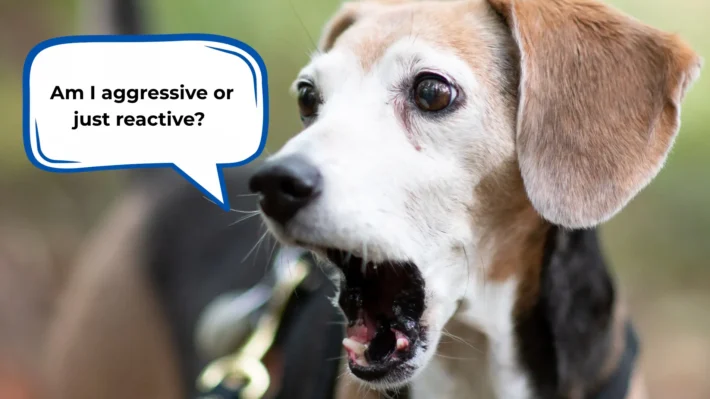
Knowing the difference between a reactive and aggressive dog is the first step toward effective support.
A common misconception is that a barking, lunging dog is “vicious,” when in reality, they may simply be terrified or over-excited.
With over ten years of experience helping more than 100,000 dogs overcome behavioral challenges, I understand that distinguishing between stressful behaviors is rarely black and white.
When a dog begins to bark or lunge, many owners are left wondering: Is this reactivity, or is it aggression? Understanding this distinction is vital for your dog's well-being. In this article, I will guide you through the key differences and equip you with proven strategies to manage and improve your dog's behavior.
Let's jump in!
Key Takeaways
- Reactivity is an emotional “explosion” driven by fear or over-stimulation with no intent to harm, whereas aggression is a functional tool used to resolve a crisis or eliminate a perceived threat.
- Reactive dogs typically recover quickly once a trigger passes and struggle mostly in high-stimulus areas; aggressive dogs have longer “cool-down” periods and show consistent behaviors regardless of the environment.
- Both require “stress bucket” management (distance and barriers), but while reactivity is often solved through positive rewiring (counter-conditioning), aggression requires specialized safety measures like muzzle training and professional intervention.
What Is Dog Reactivity?
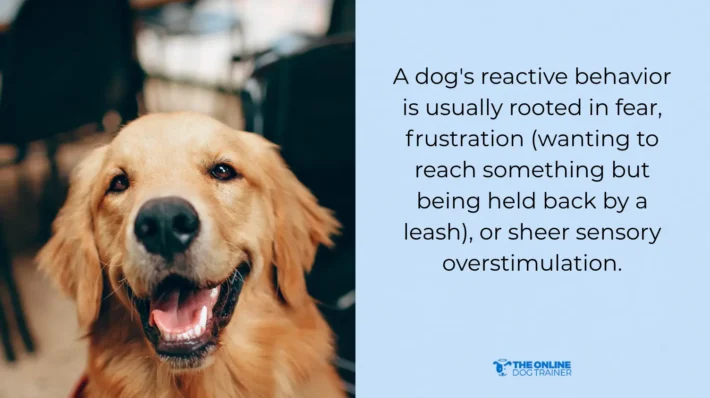
Reactivity is an abnormal or over-the-top response to a normal stimulus. It is an emotional “explosion” caused by a nervous system that has reached its limit. A dog's reactive behavior is usually rooted in fear, frustration (wanting to reach something but being held back by a leash), or sheer sensory overstimulation.
Reactivity can be seen in frantic barking, lunging, whining, or “spinning” when they see a particular trigger. What other dogs see as ordinary, the reactive dog sees it as a big deal! The intent of these reactive outbursts is to create space or release pent-up energy, not necessarily to cause physical harm.
What Is Dog Aggression?
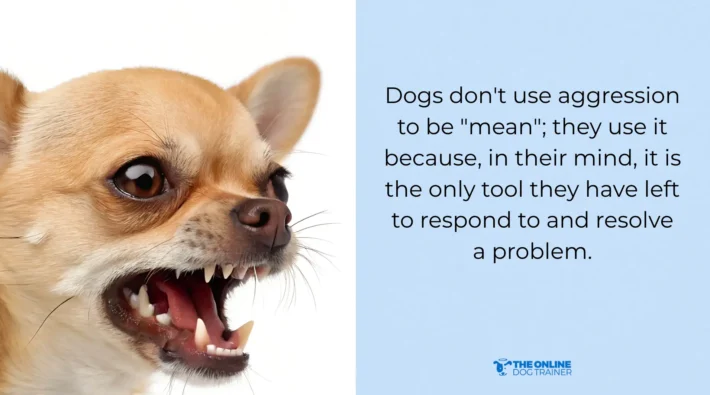
To truly help an aggressive dog, we have to look past the “scary” behavior and identify the function of the aggression. Dogs don't use aggression to be “mean”; they use it because, in their mind, it is the only tool they have left to respond to and resolve a problem.
Here is a comprehensive breakdown of the types of aggression, the specific behaviors they manifest, and how they escalate. To truly help an aggressive dog, we must look past the “scary” behavior and identify the function of the aggression. Dogs don't use aggression to be “mean”; they use it because, in their mind, it is the only tool they have left to resolve a crisis. By categorizing these behaviors into distinct sections, we can better understand the motivation and provide the correct support.
The Core Types of Aggression
A dog's aggressive behavior is usually a symptom of an underlying emotional state. Dog owners, understanding the “Why” dictates the training approach and determines how you manage your dog's environment.
Fear-Based Aggression
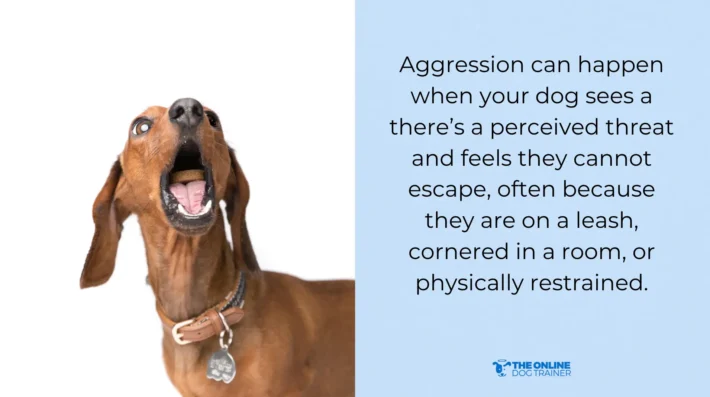
Fear-based aggression is the most common form of aggression. The dog perceives a threat and feels they cannot escape, often because they are on a leash, cornered in a room, or physically restrained.
The Mindset: “I’m terrified, so I will act big and scary to make you leave before you can hurt me.”
Imagine a dog that snaps at a stranger who leans over them to pet their head. The dog isn't being malicious; they are experiencing a panic response because their personal space was invaded and they felt unable to retreat.
Territorial Behavior & Resource Guarding (Defensive Aggression)
This stems from a deep-seated survival instinct to protect valuable “assets” that the dog believes are necessary for their safety or well-being.
The Mindset: “This is mine, and your presence threatens my access to it.”
A dog in a heightened state may lunge frantically at the window only when the mailman walks onto the porch, yet remain perfectly friendly when meeting the same person at a neutral park.
A dog might also “freeze” and growl if you walk near their food bowl or a favorite “stolen” item, like a sock or a bone. They are communicating a boundary regarding their possessions.
Predatory Aggression (Prey Drive)
Unlike other forms of aggression, this is often silent. It is not driven by anger or fear, but by biological fulfillment and the instinct to hunt.
The Mindset: “That moving object is something to be chased and captured.”
This is seen in a dog that intensely stalks, chases, and grabs a neighbor’s cat, a squirrel, or even a fast-moving bicycle. Because this is a high-arousal “hunting” state, it can be extremely difficult to interrupt once the chase has begun.
Social or Conflict Aggression
Sometimes mislabeled as “dominance,” modern behavior science views this more as a lack of social coping skills or high frustration levels.
The Mindset: “I don't like what you are doing, and I will use my teeth to make you stop.”
This often occurs during “handling” moments, such as an owner trying to clip a dog's nails or moving them off a comfortable sofa. The dog uses aggression to resolve a conflict of interest in their favor.
Examples of Aggressive Body Language
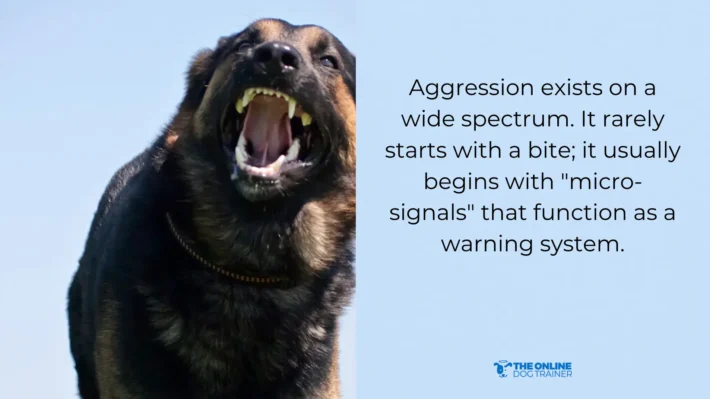
Aggression exists on a wide spectrum. It rarely starts with a bite; it usually begins with “micro-signals” that function as a warning system. Identifying these early can prevent an escalation to physical contact.
The “Hard” Stare
This is a fixed, unblinking gaze where the dog locks onto a target. The dog’s eyes may look “glassy,” and you might see the whites of their eyes, a phenomenon known as Whale Eye. This is a high-intensity signal that the dog is prepared to act to whatever trigger that captured your dog's attention.
The Low Growl
A vibrating sound produced deep in the chest. While many owners find this scary, a growl is actually a good thing—it is a clear, honest communication that says, “I am uncomfortable; please stop what you are doing.” Punishing a growl often leads to a dog that bites without warning.
Snarling (The Lip Curl)
This is a vertical lift of the upper lips to expose the canine teeth. It is a purely visual “Keep Out” sign. It serves as a final warning that the dog’s patience or tolerance has been exhausted.
Snapping (Air Snapping)
In this snapping behavior, the dog bites the air near the target but deliberately avoids making contact. This is a “warning shot.” It indicates that the dog is trying very hard not to bite the person or animal, but is signaling that they will do so if the threat does not retreat.
The Full-Contact Bite
This is the final stage of the aggression cycle. Bites are measured by the Ian Dunbar Bite Scale, ranging from a “nip” (Level 1–2, no skin broken) to a deep puncture with tearing or multiple bites (Level 4–5).what you are doing (like clipping my nails), and I will use my teeth to make you stop.”
- Example: A dog that snaps at an owner when they try to move the dog off the sofa.
Key Behavioral Differences Between Reactive and Aggressive Dogs
| Feature | Reactive Dogs | Aggressive Dogs |
| Intent | Driven by big feelings (anxiety/excitement). No inherent goal to bite. | Driven by a goal to eliminate a threat or control a resource. |
| Triggers | Often specific stimuli (bikes, hats, dogs). Usually calms when the trigger leaves. | May persist or search for the trigger even after it has moved away. |
| Body Language | High arousal, “trance-like” staring, frantic movement. | “Hard” unblinking stare, stiff “freeze,” lowered head, or lip curls. |
| Intervention | Often redirected with high-value treats or a change in direction. | Highly difficult to redirect; often requires physical barriers and expert intervention. |
Reactivity vs. Aggression: Determining the Difference
Recovery Time and Refractory Periods
The hallmark of reactivity is a quick recovery.
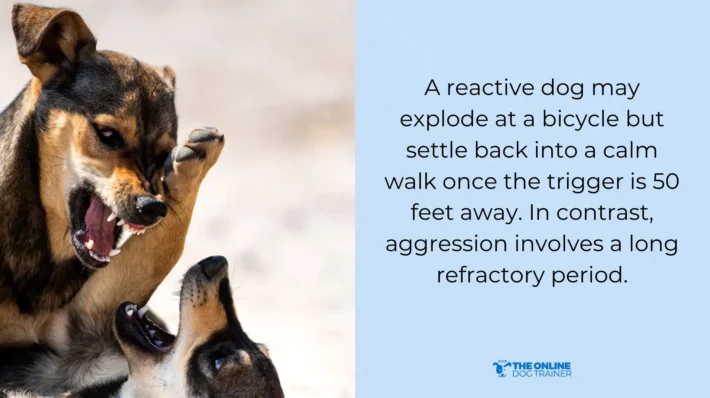
A reactive dog may explode at a bicycle but settle back into a calm walk once the trigger is 50 feet away. In contrast, aggression involves a long refractory period.
An aggressive dog may continue to lung, pace, or growl for ten minutes after a “threat” has left, indicating a persistent intent to drive the trigger away.
Professional Assessment for Reactivity and Aggression
Distinguishing between “barking to keep the world away” and a genuine intent to harm is complex.
A Certified Applied Animal Behaviorist (CAAB) uses controlled temperament tests to identify whether a dog is acting out of “leash frustration” or true “fear-aggression.”
Professional insight is the safest way to determine if a dog is trying to close the gap for physical contact.
Environmental Context
The environment acts as a “volume knob.”
Reactive dogs typically struggle only in high-stimulation “noisy” environments, like busy city sidewalks, and may appear perfectly calm in a secluded field.
Aggressive dogs show directed behaviors regardless of the setting. Resource guarding or territorial aggression will manifest even in a quiet, controlled home.
Addressing Reactive Behaviors
Environmental Management For Reactive or Aggressive Dogs
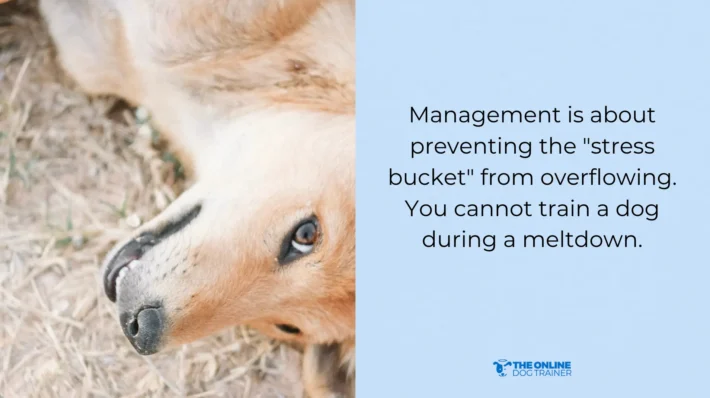
Management is about preventing the “stress bucket” from overflowing. You cannot train a dog during a meltdown. Use visual barriers (frosted window film) and escape blocks (hedges or parked cars) to keep your dog below their threshold. This ensures they remain in a state where they are actually capable of learning.
The Science of Desensitization
This process involves exposing your dog to triggers at such a low intensity—usually through great distance—that they notice the trigger but do not react. Over months, you slowly decrease that distance, “toughening up” the nervous system until the trigger becomes boring background noise.
Counter-Conditioning
While desensitization handles distance, Counter-Conditioning rewires the internal emotion. By immediately pairing a trigger with a high-value reward (like chicken), you change the dog's reflex from “I'm scared” to “Where's my treat?” This positive emotional shift is the key to long-term healing.
Addressing Aggression in Dogs
Safety and Muzzle Training
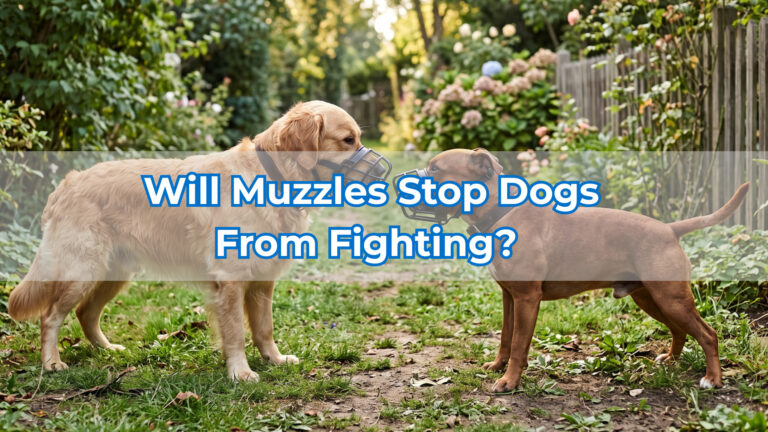
Muzzle training is a vital act of love. A well-fitted basket muzzle allows a dog to pant and take treats while preventing a “bite record.” It removes the physical risk, allowing the handler to stay calm and focused during training exercises.
Veterinary Behaviorist
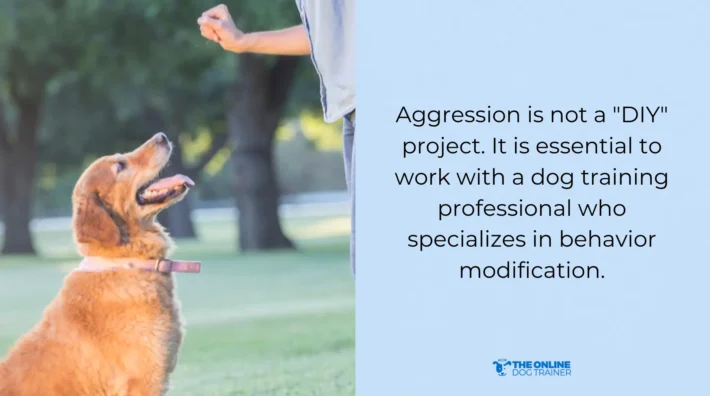
Aggression is not a “DIY” project. It is essential to work with a dog training professional who specializes in behavior modification. They identify the emotional root of the aggression and ensure you don't misread subtle signals that could lead to a bite.
The Danger of Punitive Methods
Avoid using force, prong collars, or shock collars. If a dog is aggressive because they are afraid, punishment confirms the world is dangerous. Punishing a “warning” (like a growl) is particularly hazardous, as it can teach a dog to skip the warning and go straight to a bite.
The Ultimate Reason For Your Dog's Reactive and Aggressive Behavior
Most dog owners find themselves trapped in a cycle of endless “sit,” “stay,” and “heel” commands, yet the moment a stranger walks by, the training evaporates into lunging and barking. This happens because most traditional methods treat the symptoms rather than the root cause.
True behavioral change doesn't come from drilling commands; it comes from addressing the biological instincts of the dog. Reactivity and aggression are rarely “bad” behaviors—they are symptoms of a dog that lacks a clear leader. When a dog doesn't perceive a calm, capable decision-maker at the helm, their instinct compels them to take over. They aren't trying to dominate you; they are trying to ensure the pack’s survival.
The Stress of the Security Detail
When a dog assumes they are in charge, they inherit a massive amount of responsibility. In their mind, they have been promoted to Chief of Security, a role they are often ill-equipped to handle. This self-appointed promotion manifests in ways that owners find frustrating: hyper-vigilance, proactive protection of the “pack,” and territorial guarding of the home.
This isn't just a behavior problem; it’s a quality-of-life issue. Living as a constant guardian is incredibly stressful. A reactive and aggressive dog is often just an overwhelmed dog who is struggling under the weight of a job they were never meant to have.
The Shift: Connection Over Command
To transform your dog’s behavior, you must move away from “drilling” and toward psychological alignment. The goal is to shift the dynamic until your dog fundamentally understands that you are the primary decision-maker. When you are the one who decides if a situation is safe, your dog is finally allowed to “clock out” of their security job.
This shift requires consistency. A true leader isn't manipulated by whining or nudging; they serve as a calm, steady anchor. When the bond is built on this level of trust, your dog obeys because they value your judgment, not because they are afraid of a correction.
Mastering the Dog Calming Code
To bridge the gap between human logic and canine instinct, we utilize the Five Golden Rules—the core of The Dog Calming Code. This isn't about using force or “showing them who's boss.” Instead, we use subtle, non-verbal communication to signal that you are in control of the environment.
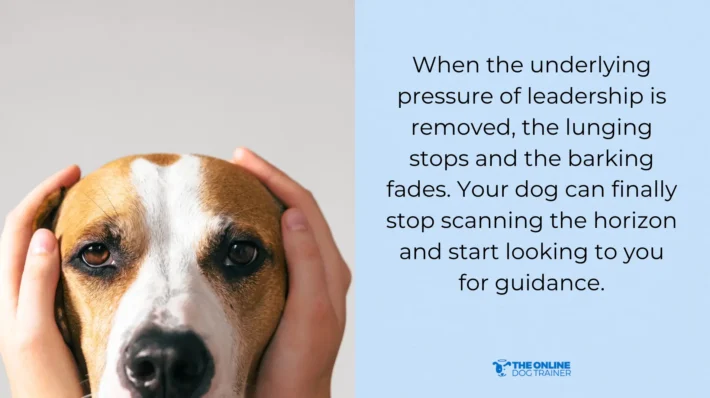
By addressing the essentials—specifically how you handle resources, perceived dangers, and pack hierarchy—you effectively empty your dog's “stress bucket.” When the underlying pressure of leadership is removed, the lunging stops and the barking fades. Your dog can finally stop scanning the horizon and start looking to you for guidance.
Conclusion
Whether your dog has “big feelings” or “protective intent,” they aren't being difficult—they are having a hard time. Patience, distance, and understanding are the foundations of improvement. There is no shame in a dog that struggles, and great wisdom in seeking help.

~Doggy Dan 🙂