A walk can turn into a real disaster the moment your dog starts to bark and lunge at almost everyone and everything you meet. If this behavior makes it a painful struggle to bring your dog outside, the reactive dog training tips featured here will bring back hope.
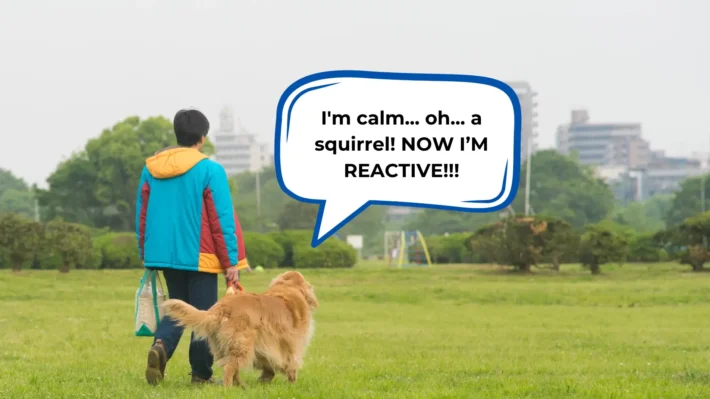
If your dog becomes uneasy and defensive on a walk, does it mean they’re aggressive? The quick, assuring answer is no.
Most of the time, lunging and barking are driven by reactivity, not really by the desire to cause harm. However, when you don't address this and take control of the situation, things can go awry fast.
Reactivity is an overreaction to a stimulus—a “big feelings” moment where a dog feels frustrated or fearful. Aggression, on the other hand, is a deliberate intent to harm or intimidate. While they look similar, the motivations are worlds apart.
If your dog is chill off leash but stressed when harnessed in, you aren't alone in this struggle. A study found that 31% of pet dogs exhibit leash reactivity.
If you want to stop your dog from turning from a reactive pup into an uncontrollable, aggressive dog, this blog is for you. I am combining my decades’ worth of actual training knowledge to provide:
- Understanding triggers and reactivity thresholds.
- Proven techniques to redirect your dog’s attention.
- Recommendations for the right gear for a stress-free walk.
Let's transform your outdoor experience from a source of anxiety into a moment of connection. Let's dive in.
Key Takeaways
- In the dog training world, reactivity isn't “bad” behavior; it’s a communication of fear or frustration. Whether a dog is scanning for threats or struggling against a leash, they are often overreacting because they feel they must protect themselves and their owner, rather than trusting a leader to handle the situation.
- Effective certified professional dog training focuses on becoming a “trustworthy leader” before even leaving the house. By implementing consistent rules and remaining a calm presence, you signal to your pet that they are not in charge of the world's dangers, allowing their hyper-vigilance to fade into relaxation.
- Training dogs effectively requires equipment that prioritizes comfort over force. Choosing a front-clip harness instead of restrictive collars ensures that only dogs who feel physically secure and unthreatened can truly focus on their owner’s guidance, turning stressful walks into peaceful, bonding experiences.
What Is a Reactive Dog?
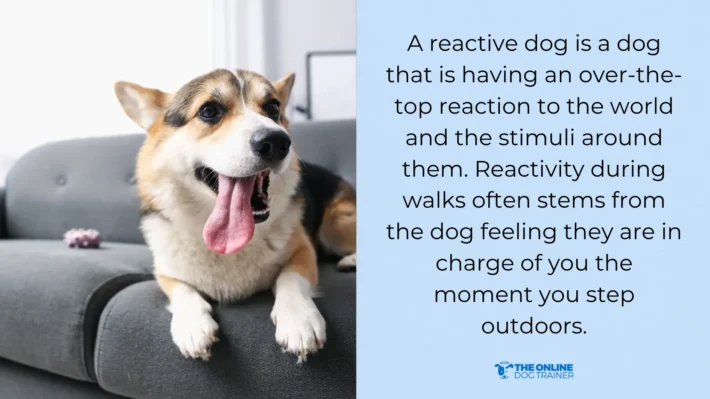
A reactive dog is a dog that is having an over-the-top reaction to the world and the stimuli around them. Reactivity during walks often stems from the dog feeling they are in charge of you the moment you step outdoors.
When a dog feels responsible for protecting both you and themselves, they enter a state of hyper-vigilance. In this guard mode, they are constantly scanning for danger, making them overreact to things that might seem harmless to us.
What you perceive as ordinary parts of the neighborhood can be your reactive dog's triggers.
Because they are always on the edge, their internal alarm system is hair-trigger sensitive. A simple rustle in a grass patch, a child on a skateboard, or a calm dog passing on the other side of the street can elicit an extreme physical reaction—barking, lunging, or freezing—as your dog desperately tries to manage a situation they feel they must control.
Common Behaviors of A Dog With Leash Reactivity
To help you visualize what these behaviors look like in a real-world setting, here are specific examples for each. By recognizing these early, you can step in as a leader before your dog reaches the “point of no return.”
Barking and Growling
- You’re walking your Golden Retriever, who is normally a “social butterfly” at home. Suddenly, a neighbor’s dog appears a block away. Your dog begins a deep, frantic bark that sounds almost scary.
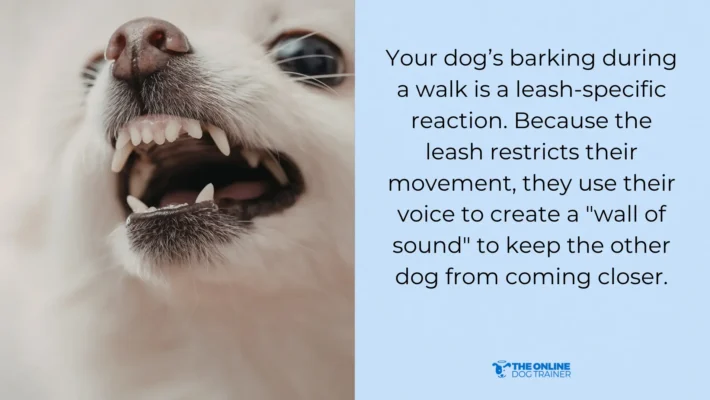
- This is often a leash-specific reaction. Because the leash restricts their movement, they use their voice to create a “wall of sound” to keep the other dog from coming closer.
Lunging
- A squirrel darts across the sidewalk. Your dog suddenly throws their entire body weight forward, front paws off the ground, straining against the harness until the leash is taut.
- Your dog is trying to close the gap to reach an exciting distraction or, conversely, trying to “scare off” a threat by looking as big and intimidating as possible.
Freezing or Stiffening
- You see a person in a high-visibility vest approaching. Your dog stops dead in their tracks. Their tail is held rigid, their ears are pricked forward, and they are staring intensely—almost like a statue.
- This is the Alert phase. Your dog is loading up like a spring. They are assessing the threat, and if you don't redirect them now, a lunge or bark is usually only seconds away.
Whining
- You’re waiting at a crosswalk, and another dog is waiting on the opposite corner. Your dog isn't barking, but they are letting out high-pitched, frantic whines while shivering.
- This is frustration-based reactivity. Your dog desperately wants to get to the other dog to say hello (or investigate), and the physical barrier of the leash is causing them genuine emotional distress.
Stress Signals
- After a delivery truck rattles past, your dog begins panting heavily (even though it’s a cool day), starts licking their lips repeatedly, or begins walking in tight, agitated circles.
- These are proof of your dog's internal anxiety. Your dog’s body is trying to process the adrenaline and cortisol from the “scary” event. They are tell-tale signs that your dog has moved out of a calm state and needs a break.
Different Types of Triggers
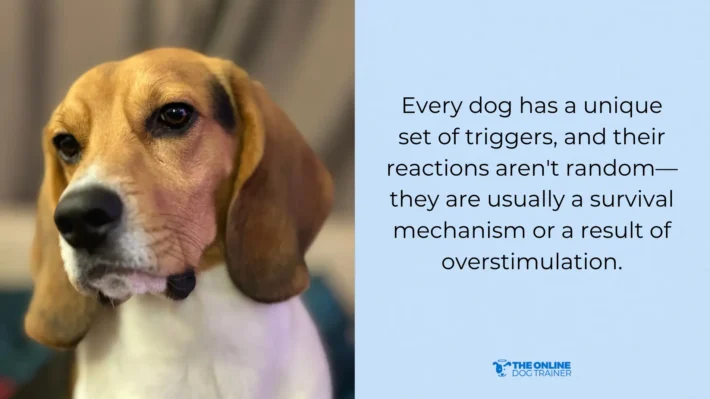
Every dog has a unique set of triggers, and their reactions aren't random—they are usually a survival mechanism or a result of overstimulation.
Here is why your dog might be reacting to these common triggers:
Other Dogs
- Stiffening, lunging, or frantic barking are just some signs your dog may exhibit when another dog enters their line of sight.
- Why does your reactive dog do this? On a leash, your dog’s natural social etiquette is broken. Usually, dogs approach each other in a curve to show they aren't a threat. On a leash, they are forced into a head-on approach, which feels like a standoff. They react to keep the other dog away because they feel trapped and unable to use their “flight” option.
People
- Your dog is triggered by people if you see them growling or backing away from strangers, children, or people in unusual gear like hats, sunglasses, or bulky uniforms.
- Why does your reactive dog react like this? Your dog relies heavily on reading human facial expressions and body language. When someone wears a large hat or a backpack, it changes their silhouette, making them look “un-human” or unpredictable. Children are also a major trigger because they move erratically and make high-pitched noises, which can trigger a dog's herding instinct or fear of the unknown.
Vehicles or Bikes
- Your reactive dog will be chasing after cars, snapping at cyclists, or lunging at skateboards and scooters if these things trigger them.
- This is often driven by prey drive. Fast-moving objects “flip a switch” in a dog’s brain that says Chase! If they are on a leash and can’t catch the object, that excitement turns into intense frustration, leading to a reactive explosion.
Environments
- If your environment causes stress to a reactive dog, you will see General agitation, inability to take treats, or constant scanning of the surroundings in loud, busy, or unfamiliar areas.
- Just like some people get anxious in a crowded, noisy mall, dogs can become overwhelmed by “stacking” triggers. A noisy garbage truck plus a gust of wind plus a strange smell can push a dog’s stress levels over their limit, making them feel unsafe and defensive.
Fear-Based vs. Frustration-Based Reactivity
Understanding the motivation behind the behavior is the lightbulb moment for most owners. While a bark is a bark, the emotion driving it changes how we handle the situation. I always teach dog owners that identifying these drivers is the first step toward reclaiming their role as a trusted leader.
Fear-Based Reactivity
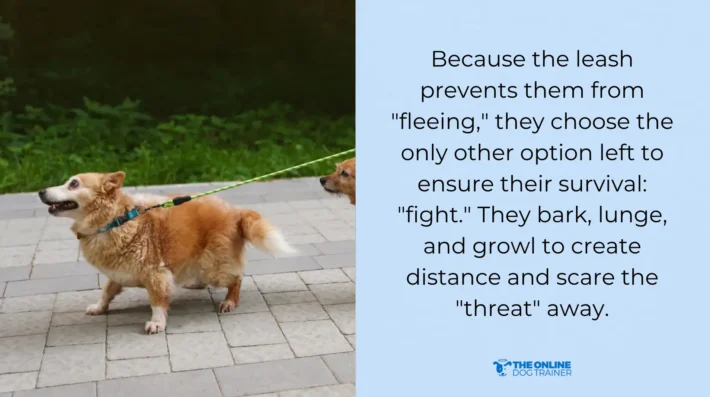
This happens when a dog feels threatened or unsafe. Because the leash prevents them from fleeing, they choose the only other option left to ensure their survival: fight. They bark, lunge, and growl to create distance and scare the “threat” away.
Imagine you’re walking your rescue dog, Cooper. A large, barking dog appears behind a fence. Cooper’s tail tucks, his ears pin back, and he begins lunging toward the fence with a frantic, high-pitched bark.
Cooper isn't being “mean.” In his mind, he is saying, Stay away from me! I’m dangerous! because he feels cornered by the leash. He believes that if he acts scary enough, the threat will leave him alone.
Frustration-Based Reactivity
This is common in highly social dogs who actually love people and other animals. They become frustrated because the physical barrier of the leash prevents them from reaching the fun thing they want to greet. This build-up of energy eventually explodes into a vocal and physical outburst that can look identical to aggression.
Your friendly Labrador, Daisy, sees her best friend (the neighbor’s dog) across the street. She wants to play, but you hold the leash tight. Daisy begins to whine, then starts spinning and barking loudly at the other dog while pulling you toward them.
Daisy isn't trying to attack; she’s throwing a “canine temper tantrum.” Her brain is overloaded with excitement, and since she can't reach her goal, that energy has nowhere to go but out through her lungs and muscles.
Why Is Your Dog Reactive?
If you’ve ever felt like you’re at the end of your rope—literally and figuratively—while your dog is having a meltdown on the sidewalk, you know that reactivity feels less like a training issue and more like an exhausting daily battle.
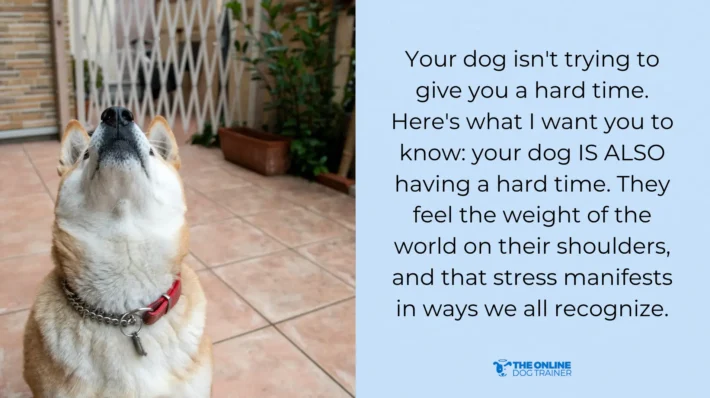
Your dog isn't trying to give you a hard time. Here's what I want you to know: your dog IS ALSO having a hard time. They feel the weight of the world on their shoulders, and that stress manifests in ways we all recognize.
If your dog can only speak, they'd probably say, “Help me, I'm also freaking out.”
Let's help your dog by becoming familiar with the top reasons influencing your dog's behavior.
Your Dog Lacked Early Socialization
You feel guilty because your puppy or your rescue didn't get to meet enough people during that critical 8-to-16-week window. This is why a good dog trainer will emphasize the importance of proper socialization early on.
Without socialization, every trash can moved to the curb, or a person wearing a floppy hat looks like a monster. Because their brain didn't learn that's normal early on, it defaults to thinking everything is dangerous to keep them safe.
They Have Trauma
You adopted a dog to give them a better life, but they brought along a suitcase of bad memories. As a dog trainer, I have seen fur parents training reactive dogs without considering their dog's history.
Suppose your rescue was once lunged at or attacked while on a leash; they’ve developed a permanent association with that experience. To them, the leash isn't a tool for a fun walk but a trap that makes other dogs a threat. Their reactivity is just them trying to make sure it never happens again.
Breed Predispositions
You love your Border Collie or German Shepherd, but you can't understand why they want to chase every passing cyclist.
Here's a quick disclaimer before I go to my explanation: not all reactive and aggressive dogs are genetically predisposed to have challenging behaviors. However, genetics can play a big role.
You can’t out-train genetics overnight. Herding breeds are hardwired to notice and stop movement (like those fast-spinning bike tires), and guarding breeds are biologically programmed to alert you to intruders on your path. In our eyes, they're being mean. However, your dog simply thinks they're doing their job.
They Don't See You As The Leader
You treat your dog like a furry family member (because they are!), but they seem constantly on edge, pacing the windows and scanning the street. You believe most dogs calm down when they're given attention, but it isn't the case for your pet.
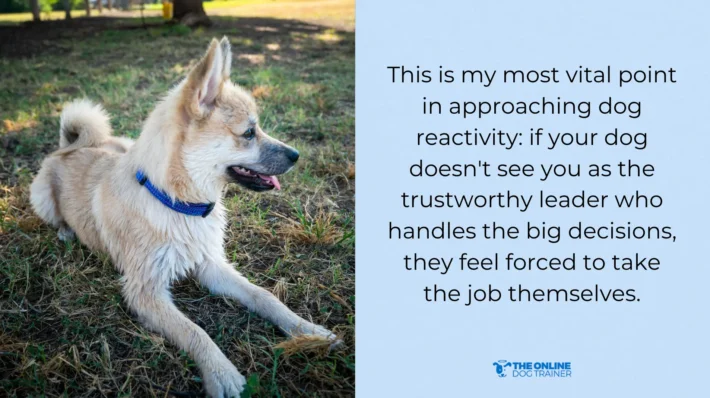
This is my most vital point in approaching dog reactivity: if your dog doesn't see you as the trustworthy leader who handles the big decisions, they feel forced to take the job themselves. They exhibit reactive behavior and become hyper-vigilant because they believe they are the ones responsible for keeping the family alive. It’s a stressful job, and it’s why they overreact to every potential threat.
This problem is what made me create The Five Golden Rules of Dog Leadership. The rules aim to help dog owners transform their reactive dog into a good dog through actions that tell their dog, “Listen to me. You can trust me.”
Your Stressed Energy
You see a trigger appears, and your heart starts racing, you wrap the leash tightly around your hand, and—sure enough—your dog explodes.
As a professional dog trainer for reactive dog training, I always make dog owners understand that their dog is a master energy reader. When you tighten that leash and hold your breath, you are telegraphing a message straight down the line: “I'm scared, something is wrong, get ready to fight!”
Your dog's behavior is a reflection of the tension they feel coming from you.
Why Are Dogs Behaved At Home But Reactive Outside?
Have you ever wondered why your dog is an angel in the backyard but a nightmare on the sidewalk?
On a leash, a dog’s natural flight option is gone. Since they can't run away, they choose the only defense left: a loud, scary fight response to keep the threat at a distance.
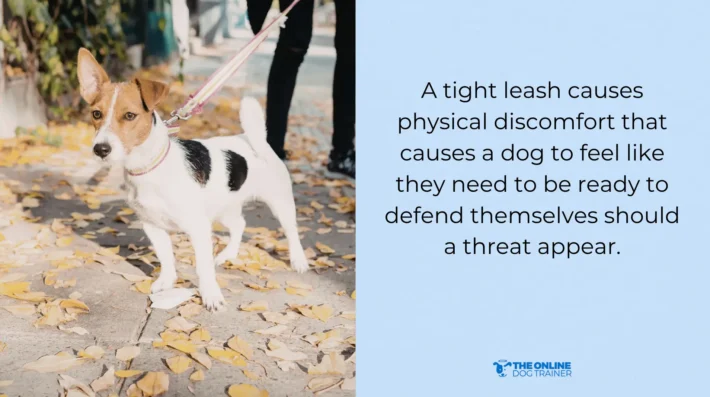
A tight leash causes physical discomfort that causes a dog to feel like they need to be ready to defend themselves should a threat appear.
In urban areas, these triggers (trucks, strangers, dogs) are constant. Without a way to decompress, the dog’s stress levels stack until they explode.
How To Stop Dog Leash Reactivity and Experience A Relaxing Walk
Tip #1: Show Them You're The Leader Before You Go Out The Door
It’s so tempting to grab the leash the moment those tail wags start. However, don't forget to intentionally stay calm. True leadership begins before you even step outside. By setting a consistent schedule and staying calm while they’re excited, your dog sees that you are in charge of the adventure. This quiet confidence is the first step in easing their reactivity.
Tip #2: Honor Their Energy
When your dog is overwhelmed, pushing through only adds fuel to the fire. If a reactive moment happens, stop. Take a breath. Your dog needs to feel that you’ve got this handled. Give them the space they need to find their “calm” again before moving forward.
Tip #3: Be Patient
Patience is a gift you give your dog. Start in the quietest spots you can find—a sleepy street or a vacant park. As their confidence grows, you can slowly introduce more “busy” environments. There’s no rush; healing happens at its own pace.
Tip #4: The Power of the Pause
True leadership means being the vigilant eyes and ears for your dog. Pay close attention to the subtle shifts in your dog’s body language—the stiffening of the tail, the pinning of ears, or a fixated stare.
When you see that tension building, remember that you are the one in charge of this journey. You don’t have to feel pressured by the path ahead or by what other walkers might think.
I also encourage dog owners not be scared of completely calling off the walk if the behavior becomes uncontrollable.
By choosing to take a detour or a total break, you are asserting your role as a calm, capable leader. By stepping back, you are managing the environment so your dog doesn't have to. Doing this tells your dog, “Hey, I see you're being reactive. I'm going to show you I'm in control. I want you to calm down first.”
This simple act of stopping proves to your dog that you are aware of their struggle and, more importantly, that you’ve truly got everything under control.
When they see you handling the stress for them, they can finally begin to relax and trust your lead.
Tip #6: Asking Other Owners To Give You Space
Don't be afraid to advocate for your pup! A simple, polite word to other owners—”We're training right now, could we have some space?”—goes a long way in keeping the environment safe and stress-free.
If your dog shows a reactive response to another dog, don't be afraid to let other dog owners know that you'd like to maintain a safe distance.
Tip #7: Lead with a Gentle Heart
Remember, your dog is struggling. They are asking for your help. Approaching training with kindness rather than punishment lowers their anxiety and strengthens your bond. I want to emphasize that punishments break trust, and if your dog doesn't trust you, training them may not be as effective.
Don't hesitate to give positive reinforcement like giving them a kind encouragement or a special treat!
Choosing the Best Equipment for a Leash Reactive Dog
Finding the right tools can assure you that you're providing comfort and safety for a dog that is already feeling anxious. Here is how to select gear that supports a calm, guided walk.
Prioritize Gentle Guidance Over Force
When dealing with reactivity, your choice of leash and collar is vital. It is best to choose a standard 5-to-6-foot leash made of durable nylon or leather, paired with a high-quality harness.
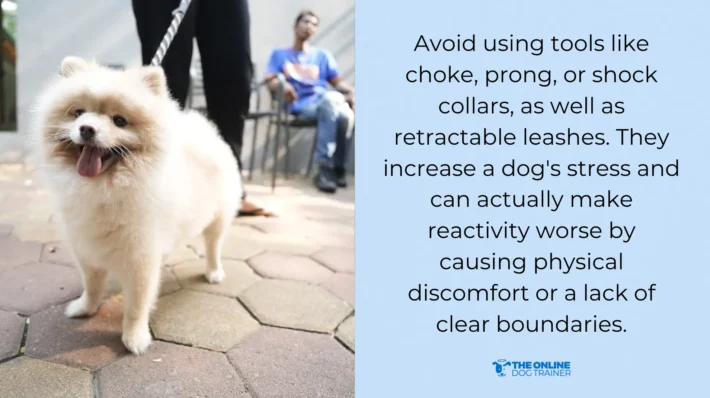
Avoid using tools like choke, prong, or shock collars, as well as retractable leashes. These options often increase a dog's stress and can actually make reactivity worse by causing physical discomfort or a lack of clear boundaries. Your dog needs to feel secure, not restricted or punished.
The Strength of a Front-Clip Design
For the most effective management, look for a body harness that clips at the chest rather than on the spine. A front-clip design gives you much better leverage and strength, allowing you to gently redirect your dog’s focus away from triggers. Because the point of contact is at the front, it naturally guides their body back toward you, making it easier to lead them through a tense moment.
Comfort That Leads to Calm
A specialized No-Pull Harness is an excellent choice for dogs prone to reactivity. Using a front chest loop discourages pulling by aligning your dog’s movement with your own—all without causing them any pain. This allows you to keep a loose leash as much as possible.
The Doggy Dan No-Pull Harness, in particular, is designed with your dog's well-being in mind. Unlike traditional harnesses that can press against the throat, this one rests securely across the chest. This ensures your dog never feels constricted or trapped. When a dog feels safe and unhindered, they are far less likely to react out of fear or frustration, allowing you to stay firmly in charge of a peaceful walk.
Want To End Leash Reactivity For Good? Get The Help Of An Experienced Trainer
Whether you are dealing with a reactive pup or one showing signs of aggression, the experience is stressful. It is heartbreaking to feel like your bond is being tested every time you step outside.
You might be wondering, “Is there actually hope for my dog?”
While other behavior modification experts might encourage you to use force and hurtful tools, I am here to remind you that gentle leadership CAN CHANGE THE CAME.
I want you to know that the answer is a resounding yes; yes, your dog can change. I have witnessed a beautiful transformation in thousands of owners who reached out for professional help to understand their dog’s behavior, especially with leash reactivity.
The secret lies in understanding dog psychology and learning how to truly shift how they feel inside.
When your dog knows they can rely on you, their anxiety and over-excitement begin to fade. They finally let you “handle the show,” and the leash stops being a source of panic for them.
I share this exact formula in my online program, The Dog Calming Code. Together, we dive deep into the Five Golden Rules of dog leadership so you can lead with kindness and help your dog break free from the weight of leash stress. This is where the journey to a calm, happy life begins.

~Doggy Dan 🙂