
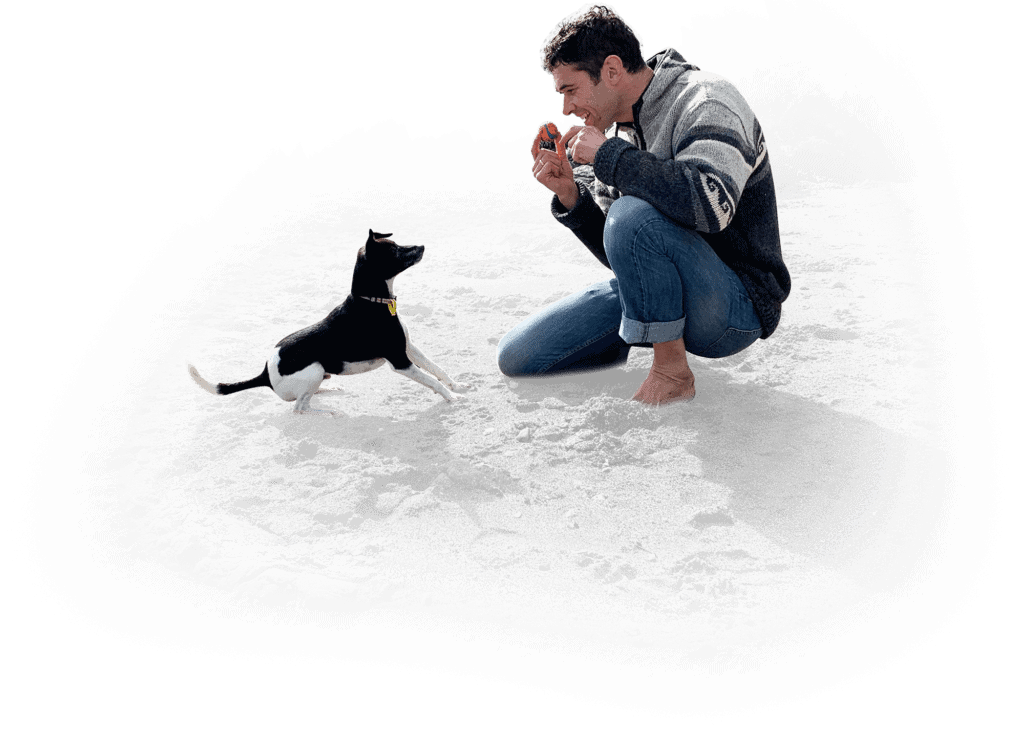
Dogs do not bark just because. Anyone who wants to know how to stop dog barking should understand behind any excessive barking is a real, serious trigger… at least in our dog’s eyes.
Indeed, barking is a big behavioral issue! But it is often misunderstood. Most dog owners and even dog trainers treat barking at face value, as if there’s nothing more to it.
This is where most solutions get it wrong — they focus on stopping dog barking without addressing the root cause of the problem. Dog owners get frustrated because even if they do get some success, after a few days of silence, the barking resumes!
This is what I aim to change with Rule #4 of the Doggy Dan Five Golden Rules.

JOIN MY FREE REACTIVITY CLASS
As a top dog trainer who has seen the most notorious of barkers switch off after just a few tries, I have proven that the best way to solve a barking issue is to be the leader WHO DEALS WITH DANGER.
A leader who can tell a dog “You can hand over the protecting to me. I deal with danger. I’ve got you covered. You can relax.”
What does this mean and how can you be this kind of leader? Read on to learn more about Doggy Dan’s Golden Rule #4.
Key Takeaways:
- Dogs are naturally protective because for them, all that matters is their survival and the pack’s.
- Rule #4 focuses on helping dog owners communicate to their dogs “I am in charge, I will decide how to react, I deal with danger, you can relax.”
- Saying “Thank You!” is one of the ways to make dogs understand that YOU are in charge with danger, not them.
JOIN MY FREE REACTIVITY CLASS
Table of Contents
- Recap: Rules #1, #2, #3 of the Doggy Dan Five Golden Rules
- Rule #4 is Dealing with Danger: Dear Dog, I am in Charge of Danger, Not You
- How Rule #4 of the Doggy Dan Five Golden Rules Help You React Like a Leader In Charge of Danger
- What Your Dogs Will Learn From the Rule #4
- The Five Most Common Mistakes Dog Owners Do to Stop Dog Barking
- How to Stop Dog Barking: Calmer Dogs Have Owners Who Understand Rule #4 By Heart
- Dog Calming Code: Helping Dogs Stop Barking and Live the “Switched Off” Life
How to Stop Dog Barking: Rules #1, #2, #3 of the Doggy Dan Five Golden Rules Recap
Important Note: Before you implement Doggy Dan Golden Rule #4 — Dealing with Danger — with your dog training, it’s imperative that you are already following Rules #1, #2, and #3.

Unless these rules are in place, you and your dog won’t be able to make Rule #4 work as effectively.
To recap, the first three rules focus on winning your dog’s mind by showing them you’re the pack leader, not them:
- Rule #1 talks about controlling the food and understanding why being in control of the food communicates that you are in charge. (You can check Rule #1 here.).
- Rule #2 is about the importance of ignoring your dog after separation and why it’s crucial in establishing leadership in the home. (Learn about Rule #2 here.)
- Rule#3 is about helping your dogs pass on the leadership hat to you through showing them that you and not them call the shots. (Learn about Rule #3 here.)
These rules are important prerequisites to make sure Rule #4 really does its magic on your dogs.
LEARN THE DOG CALMING CODE (FOR FREE)
Rule #4 is Dealing with Danger: Dear Dog, I am in Charge of Danger, Not You

Dogs are naturally very protective of us. Why?
As established in the first three blogs for this series, nothing matters more to our dogs than their survival, and the pack’s.
(Watch the full video below for Rule #4)
This protectiveness comes from their wolf ancestry as wolves are stalwart in protecting the pack from potential threats. Therefore, anything they think poses any danger to the pack are dealt with VERY SERIOUSLY
- Strangers walking past the property? Dog will bark.
- Motorcycle zooms by? Dog barks.
- Birds swooping through the garden? Dog goes nuts.
I often say this: unless trained, dogs are instinctive—they DO what’s natural for them. And what’s natural is to ensure the pack and the property are safe.
WE CAN’T BLAME A DOG FOR BARKING AT RANDOM THREATS ALL THE TIME: THEY NEED TO ALERT US TO DANGER TO KEEP US SAFE.
What Dogs Communicate with Every Bark
In every “woof, woof” your dog makes to a stranger across the street, or a distant sound is this message:
“Hey, this is my property and I am in charge. I will deal with you! You look dangerous, you have to stay away! I’m going to bark so you will be scared to come near.”
If you want to know how to stop dog barking, this is crucial info! Simply saying “STOP!” won’t do it for our dogs, no matter how much we try.

They’re protectors — they won’t get it why you’re asking them to stop when danger is really there!
They’re worried the strange shadow that passed the window will harm you or the property, so unless their fear of the danger is pacified, barking will persist.
How Doggy Dan Rule #4 Helps Dogs Switch Off and Stop Barking
Rule #4 enables dog owners to communicate this clearly to dogs:
“You are not the one in charge of danger, I am. You can relax. I’m going to handle every decision around danger. I deal with the threat. Thank you, you can calm down now.”
Of course, we can’t just say this out loud expecting our dog to immediately walk away from the threat.

Your dog has to feel, see, and hear that you are indeed a confident, capable leader they can trust to handle danger.
And when they feel your confidence—your calm, unbothered energy, with body language that’s relaxed—they will catch on.
But what do you need to do to become a capable Alpha in your dog’s eyes?
FREE REACTIVITY MASTERCLASS
How Rule #4 of the Doggy Dan Five Golden Rules Help You React Like a Leader In Charge of Danger
In situations where your dog barks non-stop, you can seize the chance to tell your dog: “I’ve got it handled, buddy. No need to worry or agitated. I got you covered.”

You can convey this POWERFUL message through your words, voice, body language, and overall demeanor.
Communicating this message is purely done through dog psychology so your dog can absolutely get what you mean.
If your dog is in a middle of a barking episode, here are three things that can encourage your dog to switch off and be calm.
GET MY 5 GOLDEN RULES FOR FREE!
Showing Your Dog You Hear Them with a “Thank You!”
Your dog has to know that you hear “Danger! Danger! Danger! I’m protecting you so I’m barking” instead of just… well… barking.
You can’t be the protector in their eyes if you can’t even understand the urgency of their barking!

Now, there’s a thin line between letting your dogs know you get them, and indulging them.
I’m sure it’s tempting to go to your dog and give them a comforting pat or hug and say “Where’s the danger? You scared right? Good boy, I’m here.” But that only tells them they are still the ones making the decisions around danger.
All I would do is say “Thank you!” in a calm, gentle, relaxed voice just to let your dog know you hear them but you’re not worried.
Acknowledging The Danger and Saying Thank You
From experience, I know that some dogs aren’t satisfied with just hearing “Thank you!”
They persist with the barking as if saying “You don’t get it! There’s danger outside! How can you be unbothered when you haven’t even checked yet!”
It’s very powerful when they see you get up, walk calmly over and check what they’re seeing, remaining unfazed, then turning your back on the “danger”, and walk off with a “Thank you!”
Your. Dog. Will. Get. It.

You’ve seen the “danger” and you’ve totally ignored it! You made the decision that you’re not worried about the threat your dog sees.
It’s an effective way to let your dogs know “I’ve seen the danger and I have a decision about it. The bird you are barking at does not bother me so it should not bother you. Go on and relax.”
Making It Absolutely Clear That Barking is NOT Okay
In some cases, using the two solutions I mentioned above won’t immediately work for the first or second time.
Your dog may still continue to bark.
If barking persists, you can calmly take them to timeout for a few minutes until they relax.
REVERSE REACTIVITY (FREE WEB CLASS)
What Your Dogs Will Learn From the Rule #4
This powerful rule has three pillars that dog owners ABSOLUTELY have to know:
#1: I am the Pack Leader. I Deal with Danger
Rule #4 lets your dog know “I am the leader here, so I will protect you. If there’s danger, I’ll handle it. You don’t have to worry.”

Dogs naturally look up to a strong and confident pack leader, someone they can trust to make decisions in potentially dangerous situations.
Being a leader who makes the decisions and remains unbothered by threats makes your dogs feel “Ahhh, someone capable is taking the protector hat from me. Finally, I can relax!” Dogs will start to switch off their vigilance (and non-stop barking!) and have faith in you as a leader.
#2: I Decide What’s Dangerous or Not
It’s true — your dog barking aggressively at a bird’s shadow looks ridiculous! But your dog doesn’t know a bird is NOT a big threat.
However, you do! And the simple gesture of saying “Thank you!” and calmly acknowledging the source of the barking without a worried energy can help your dog understand there’s nothing to stress about.

Rule #4 helps you communicate “Relax, it’s not a threat” through your energy, tone of voice, overall demeanor, and body language!
#3: I Take Lead on How to React
To explain this fully, let me tell you a story about an Alpha, their pack of wolves, and an ice cream motorcycle.
For wolves, the ice cream motorcycle is totally alien! It’s not a creature of the woods. It’s strange, so therefore, dangerous.
When it comes to tricky situations like this one, the Alpha is steps in to do the checking while the other pack members wait.
REACTIVITY SOLVED (NO FOOD, NO FORCE)
Then, after a few minutes of checking, the Alpha walks away, totally ignoring the bike.
Do you think the other wolves will cry out “Uhm, excuse me? It’s still dangerous!”
NO!
The Alpha knows. And because they walked away calmly, ignoring the thing that all of the pack thought dangerous, the other wolves understand there’s nothing to worry about.

Oh but how different would it be if the Alpha started barking at the bike! Other wolves surely join in in no time!
In situations your dog perceives as dangerous, THEY WILL BE LOOKING TO YOU.
The way you react to things your dog considers as threats has the power to stop your dog from having a full-on barking spree!
GET THE DOG CALMING CODE™
The Five Most Common Mistakes Dog Owners Do to Stop Dog Barking
Yes, even the most well-meaning gesture can encourage frequent barking responses from your dog.
Let me explain…
In an ideal world, we dog owners should be reacting to our dog’s barking episodes with a calm energy and an unbothered body language.

However, this is NOT ALWAYS the case.
In fact, I have worked with dog owners who correct dog barking through this scenario:
Let’s say a dog named Rover starts barking at someone walking past the front gate.
In the eyes of Rover, the stranger poses a threat of real danger!
But here’s the scenario that PLAYS OUT MOST IN REAL LIFE.
Rover: *Barking to say “Hey everybody, there’s a stranger close to the property. Is this danger real? What should I do?”*
Dog Owner: “Cut it out, Rover!” (in a shouty voice)
Rover: *Continues barking to say “But seriously, I’m barking because they look dangerous, and you’re shouting back so I’m barking louder—can’t you hear me?!”*
Dog Owner: “I said cut it out now!!” (more irritated)
Rover: *Barking louder than ever “There’s danger present and I’M BARKING THE LOUDEST BECAUSE YOU’RE NOT SEEING THIS FOR YOURSELF PLUS YOU SOUND AGITATED SO I’LL BARK EVEN MORE!”
Finally, the stranger is no longer in sight. Rover stops barking, and goes over to his owner who says “Good boy, Rover. Good boy.”
From the interaction above, we learn of FOUR BIGGEST MISTAKES that you can do when teaching your dog to stop barking.
Mistake #1: Dog Owner Shouts Without Doing Anything to Acknowledge the Dog’s Call for Attention.
They made no effort to confirm if there was danger or not, sending the signal to the dog that danger is their job to deal with. That puts stress on the dog to take charge and become overly protective.

Mistake #2: Not Keeping Their Energy in Check
Dogs are big energy readers and absorbers. You can influence them with your energy.
Even if you’re saying “Thank you!” but you’re doing it with an irritated tone, your dog will think the danger is bothering you.
Mistake #3: Giving a Treat After a Dog’s Barking Episode
If you give your dog a pat, a cuddle, a hug, or a treat after they barked non-stop, your dog will start thinking they did the right thing!
Your dog will think “If I sense danger, my owner wants me to bark my loudest because I have to do all the protecting.”

The more you give rewards to a dog that barks non-stop, the more they will think that there’s no problem with barking all the time!
Now, I’m going to include two more mistakes not found in the scenario above, which often stall the success of Rule #4.
Mistake #4: Giving Pats and Cuddles WHILE Dealing with Danger
I empathize with you — it’s heartbreaking to see a stressed dog. It’s so easy to give in to hugging them or patting them while on a barking episode.
You might go “Oh, Rover. Is that bird making you scared? Go away, bird! How about now? Are you still scared?”
Let me tell you this: it’s going to do more harm.
You have to be absolutely clear that it’s you who will have the final say whether or not something is worth the worry.
JOIN MY FREE REACTIVITY CLASS
Mistake #5: Cheating Through the Process
Some dog owners give up after the first “Thank you!” thinking it will still work on their dogs.
Truth is: it won’t.

You have to operate in a language dogs can process and understand. And the process of saying the first “Thank you,” checking out the source of the barking, showing calm and unbothered demeanor, and giving timeouts when necessary should be done in order for it to work.
How to Stop Dog Barking: Calmer Dogs Have Owners Who Understand Rule #4 By Heart
Dogs — especially those who have taken on the responsibility of protecting you and your property — can’t relax.
They’re constantly running around, barking non-stop at everything and everyone, and often exhibit serious separation anxiety.

You can easily tell a relaxed dog from a wired one, and the difference is always so sad.
I remember the first time a dog licked my hands after using Rule #4 on him.
In that moment, I thought it was just a sweet coincidence.
However, so many dogs I’ve helped since then would do the same.
Dogs who FINALLY SWITCHED OFF would lick my hands as if saying “Thank you!”
It’s as if it’s their way of telling me:
“Wow, mate. You finally got the security covered. I’m gonna switch off now.”
This is why I always ask dog owners to learn Rule #4 of the Doggy Dan Five Golden Rules as it is the solution that solves both the root cause of the problem and the non-stop barking.
I’ve seen it transform my dogs and the dogs of the people I have worked with.
Dog owners who follow it have less stress on the park and during walks because unfamiliar stranger and dogs in the park no longer triggers their dogs!

I know you love your dog, and I know that aside from the barking, you also want them to be the happy, calm, relaxed, healthy dog you’ve always wanted them to be.
I have four words: follow Rule #4.
LEARN THE DOG CALMING CODE (FOR FREE)
Dog Calming Code: How to Stop Barking and Help Dogs Live the “Switched Off” Life
I hope by now you see that Golden Rule #4 of dog training is a gift our stressed, anxious, high-wired dogs WILL ABSOLUTELY THANK US FOR.
However, as a dog trainer who has helped thousands of dog owners navigate their dog’s barking problem with Rule #4, I know that it’s also EASY TO GET THIS WRONG.
But in your quest for a bark-free household and happier dog, I’ve made sure YOU WILL NEVER FEEL ALONE OR CONFUSED BY HOW TO IMPLEMENT THIS RULE.

In my online dog training program, the Dog Calming Code™️, you’ll discover the thorough, step-by-step instructions on Rule #4, and all the other Golden Rules.
With the Dog Calming Code, you’ll learn answers to common questions around Rule #4 including:
- What do we do if we don’t know what our dog is barking at?
- Will we have to do this forever?
- Is it ok to call the dog to us to stop it barking?
- What should we do if after the second thank you our dog runs away and plays a game of chase!
- Should we praise our dog when he comes to us after he has barked?
- Is it ok if we change the word to something else?
- Is it ok to recall our dog when he is barking?
- After the second Thank You our dog likes to do one more gruff but then follows us inside, my question is do we have to isolate him for this?
- We still want a guard dog, how will this work?
Let me assure you: this is not one of those temporary, quick-fix, no-more-barking-solutions.
Rule #4 talks to your dog’s very core, assuring them “Hey, you’re not in charge. And the one in charge has you covered 100%. No need to bark, or bite, or chase anymore. Take a break, buddy. You deserve it.”
And really, isn’t that what YOUR dog absolutely deserve?
If you agree, click here to learn more about the Dog Calming Code.

~ Doggy Dan




One Response
I have learned through the original dog calming course i took and review of this, being calm and standing tall and confident will go long way. Hardest thing thats most important is to be consistent and patient.