Listen above or: iTunes / Spotify (Tap the subscribe button – it’s free and keeps you updated!)
How to Stop Dog Barking in Seconds: The Training Tip That’s Worked for Thousands of Dog Owners
Today’s Guest
Dr. Gary Richter – America’s Favorite Veterinarian
What’s all the fuss about CBD Oil, and why is it so popular?
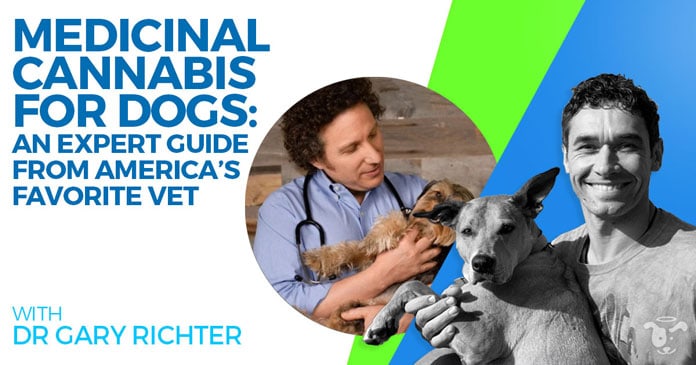
Well, where do I start? In today’s podcast Dr. Gary Richter chats with me about all the ways CBD Oil can HELP our dogs. Dr Gary answers all our questions about what’s in CBD Oil, and how it may help!
Perhaps you’ve already decided to use CBD Oil and you’re wondering how to choose and source the right product, maybe you’re overwhelmed by the terminology and conflicting information about the safety of certain components, or you don’t know much about it at all but would like to learn more…
… then this podcast is for you!
If you want to learn more about this miracle plant and how it can help, then tune in to today’s mind-blowing podcast!
You’ll Hear About
- [05:30] The components of the CBD Oil plant and what all the terminology means
- [07:30] Legal considerations
- [12:30] Why it’s important for pet professionals to know about CBD Oil
- [14:00] If CBD Oil is safe
- [28:00] How CBD Oil works in the body
- [30:30] THC: Helpful or harmful?
- [32:00] How to choose and source a product
- [33:20] Why a Certificate of Analysis is important
- [35:30] What we’re learning about dosing
- [38:00] The “Entourage Effect”
- [42:10] When side-effects are good!
- [43:20] How to find out more about Dr. Gary Richter
How You Can Get Involved:
Get started with the right nutrition and health information for YOUR beloved furry friend. Read Dr. Gary Richter’s book, The Ultimate Pet Health Guide: Breakthrough Nutrition and Integrative Care for Dogs and Cats.
Learn more about what’s going on with CBD Oil in the veterinary world and support the Veterinary Cannabis Society
Where To Get CBD Oil For Your Dog
As you’ve heard, it’s all about the quality of the CBD oil out there in the market. Is it Broad Spectrum? Is it Premium Grade? Does it have zero THC? These are really important questions, and I’ve spent a long time researching this.
I can now say that the only CBD products for dogs I recommend are the ones I have personally been involved with, right from the growing and sourcing of the hemp to the final manufacturing…
Check out my range here: Doggy Dan’s Angel Oil CBD For Dogs
Links & Resources
- Dr. Gary Richter’s veterinary practice: https://holisticvetcare.com
- Dr. Gary Richter’s website: https://drgaryrichter.com/
- The Veterinary CBD Oil Society: VCS.pet
- Facebook: https://www.facebook.com/petvetexpert/
- Education: https://www.veterinarycannabis.org
- YouTube: https://www.youtube.com/c/UltimatePetNutrition/
- Instagram: https://www.instagram.com/petvetexpert @petvetexpert
- Twitter: https://twitter.com/petvetexpert
- Doggy Dan’s Angel Oil:
Learn more by tuning into the podcast!
Thanks for listening—and again, don’t forget to subscribe to the show on iTunes / Spotify to get automatic updates.
Cheers,

~Doggy Dan 🙂
How to Stop Dog Barking in Seconds: The Training Tip That’s Worked for Thousands of Dog Owners
|
Voiceover: |
Welcome to the Doggy Dan podcast show, helping you unleash the greatness within your dog.
|
|
Doggy Dan: |
Hello and welcome everybody, Doggy Dan here with another edition of the Doggy Dan podcast show. And today I'm with Dr. Gary Richter. So excited to have you here Dr. Gary.
|
|
Dr. Gary Richter: |
I'm thrilled to be here, thanks for having me.
|
|
Doggy Dan: |
Yeah, today... I'm so excited because this is a topic which is fairly new to me to be honest, CBD oil for dogs, and Dr. Gary Richter is going to talk us through so much stuff. So for those of you who think you know a lot about CBD oil and hemp and marijuana and this sort of stuff, then Dr. Gary Richter's going to be able to explain a little bit more.
|
|
[00:01:00]
[00:01:30] |
And for those of you who are new to this and are thinking about what is involved, what is THC and CBD and you've heard all these words, like I say, Dr. Gary's going to talk us through all that stuff and yeah, going to be a really fascinating podcast, so much to cover off, but first I wanted to explain a little bit about who Dr. Gary Richter is. So he's a certified veterinary acupuncturist and chiropractor. He's owned his own veterinary hospital for almost 20 years now in the San Francisco Bay Area, he's a graduate of Florida in the Bachelor of Science there. He's got a Masters of Science, he's got a Doctorate of Veterinary Medicine. He's written books, he's been on TV, he's done all sorts of stuff. Is that a fair summary? You're one of those people Dr. Gary who's got so much knowledge about so many topics and so many things, it's hard to put you in a... to summarize you, is it?
|
|
Dr. Gary Richter: |
It is a fair summation, I know there's a... It can be hard to determine which way to go there.
|
|
Doggy Dan: |
Yeah, I know you do all sorts of other stuff like the hyperbaric oxygen chambers and pulse signal therapy, and people are probably thinking, “What on earth is all that stuff?” but that's a totally different podcast. But tell us a little bit about yourself in your own words, love to hear it from you.
|
|
Dr. Gary Richter: [00:02:30] |
Sure, so as you mentioned I'm a veterinarian, I would describe myself as an integrative practice veterinarian meaning that I practice both western medicine as well as what is frequently termed complementary and alternative medicine, or holistic medicine, and the reason why I do that is because I find that no one form of medicine has all the answers. There's certainly things that western medicine is very good at fixing, and others that it is not. There are things that alternative medicine is very good at fixing and others that it is not. |
|
[00:03:00]
[00:03:30] |
So I've always been one to really try and keep options open as far as treatments go for my patients, in order to try and figure out what is the best course of treatment to get them healthy and keep them healthy. And really that has led me on a career path to always be looking for other things out there that may be able to help my patients, whether that is western medicine or ancient traditional medicine or cutting-edge technology. To be honest with you it's not as important to me where it came from as it is does it work?
So that was really what led me down the path to start investigating cannabis for animals, as you mentioned I live here in the San Francisco Bay Area, for those of you that are not aware California and the San Francisco Bay Area in particular has really been at the epicenter of the medical cannabis movement in this country, and it was inevitable that both I and every other veterinarian in this area was going to have people coming into their offices asking about using cannabis for their pets. And it really started to get me thinking about whether or not this is something that could be done, and low and behold years later I think the unequivocal answer to that question is yes. And now we're at a point where every other medication, pharmaceutical or otherwise, it's a question of what is the appropriate safe and effective dose for any given individual or any given condition? |
|
Doggy Dan:
[00:05:00] |
Wow. I loved what you just said, it so resonated with me. We partly have this... Mainly I would say actually because we have the same philosophy with our own health and for the health of our children, that sometimes we go down what we call that western route and sometimes we go much more down the eastern side or the alternative or whatever, and yeah, and I think like you say at the heart of this is we will do what is best for our dogs or our children or ourselves. So a lot of respect to you and I can feel that at the end of the day this is what a lot of what I try and share with people, is at the end of the day it's that love and care for the dogs that is the most important thing of all. So total... So much respect and thank you for coming on the show once again. |
|
Dr. Gary Richter: |
You bet. |
|
Doggy Dan: [00:05:30] |
So for those people who really want to know about just the basics like the differences between hemp and cannabis, could you talk a little bit, just very, very top line stuff. So what's the difference between hemp and marijuana and cannabis, and what is CBD? What does it stand for? |
|
Dr. Gary Richter: |
Okay, so let's start from the beginning, we'll start with the plant and work our way outwards from there. |
|
Doggy Dan: |
Beautiful, beautiful. |
|
Dr. Gary Richter: [00:06:00]
[00:06:30]
[00:07:00] |
So if we're going to get technical, the cannabis plant that is used to derive all forms of either medicinal or recreational cannabis is known as Cannabis Sativa L. There are other species of cannabis that exist out there but pretty much everything that is used to make medicine or recreational compounds comes from Cannabis Sativa L. So Cannabis Sativa is a very broad thing however because there are countless, and the terminology is not exact here, but call it either sub-species of cultivars or strains, or whatever your word or choice is, but there are countless different (I'll use) strains that produce different chemical compounds. Now cannabis as a plant can produce hundreds if not thousands of different chemical compounds that have medicinal activity, including compounds called cannabinoids, and there are well over 100 cannabinoids that have been identified in cannabis. Some of which you've heard of, such as CBD, THC, others you may not have, CBG, CBC, CBN, these sorts of things. |
|
[00:07:30]
[00:08:00] |
And there is intense research looking into what the potential medicinal uses are for these various compounds. So when we start to look at the difference between hemp and what is termed marijuana then we're really starting to get away from the scientific and more into the legal. So as I said, it's all coming from the same plant. It's all Cannabis Sativa L, however at least in the United States, federally speaking, any cannabis plant that naturally produces less than 0.3% THC, and THC is the psychoactive compound in cannabis that gets people high. |
|
[00:08:30]
[00:09:00] |
So any plant that produces less than 0.3% THC is called hemp. And that is something that at this moment in time is legal to produce and transport in the US, to be honest with you the legal framework beyond that is a little bit murky although clearly there is a robust hemp-based product market out there. So generally speaking anything that produces more than 0.3% THC is what the federal government calls marijuana. Now again this is a bit of a digression, but marijuana really quite frankly is somewhat of a pejorative term and the industry's trying to get away from it because it has all kinds of negative connotations. The term that most people are preferring to go with is cannabis or high THC cannabis, or something to that effect. But clearly marijuana is still out there in the vernacular and you will hear it quite frequently. |
|
[00:09:30]
[00:10:00] |
Now other than THC, the psychoactive component, is another compound, the other predominant cannabinoid that cannabis produces which is called CBD, which is also called cannabidiol. So cannabidiol is... It's not intoxicating in the sense that it doesn't get you high, it is in a technical sense psychoactive because anybody who's ever taken cannabidiol will tell you that it is very relaxing, it is very calming, it clearly has an effect on your mental state. So it does affect your brain but not in the profound and potentially debilitating way that THC can. And there is a lot of research looking into medical uses of CBD along with all of the other cannabinoids. |
|
[00:10:30] |
CBD tends to get a lot of attention right now because of the availability of these very low to no THC but relatively high CBD strains of cannabis that are called Hemp. And as I think most people know there is a robust market out there for both humans and animals selling these medicines that are derived from hemp, most of which contain CBD as well as other compounds naturally produced in the cannabis plant. |
|
Doggy Dan:
[00:11:00] |
Brilliant. Everybody got that? Hemp-based CBD product basically is so many of the benefits but without the high. And obviously when we're working with dogs we don't really want any high, we don't want them getting the hallucinogenic side of things. That's great. And I know one thing is... There are different laws obviously all round the world, so what you're talking about if you want to just put this into perspective. This is really... Everything you're talking about here is based on US law, I think we should just cover that off as a bit of a disclaimer at the start as well. |
|
Dr. Gary Richter: [00:11:30] |
Yeah, that is correct. Everything I just said as it pertains to hemp being defined as less than 0.3% THC and federal laws, that is all specific to the US. Every country has their own laws, and frankly even within the US, every state has specific laws that impact both people as well as veterinarians. SO it's both a national and a local issue wherever you live. |
|
Doggy Dan: [00:12:00] |
Brilliant. Now there is something I'd love to cover off as well, which is your position as a vet is very interesting for me. You don't actually sell... We're not at the stage yet, I say yet, maybe it'll happen maybe it won't, but where you're actually able to promote and recommend products. And so you don't actually sell these in the vets’, is that... Can you give people an understanding of your angle, where you're coming from as to what you are allowed to talk about? |
|
Dr. Gary Richter: [00:12:30]
[00:13:00] |
Yeah, so again this really comes back to, it's not only a national issue but it's a more local issue, so here in California myself and a number of my professional colleagues have been involved in what is now going on a four year battle, if you will, of both the state legislature as well as the veterinary medical board in this state to allow veterinarians to recommend cannabis for our patients, because as I have explained to various regulatory agencies, if people are not able to get reliable information about cannabis for their pets from their veterinarian they're going to go somewhere else and look for it.
|
|
[00:13:30] |
So they're going to go to the pet store, they're going to go to a cannabis dispensary, they're going to go online, regardless, they're going to get information from questionable and possibly unreliable and unsafe sources. So we've been making the argument for years that veterinarians need to be part of this process. Now I will say that we have had moderate success, so veterinarians in California are now allowed to “discuss” the use of cannabis for our patients. We are not allowed to “recommend,” although to be frank, where the definition of “discuss” ends and “recommend” begins, nobody can really seem to define. But nonetheless that's the line that veterinarians at least in California have to walk. |
|
[00:14:00]
[00:14:30] |
So the other interesting thing is everything I just said pertains to what the federal government would refer to as “marijuana” or higher THC products. The irony is that in California veterinarians are not supposed to even discuss the use of hemp-based CBD products, which is ridiculous because these products are incredibly safe and can be very therapeutically beneficial, but it's really just an example of how the regulatory agencies are lagging behind what's happening in the real world. |
|
[00:15:00] |
So that's a very circuitous way to answer your question, which is veterinarians at least in California are not only allowed to recommend or sell any sort of cannabis product, hemp included, we are allowed to discuss “medical marijuana,” and to be honest with you there is discussion about hemp products going on as well. It's not... Those regulations are not something that the veterinarian medical board is really actively enforcing. |
|
[00:15:30] |
As I look broader across the United States, these laws are very, very variable from one state to the next. There are states where veterinarians can recommend medical marijuana. There are states where veterinarians can and do sell hemp-based cannabis products out of their office. It really just depends on how the state government has chosen to deal with it. |
|
|
So long story short, it's complicated. |
|
Doggy Dan:
[00:16:00]
[00:16:30] |
Yeah, I wanted to add this in just in case people wonder why I'm framing questions in a certain way, and I'm not just saying, "So what do you recommend?" I wanted to make sure people understand, that is the reason why we're talking about discussing stuff and suggesting, and I would say things like, "Tell us a bit about what you know about..." Stuff like that. So I will throw in here, I'm in a similar situation that I was faced when I came over to America a year and a half ago in the Summer of 2019. A similar situation, so many people were asking me what products, what I would recommend as a person, as a dog lover, as a dog owner. People who've followed my online training program, they were saying to me, "What is the best product, how do I know what's good and what's bad?" And it's something we'll touch on. |
|
|
And that's why I went down the track of actually putting together, using one of the best manufacturers we could find to put together a product because it was so complicated, and that's something I'd like to touch in. |
|
[00:17:00] |
I'm not going to go into our product at all here, I'll talk all about it a little bit maybe at the end just for those people who are interested, but this is very much a general conversation about the benefits of hemp-based CBD product and just what people should really be looking for if they're going to move down that track. So I'm looking at the time, I'm thinking I want to get into this, so maybe we could jump into the real meat of this really in a way. And you could tell us a little bit about maybe just your general experience of hemp-based CBD products with dogs, and what you've noticed or what you've found, what you've come across, what people have told you, that sort of stuff. |
|
Dr. Gary Richter: [00:17:30]
[00:18:00] |
Sure, so as most of us know, there's no shortage of availability as far as hemp-based CBD products. And this is very much what I would describe as a “buyer beware” market, in the sense that there's so much money out there that's being made. And unfortunately what that means is that you invariably are going to end up with people getting into this business with really the only goal is to make as much money as possible and usually that means they're making sub-standard products. |
|
[00:18:30] |
So it is very much a marketplace where, as the person purchasing the product, you need to be careful about what you're buying and who you're buying from. But speaking to well-constructed, well-formulated hemp-based medicines, I have seen a lot of benefit in my patients with these medicines, with things ranging from control of arthritis and other forms of pain, partial control of seizures, help with anxiety, help with gastro-intestinal problems, we've really seen quite a wide range of value and potential benefit here. |
|
[00:19:00]
[00:19:30] |
And in fact in the past few years there has been more and more research that is being published to that effect, so for example we now know based on the research that CBD is beneficial for dogs with osteoarthritis. We now know from the research that CBD is at least partially beneficial for dogs with seizures. Interestingly there was a study that came out literally just a couple of weeks ago looking at the use of CBD for anxiety and fear in dogs, and the conclusion of that study was, it was not helpful. In my experience I have found it to be helpful in some dogs, so I think that may be something that certainly warrants further study. |
|
|
But the point is that we are not fortunately in a place where legitimate scientific research is coming, and that's going to give us a lot more information to base our decisions on. |
|
Doggy Dan: [00:20:00] |
Brilliant. I have a lot of people listening to the show who have older dogs, I myself have had older dogs. I've got an older dog now who's struggling with the sore joints. Have you any understanding of why or how it actually helps, is it working as possibly like an anti-inflammatory? Is that the way it's possibly working, or? |
|
Dr. Gary Richter: [00:20:30]
[00:21:00] |
Yeah, that's a great question and cannabinoids are... Or if we're going to be more specific, CBDs have multiple mechanisms of action that are probably helpful for pain. Probably the... I would say the three biggest ones are number one, it is an anti-inflammatory, and cannabinoids function in very similar ways to pharmaceutical non-steroidal anti-inflammatories. So if anybody's got a dog that was ever on Medicam, Remideal, Galprap, what have you, cannabinoids function in similar ways as those drugs. |
|
|
In addition to that they are also what are called allosteric modulators of opioid receptors. So in English what that means is the cannabinoids... They don't activate the opioid receptors but they allow the opioid receptors to become more active to the body's own natural endorphins, so it can help relieve pain in that way. |
|
Doggy Dan: |
Wow. |
|
Dr. Gary Richter: |
And then lastly there is a class of neurofiber receptors called TRPV1 Receptors, and to make a very long story short these receptors play a really large part in pain response, and cannabis and cannabinoids can really help down-regulate those so there's just less painful stimuli from the nerves. |
|
Doggy Dan: [00:22:00] |
Wow. I mean for me anything that's allowing the body to behave better and cope with pain better that's pretty... Not only is that awesome news, it's also... For me it makes me go, "Wow this is actually working with nature." This is a natural product in a way working with nature to help dogs cope with the pain as they get older, what a beautiful thing. |
|
Dr. Gary Richter: |
It sure is. |
|
Doggy Dan: |
Yeah. And another thing you touched on earlier is how it can actually help with seizures, so I'm presuming that's... We're talking about epilepsy there, it's been seen to possibly ... |
|
Dr. Gary Richter: |
Yes.
|
|
Doggy Dan: [00:22:30] |
I loved your explanation of how it actually works from a medical point of view. Are you able to touch into that? Is it a similar thing, it's obviously not so much to do with anti-inflammatory I wouldn't have thought, but I'm guessing at this point, so. Do you have any understanding of how…? |
|
Dr. Gary Richter: [00:23:00]
[00:23:30]
[00:24:00] |
There is at least theoretical understanding. So we know that cannabinoids affect the central nervous system and we know that they affect particular neurotransmitters, particularly neurotransmitters like gaba, like serotonin, neurotransmitters that can play a part in seizure activity. So when we're talking about a patient that has epilepsy, effectively epilepsy is a malfunction in the brain where neurons fire when they shouldn't. And there's no one reason why that would happen in a person or an animal, it's a very individual and very variable thing which is probably why there is no medication nor no one cannabis formulation that works for everything, because the mechanisms from one individual to the next would tend to be different. But because cannabis can regulate the release and amount of these neurotransmitters in the central nervous system, at least in some patients we appear to be able to affect the frequency and severity of seizures. |
|
Doggy Dan: |
Wow. With a lot... Sometimes I guess it is a case of we try it, people test it and they give feedback as to whether it works, and like you said at the very start of this podcast, if it works it works, and that's the stuff you're interested in, the end result really. |
|
[00:24:30] |
I've experienced that myself, sometimes I know stuff works and I can't figure out how or why but I keep going and then finally it starts to make more and more sense, and yeah. That's awesome. |
|
|
I have a dog training program called the Dog Trainer Academy and I help people become dog trainers so I've actually got dog trainers all over America who are using my program, and a lot of them are always asking and interested in whether or not we should be looking at suggesting CBD, hemp-based CBD products, so that's also why I ask. So many just want to know. |
|
[00:25:00] |
I was asked the other day about whether I believe hemp-based CBD products could help with things like cancer. And I've read a little bit about it possibly being able to help, but is that something you have any experience with? |
|
Dr. Gary Richter:
[00:25:30]
|
Well, here's what I can tell you. I mean if you look at the research, there's been a lot of research looking into the effects of various components of cannabis on cancer. And there is a lot of laboratory data that would show that the various components in cannabis can have very profound anti-cancer effects. Now to be clear, when I say laboratory data I'm talking about either in-vitro studies meaning it's happening in a Petri dish or a test tube, or we're talking about lab animals like mice and rats. And just because something can cure cancer in a mouse does not mean it can cure cancer in a person or a dog. |
|
Doggy Dan: |
Sure.
|
|
Dr. Gary Richter:
[00:26:30]
[00:27:00] |
So we're a ways away from that. I can tell you from personal experience just from having had quite a number of cancer patients who are using cannabis along with other therapies, my impression is, I think the pets seem to be more comfortable, they have less pain, they tend to eat a little bit better, they just seem a little bit more settled. I have seen instances where I feel like the timeline or the period between when treatment was started and then when the animal gets really sick, I feel like that timeline can be extended. The caveat I'll throw out there is I don't really have patients that are using cannabis and nothing else, so frequently it's being combined with other natural therapies, sometimes with chemotherapy, radiation, surgery what have you. So it's a little bit hard to parse out exactly what was doing what, but speaking in the broad sense I do think that these animals tend to do better and have a better quality of life for longer when they're on cannabis as opposed to when they're not. |
|
Doggy Dan: [00:27:30] |
Yeah. Skin irritations, a lot of people have told me that it seems to help relax their dogs. You've talked about it being a pain killer, is that how you think... I mean first off I guess I should ask, have you come across CBD, hemp-based CBD products being used to help dogs who have got irritations and scratching and itching, and all that sort of stuff? |
|
Dr. Gary Richter: [00:28:00]
[00:28:30] |
Yeah, they're out there, I mean it's certainly not the primary thing that CBD products are marketed for. That said, we do know that there are endocannabinoid receptors in the skin and the hair follicles so we do know that using a cannabis product externally can affect the endocannabinoid system. I can tell you from personal experience that topical cannabis products can be very helpful for pain, that's something that at least in my mind is not in question in the slightest. |
|
Doggy Dan: |
When you said topical, can you just clarify topical? |
|
Dr. Gary Richter:
[00:29:00] |
So topical, depends on the product. Could be a cream, could be a balm, could be a spray, but effectively what you're really doing when you use a topical product is, it's not that the product is significantly being absorbed into the deeper tissues, but, as I say, there are receptors in the skin and the hair follicle that are responding to those cannabinoids and those receptors are then transmitting effects deeper into the dog or person or animal or what have you. |
|
[00:29:30] |
But to get around to your question as far as skin irritation, I think that there may be some application there, I will tell you that it's not something that I use all that frequently for skin-related things and I'd be very curious to see if there's any emerging research in that field, and it wouldn't surprise me ultimately if there was a combination of cannabinoids that was helpful, we would just have to figure out what that is. |
|
Doggy Dan: |
Yeah. A number of times you've mentioned it being used as a pain relief, have there been tests, studies done on how powerful it is, how it actually works? |
|
Dr. Gary Richter: [00:30:00]
[00:30:30]
[00:31:00] |
Well from a pain relief standpoint the mechanisms are pretty much the same as what we discussed earlier from a inflammation perspective, so it's a COX inhibitor, it's an allosteric modulator of opioid receptors, it's a TripV1 inhibitor, I mean that's really how it helps with pain. There have been some studies both comparing the effects of cannabis versus more conventional pain relievers, both in patients as well as looking at specific mechanisms in a laboratory setting, and to be honest with you, the results are... they're a little bit inconsistent. I think that it is unequivocal that cannabinoids are beneficial from a pain control standpoint and for the sake of saying it, speaking broadly, THC is probably a more potent pain-relieving cannabinoid than is CBD, and THC absolutely can be used in animals, it just has to be dosed very carefully. |
|
[00:31:30] |
Because as you mentioned earlier having your pet stoned is never going to be an acceptable side-effect. But that said, just like a person can take a small amount of THC and not feel anything, so can a dog or a cat, again it just has to be dosed properly. But to get back to your original question, there's a lot of interesting work out there looking at the use of these products for pain, and like I say both in the research as well as just real world experience would indicate that there's a lot of uses for pain control as it pertains to cannabis. |
|
Doggy Dan:
[00:32:00] |
Brilliant. Feel like I could chat for ages about all these different things, but I want to keep this moving along so for those people who are sitting listening going, "Wow, wow wow, okay that's great,” but you've already mentioned there's so many products out there, there's so many different things, broad spectrum and all this different language almost which is used when describing CBD products, what would your advice be for somebody who's looking at choosing or selecting or trying some sort of product? What would your main guidelines be? |
|
Dr. Gary Richter: [00:32:30]
[00:33:00] |
Sure, that's a really excellent question and I think that that all really comes back to... realistically speaking, the two questions that you need to answer are, is it safe and is it effective? So on the safe side, that's where you have to do a little bit of investigation to make sure that a product has in it what the company says is in it, and doesn't have anything in it that shouldn't be in it. So in other words, sometimes depending on how cannabis is grown, like any other agricultural product, it could wind up becoming contaminated with pesticides, fungicides, bacteria, mold and what have you. Obviously that's not something you want in your medicine or your dog's medicine. |
|
[00:33:30]
[00:34:00] |
Similarly companies will very frequently make claims about the amount of CBD or the amount of other ingredients that are in their product, and the only way to really know for sure what's actually in these products both good and bad is to get what's called a certificate of analysis, or a COA. So a Certificate of Analysis is a laboratory analysis of that cannabis product. So when a company makes a formula, they... at least they should, send it to a qualified lab and that laboratory will analyze that product both for cannabinoids, other ingredients in cannabis, terpenes what have you, but also for contaminants. So bacteria, fungi, pesticides, etc, and the company should be willing and eager to provide a Certificate of Analysis for any product that they sell. If they don't want to provide a Certificate of Analysis I would suggest getting a different product because I think that that brings into question what it is that that company doesn't really want you to see. |
|
[00:34:30]
[00:35:00] |
One last note on a COA is, as you know, cannabis is an agricultural product, it's a plant. As such every time a crop of cannabis is grown it's going to be a little bit different from the last one. It's never going to be exactly the same. As such, every new batch of medicine that is made needs to have a COA that is specific to that batch. So if somebody's going to send you a COA for a batch that's a year and a half old, that's probably not super valid for the thing that you're buying off the shelf right now. So you have to make sure that what you're getting is recent and applicable to the product that you're buying. |
|
[00:35:30]
[00:36:00] |
So that really... all of that satisfies the safety issues, then there's the efficacy side of things. So what we know, based on the research as I mentioned earlier, is cannabis can be beneficial for dogs with arthritis pain and at least can be partially beneficial for dogs with anxiety. Now all of that really hinges on dosing and here's where things can get a little bit tricky, is the dose for both... The published dose in research for both arthritis as well as for seizures is kind of in the ballpark of about a milligram of CBD per pound of dog, twice daily. So for example if you have a 60 pound dog you would be giving 60 milligrams of CBD twice a day. |
|
[00:36:30] |
Now for those of you who are not familiar with the CBD market, 60 milligrams of CBD twice is a very expensive dose of CBD. And probably not something that a lot of people can sustainably afford for the long term. Now that said, that doesn't mean that lower doses aren't effective, they certainly can be, but that's where we're at with the published dosing. So normally I would suggest people start off at a much lower dose and work their way up slowly to the dose that they feel is effective. |
|
[00:37:00]
[00:37:30] |
So from the standpoint of product selection, one of the things that's really important is the concentration of the product. So for example if you bought a product that had one milligram of CBD per milliliter of oil and you had a 60 pound dog, you would have to give 60 milliliters or, ballpark, around two ounces of liquid every dose. That's not practical. So what you would need to be looking for is a much, much higher concentration of product, like so for example in that same example if you got a product that was 60 milligrams of CBD per milliliter of oil, you would have to give one milliliter, which is like a fifth of a teaspoon. |
|
[00:38:00] |
So... sometimes people tend to shop for products based on price, but frequently if you look on the ingredients list and you look at the concentration of say CBD in the product, you have to really do the math that way to figure out what you're getting when you buy it. And then just one last thing to note as far as efficacy goes, CBD is not the only thing that's effective in hemp-based cannabis. There is such a thing in whole-plant medicine and cannabis medicine called the Entourage Effect, and what that refers to is the synergistic activity of many of the different compounds that occur naturally in cannabis.
|
|
|
So not only CBD, but other cannabinoids, other compounds called terpenes which can have a lot of natural benefits. So there's research that shows that when people are given 100% pure CBD it does not work as well as when they're given full-spectrum cannabis products that benefit from the Entourage effect, meaning they have things other than CBD in them. |
|
[00:39:00] |
So, my suggestion when you're looking for a product is, don't get a product that is... the term would be a “CBD Isolate”, meaning there's nothing there but CBD. I would suggest getting what's called a full-spectrum product. |
|
[00:39:30] |
Now as far as exactly which full-spectrum to look for, to be honest with you, that really depends on what you're trying to treat. So for example the ideal spectrum for arthritis might be a little bit different from the one for seizures or for anxiety, what have you, so that requires a little bit more homework on your end. But I think in broad strokes those are the kinds of things that you should be looking for when you're out there shopping for a hemp-based CBD product. |
|
Doggy Dan: |
Brilliant, very helpful. I often think of full-spectrum CBD as being a bit like a rainbow. Rainbows are so beautiful with all those different colors, but if you just had red, if there was just a line of red it would look a bit weird. And if you just had a blue rainbow ... bit of blue in the sky, it's not as beautiful as when you have them all, so full-spectrum is the way to go. |
|
[00:40:00]
[00:40:30] |
Just touching on it, just so that people who are listening, the product that I promote and sell and have put my name to which is called Angel Oil, yeah, we have a COA. Every single batch is checked and tested, and obviously this costs money but that's exactly the route we went down. We wanted to be able to guarantee that there's nothing in there that shouldn't be in there, and that what it says on the label is in every single batch. And so we've got that and it is all full-spectrum and super-high concentrate, so I'll put some links in there for people who are interested. But wow, that's absolutely fantastic. Look, the time has flown by, I could chat for hours and hours. I'm sure people are thinking, "Wow, I'm interested, I want to know more." |
|
|
But I want to make sure people can get in touch with you as well, so... we didn't even get to talk about Leo your dog, we jumped into this so fast. I always think people who are listening want to know have you got a dog, would you tell us a little bit about Leo? |
|
Dr. Gary Richter: [00:41:00] |
Well Leo... Sadly Leo is now a former dog, but that's okay. He was a wonderful dog. Leo had a seizure disorder ... |
|
Doggy Dan: |
Yes... |
|
Dr. Gary Richter:
[00:41:30]
[00:42:00] |
And I tried a lot of different things to try and manage that, both naturally and pharmaceutically, and some of the natural things I tried didn't really work very well. The pharmaceuticals... I wasn't overjoyed with side-effects in-so-much as he was kind of a zombie, but I did wind up trying CBD, both hemp-based CBD as well as a more broad-spectrum product with a little bit of THC in it, and I found that those products really had a positive effect on both the frequency and severity of his seizures. Now to be clear it didn't completely alleviate the seizures but it certainly made them less frequent and less severe. So to me that... you can't put a price on that, when it's your own family. |
|
Doggy Dan: |
Yeah, totally. And you mentioned the side-effects which is another thing regarding hemp-based CBD products. The side-effects... Often it's gentler on the stomach, the dog doesn't have so many side-effects. Is that fair to say, was that your experience? |
|
Dr. Gary Richter:
[00:42:30] |
That is very fair to say, and one of the things that I often tell people about natural medicine in general is when you're using natural products frequently your side-effects profile are actually good things, so you may be treating your dog for arthritis but maybe he's a little calmer, maybe his stomach's a little more settled. Maybe he's sleeping a little bit better. As opposed to where if you were to give a pharmaceutical anti-inflammatory, you have to worry about stomach upset, you have to worry about liver and kidney related issues, but with natural medicine it's more frequently the opposite. Your side-effects are good things. |
|
Doggy Dan: [00:43:00] |
Which is the entourage effect again, that because the dog’s sleeping better he's more relaxed, more happy. |
|
Dr. Gary Richter: |
Yup. |
|
Doggy Dan: |
...and eats better and all the rest of it. So in terms of people getting in touch with you, you've got a number of websites. You've got a beautiful book you've written. What would you recommend if people want to know more about you, they thought you're fantastic and they're going, "Who is this guy, where do I find out more?" |
|
Dr. Gary Richter: [00:43:30]
[00:44:00]
[00:44:30] |
Well, so it depends a little bit on what somebody's looking for, so for example if it was somebody in California in the San Francisco Bay Area and they wanted to come see me and bring their dog as a patient, I would suggest that they go to my office website which is holisticvetcare.com. If somebody's looking for a little bit more general information about holistic and natural medicine there are a couple of websites they can look at. There is DrGaryRichter.com as well as petvetexpert.com, and, not to inundate you with websites, but I've also been involved this year with the formation of a non-profit called The Veterinary Cannabis Society, and the goal of this non-profit is to promote and provide education about cannabis as medicine to both pet owners and veterinarians as well as advocate for legal changes that will make things more easy and more appropriate as far as veterinarians being able to discuss and recommend cannabis. |
|
[00:45:00] |
We're just launching, the website is up. The website is VCS.pet, so if people wanted to go check that out, at the very bottom of the website if you would like to put your name there it will go onto our mailing list, so as new things come out we'll be able to send you updates. |
|
Doggy Dan:
[00:45:30] |
Brilliant. And all of these links are going to be on my website, on the page which is going to host this podcast. And so if you wanted to remember just one URL website, then go to theonlinedogtrainer.com/holisticvetcare. So if you want to remember that, theonlinedogtrainer.com/holisticvetcare. And then you'll be able to get access to all of Dr. Gary Richter's websites and all the stuff that he's mentioned and all the stuff that he does. Fantastic. |
|
Dr. Gary Richter: |
Lovely. |
|
Doggy Dan: |
Well, that's a wrap today. So so much love and gratitude and thanks for your... I can feel your heart, I can feel the love that you have for the dogs, and I can feel that's why you do this. And coming on the show today has meant a lot to me, it's really opened my heart and my eyes, and yeah, I've learnt a lot myself. |
|
[00:46:00] |
Yeah, it just feels like yeah, we're on the right track and yeah, just appreciate what you do for the dogs. |
|
Dr. Gary Richter: |
Thank you. Thank you, it's been a great pleasure. |
|
Doggy Dan:
[00:46:30] |
Thank you once again Dr. Gary Richter. It's been an absolutely awesome, informative podcast, I've loved it. I'm sure you've all learnt loads and you're thinking, "Gosh, my life's changed. My life's pivoting again. Maybe I need to look into this a bit more." So do check out theonlinedogtrainer.com/holisticvetcare. And that's all from me. I'm Doggy Dan, this is the Doggy Dan podcast show, have a wonderful day and, as always, love your dog. |
|
Voiceover: |
You've been listening to another episode of the Doggy Dan podcast show, bringing you one step closer to creating harmony with your dog.
|
Sign up to receive email updates
Enter your name and email address below and I'll send you periodic updates about the podcast.