
“Doggy Dan, my dog is too strong for me to walk! What should I do?” If getting your dog to walk outdoors TERRIFIES you, these tips will help you get through.
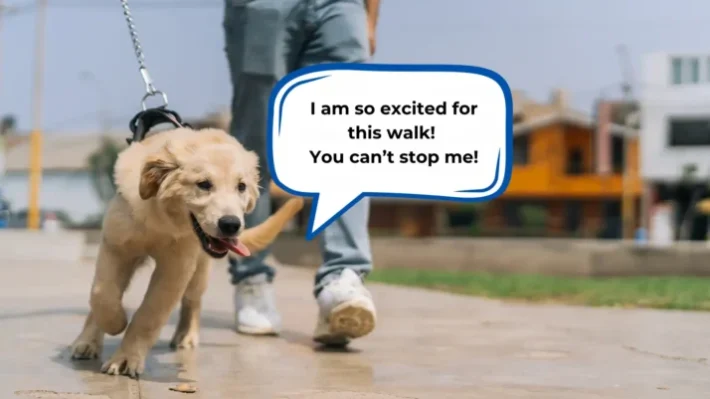
Taking your dog for long walks is supposed to be one of those pleasant experiences; relaxing, enjoyable, and memorable. However, for many people, they're memorable for all the wrong reasons! Dragged down the street, pulled off your feet, arm yanked out of its socket, damaged wrists, and a lot of stress.
It can actually be quite frustrating to see other dog owners with their dogs walking nicely beside them off-leash!
One lady I worked with told me about how she had just bought a coffee to enjoy whilst walking her two black Labradors, when they spotted another dog and charged towards it. She ended up clinging to a lamppost, arms and legs wrapped around it, coffee in one hand and two dogs in the other! That was the final straw… She called me for help as soon as she made it home.
So how do you go from this crazy situation where your dog is out of control from the very start to having a nice, calm walk? When it comes to leash training your dog when they're too strong or too excited for the walk, you have to start right at the beginning.
Key Takeaways:
- Calmness Starts at Home: The foundation for a good walk is laid before you even step outside. By establishing yourself as the leader and ensuring your dog is in a calm state of mind at every stage (picking up the leash, opening the door), you prevent the overexcitement that leads to pulling.
- Drain Intense Energy First: For the small percentage of “super-charged” dogs that are too energetic to calm down, a special technique is recommended. Take them for a vigorous run to burn off excess energy before the structured walk, as a tired dog is much more receptive to learning new, calm behaviors.
- Use Consistent Techniques and Proper Tools: During the walk, use consistent training methods like stopping whenever the leash tightens or changing direction to teach your dog that pulling is counterproductive. Furthermore, using appropriate equipment, such as a head halter, can provide better control and safety for particularly strong dogs without causing harm.
Best Tips Before Starting Leash Walking
In this podcast, I explain a technique that I suggest only dog owners with the most energetic pet dogs need to apply. For most of us, this method is not necessary. Becoming the pack leader and waiting for your dog to calm down at every stage of the walk will be enough to regain control as you leave the house.
Before we get into it, I have a free download for you. Learn The 7 Most Common Mistakes People Make When Walking Their Dogs. Just click the button:
Download: The 7 Common Walk Mistakes
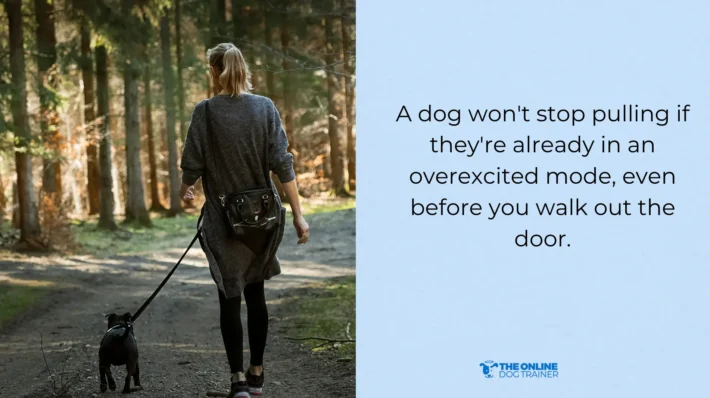
I know some pet owners would just overlook their dog's behavior before the walk, hoping they'd calm down eventually. Sadly, this rarely happens. A dog won't stop pulling if they're already in an overexcited mode, even before you walk out the door.
So, how do you keep your dog calm before you even head out to the dog park? Here are some tips.
Keeping Dog's Energy Under Control Before Heading Out
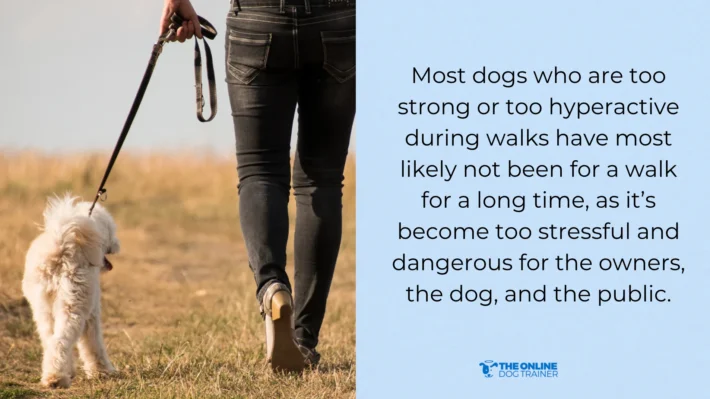
In maybe 1-in-20 difficult dogs who pull on the lead, I will apply this method of draining some of the dog’s energy before attempting to get them under control. Most dogs who are too strong or too hyperactive during walks have most likely not been for a walk for a long time, as it’s become too stressful and dangerous for the owners, the dog, other animals, and the public.
The approach I explain in the podcast is simple, but it needs to be done correctly, or you’ll get nowhere fast because it’s very subtle, and it’s easy to miss the whole point. Here’s the general idea of what we’re doing.
The Standard Approach
As a dog trainer, let me first summarize the standard approach to calming your dog down before the walk. Usually, when we’re training our dogs to stay calm and walk nicely on the leash, we only continue with the walk if your dog is calm. So we would only progress through the door if your dog has calmed down to a reasonable level. Then we would only progress down the garden path if your dog is still calm. Simple enough?
To see exactly how to do this and get your walk off to a good start, watch this video…
Training your dog to walk on the leash – The Online Dog Trainer
However, with a very small number of dogs, this is never going to happen!
Some dogs are just so super-charged up, due to their age, character, lack of exercise, breed, situation, and many other factors, that it’s almost impossible for them to calm down before we take the top off their energy.
If you have a dog that struggles with high energy levels, I encourage you to check out my program – The Dog Calming Code.
Or if you have a puppy, my Puppy Coach training program would be a great first resource for you!
THE PUPPY PROGRAM THAT WILL TRANSFORM YOUR PUPPY IN JUST DAYS!Breaking Old Habits And Creating New Ones
This approach looks at taking them for a good run at the park. The clever and very subtle part is how we take advantage of our tired-out dog when we return home and immediately put in place some brand new habits!
Breaking old habits and forming new ones, new associations and new ways of behaving, is half the battle. Once you get started, it’s so much easier to keep improving. You'll learn everything in my podcast. (And yes, this involves more than just positive reinforcement training!)
If you love learning about dog training or you have a super-charged dog… enjoy the podcast.
To take a look at my complete dog training program, The Dog Calming Code, click here.
JOIN HERE AND GET THE DOG CALMING CODE FOR FREE!Points to Remember When Walking Your Powerful and Excited Dog
The goal of our daily walks is not just a quick potty break; it's a chance to connect with our dog and provide both physical exercise and mental stimulation. But for that to happen, we need to lay the right foundation. If you have a strong dog, these points are not just helpful; they are essential to maintain control and have an enjoyable walk.
Point #1: Show Them You're The Leader In Control
From a dog's perspective, the one in front is the leader making the decisions. If your dog is dragging you out the door, they've just nominated themselves for the job! This is why they pull on the leash—they believe they're in charge of the expedition. You need to gently show them that you are the one in control of the resources and the activities.
A simple way to start this is with the food bowl. Before you feed your dog, ask them to sit and wait calmly. Only when they are relaxed do you place the bowl down. This small act communicates that you are the provider and that calm, patient behavior gets rewarded. This mindset will carry over to the walk. When your dog understands you're the leader, they are far more likely to listen to you.
Point #2: Control Their Energy Before Heading Out
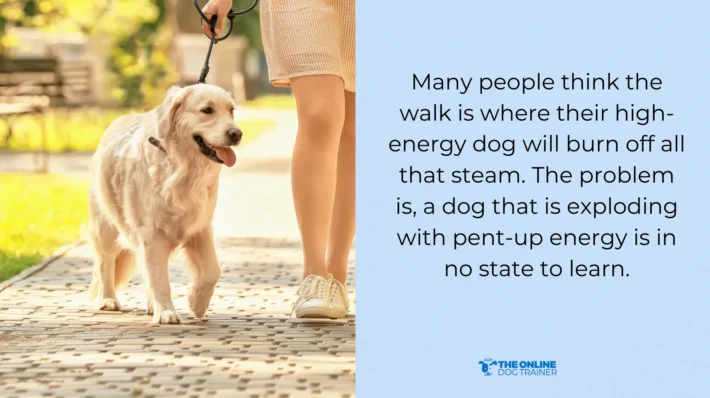
Many people think the walk is where their high-energy dog will burn off all that steam. The problem is, a dog that is exploding with pent-up energy is in no state to learn. It's like trying to teach a child algebra at a rock concert. It’s just not going to happen.
For a very excited or strong dog, especially breeds like a Border Collie that need immense mental stimulation, you must drain some of that intense energy before the walk. This doesn't mean a full-on run. It can be 5-10 minutes of indoor training, a game of “find the treat,” or some obedience drills. Providing both physical stimulation and mental challenges will take the edge off their excitement, making them calmer and more receptive to learning how to walk nicely.
Point #3: Show Your Dog You Call The Shots
The ritual of the walk itself is a major point of communication. Does your dog go frantic the moment you touch the leash? Do they rush the door? Many dogs do, and their owners simply follow them out.
You need to show your dog that the walk happens on your terms, and only when there is calm energy. If you pick up the leash and your dog starts jumping and barking, put it down and walk away. Sit down on the couch. Wait. When they’ve calmed down, try again. The moment they get rowdy, the process stops. This is how a dog learns that calm behavior is the only thing that makes the walk happen. You are in charge, and you have the power to call the whole thing off if the energy isn't right.
Point #4: Incorporate the Pause/Stop Method
This is a powerful technique to use during the walk itself. The rule is simple: the instant the leash goes tight, you stop. You become a tree. Don't move forward, don't yank the leash, just stop. Stand still and wait.
Pay close attention to your dog's body language. At first, they might keep pulling, confused as to why you've stopped. But eventually, they will ease the tension on the leash, maybe even turn to look at you. The moment they do, and the leash goes slack, you continue the walk. This process teaches your dog a very clear lesson: pulling gets you nowhere, but walking on a loose leash lets the journey continue. It may take some patience, but it’s a brilliant way for a dog to learn the proper way to walk nicely.
STOP LEASH PULLING FAST: THIS FREE WEBINAR WILL TEACH YOU HOWPoint #5: The Leash That You Use Matters
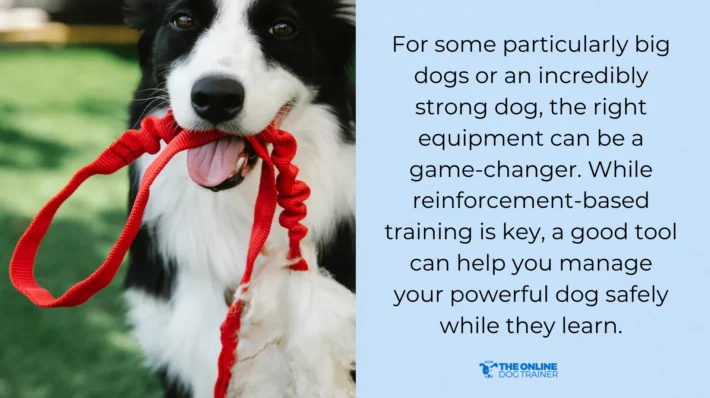
For some particularly big dogs or an incredibly strong dog, the right equipment can be a game-changer. While reinforcement-based training is key, a good tool can help you manage your powerful dog safely while they learn.
One of the tools I often recommend is a head halter. A head halter works on the principle of “where the head goes, the body follows.” It gives you gentle, effective control without any pain, allowing you to redirect your dog's attention back to you. This isn't a muzzle; your dog can still pant, drink, and carry a ball. It’s a training aid that helps you establish clear communication and prevent your strong dog from using their full body weight against you. Of course, every individual dog is different, so it's about finding what works best for you and your companion.
I also recommend my No-Pull Harness. It has a front-clip design that gently corrects pulling by redirecting your dog. By resting on the chest instead of the throat, it eliminates pressure and prevents choking, making it an ideal tool for comfortable walks with light to moderate pullers.
Point #6: Reward Good Behavior
Being a pack leader isn't about being stern about behavior problems always; it's about being clear and fair. You must let your dog know when they are getting it right! When your strong dog is walking beside you with a loose leash, even for just a few steps, tell them “Good job!” in a happy, calm voice. You can give them a small, high-value treat.
This is the core of reinforcement-based training. You are marking and rewarding the desired behavior. This makes your dog want to walk beside you because it’s a rewarding and pleasant place to be. Positive reinforcement is essential to help your dog learn quickly and build a wonderful bond with you. Many, many dogs thrive on this positive feedback.
Point #7: Watch For Safety Issues for Your Dogs or For Other People and Dogs
A true leader is always aware of the environment and protects their pack. When you are out walking your powerful dog, you must be their eyes and ears. Scan ahead for potential triggers—other dogs, cats, cyclists, children.
Watch your dog's body language closely. A stiff body, a fixed stare, or ears pointed forward can signal that your dog is about to react. By spotting these signs early, you can create distance, redirect your dog's attention, and prevent a situation from escalating. Your ability to anticipate and manage these encounters is crucial for a safe and stress-free walk, which is the foundation for any enjoyable walk with your strong dog. This is how we ultimately teach our dog to stop pulling and trust our guidance.
FREE WEBINAR: HOW TO RAISE A CALM DOG WITHOUT THE STRESSCore Techniques for Loose-Leash Training
Once you've set the stage with the points above and established that calm, respectful energy before you leave, you can start putting the finer points on your walk. These are the specific, in-the-moment techniques that will teach your dog that the best place to be is right by your side, on a nice, loose lead.
Technique #1: Master the “About-Face” Turn
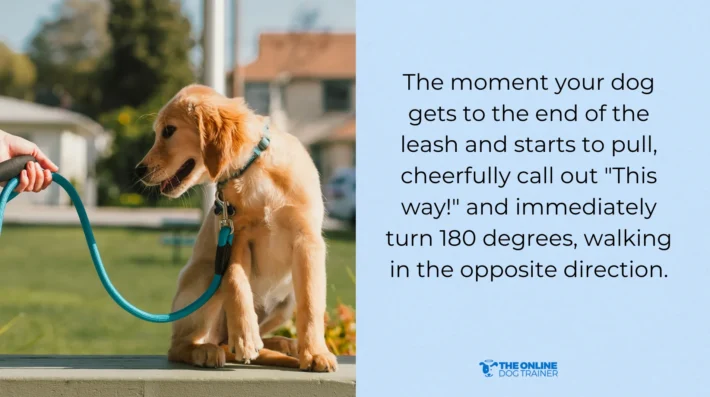
This is a wonderfully effective technique. The moment your dog gets to the end of the leash and starts to pull, cheerfully call out “This way!” and immediately turn 180 degrees, walking in the opposite direction. Don't yank or get frustrated; you are simply redirecting. The first few times, your dog might be surprised, but they will quickly catch on. This method teaches a powerful lesson: “Pulling ahead doesn't get me where I want to go. In fact, it takes me further away. I need to pay attention to my leader.”
Technique #2: Reward Every “Check-In”
On your walk, there will be moments when your dog, without being asked, glances back at you. This is a golden opportunity! They are checking in with their pack leader. You must reward this behavior. The instant they look at you, mark it with a happy “Yes!” and give them a small treat or warm praise. By doing this, you are reinforcing their choice to connect with you. Soon, your dog will be checking in with you more and more, making them far less likely to be distracted by the environment and pull ahead.
Technique #3: Aim for the “J” Shape in the Leash
A loose leash should have a visible sag in it, creating a “J” shape between your hand and your dog's collar. A constantly tight leash creates physical and mental tension. For many dogs, especially a strong dog, it triggers something called an opposition reflex—their instinct is to pull against pressure. If you are always holding the leash tight, you are inviting a tug-of-war. By consciously keeping a bit of slack, you reduce this tension and can communicate with much more subtle cues.
Technique #4: Be More Interesting Than a Tree
As the pack leader, you should be the focus of the walk. To achieve this, be a little unpredictable. Don't just walk in a straight, boring line. Suddenly change your pace from slow to fast, then back to slow. Make a surprise right turn. Stop and ask for a quick “sit.” By keeping your dog guessing, you have to pay more attention to them. You become more interesting than the smells on the ground or the squirrel in the distance, which is key to teaching them to walk nicely by your side.
JOIN THIS FREE WEBINAR AND GET MORE ENJOYABLE WALKS WITH YOUR DOGThanks for Listening!
Thanks again for listening to the Show! If it has helped you in any way, please share it using the social media buttons you see on the page.
Additionally, reviews for the podcast on iTunes are extremely helpful and greatly appreciated! They do matter in the rankings of the show, and I read each and every one of them. The higher the ranking, the more people will discover this calm and gentle method of dog training.
Doggy Dan's Training: My Answers to Your FAQs
My dog is too strong and pulls me on walks. What's the first thing I should do?
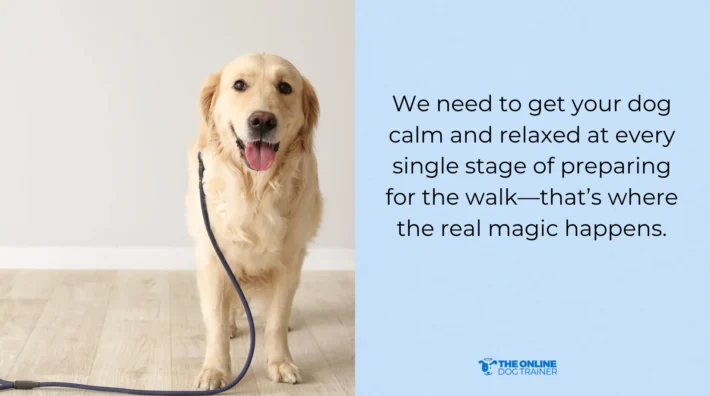
The very first thing I always tell people is that the key to a calm walk starts long before you even step outside. It all begins inside your home with you establishing yourself as the pack leader. We need to get your dog calm and relaxed at every single stage of preparing for the walk—that’s where the real magic happens.
How can I calm my dog down before a walk?
My approach is simple: we only proceed with the walk when your dog is calm. That means we patiently wait for your dog to settle down before opening the door, and then again before taking that first step down the path. If your dog gets excited, we simply pause and wait for that calm energy to return before we continue. It's all about teaching them that only calm behavior gets them what they want.
What is your “standard approach” to leash training an overexcited dog?
I teach a step-by-step process that’s all about rewarding calm behavior. We only move to the next stage—whether it's picking up the leash, opening the door, or stepping outside—if your dog is in a calm state of mind. This quickly teaches your dog a powerful new rule: excitement gets you nowhere, but calmness opens the door to a wonderful walk with me.
What if my dog is too energetic to ever calm down before a walk?
I've worked with thousands of dogs, and I've found that for a small number of them—maybe 1 in 20—the standard approach isn't quite enough. These are what I call “super-charged” dogs. They have so much pent-up energy that it's nearly impossible for them to calm down. For these special cases, I have a different strategy we can use.
What is your special technique for these “super-charged” dogs?
With these incredibly energetic dogs, my recommendation is to drain some of that excess energy before we even attempt a structured, calm walk. This often means taking them for a good, hard run at a park or another safe, open space first to take the edge off their energy.
How does tiring my dog out before a walk help with leash training?
Now, here’s the clever and very subtle part of my technique. It’s what we do after your dog is tired that makes all the difference. As soon as you return home from that run, we immediately start putting new, calm habits in place. A tired dog is much more receptive to learning and far less likely to pull. This is the golden opportunity to break those old, frustrating habits and build new, positive ones.
What are the key principles of your training philosophy for walking?
My entire training philosophy for walking boils down to a few core principles. First, you must be the pack leader. Second, calmness is everything; it's the foundation for a good walk. Third, be consistent in everything you do. And finally, remember that our goal is to break old, unwanted habits and create new, wonderful ones.
How does your approach help me achieve loose leash walking?
This is a great question because loose leash walking is the beautiful result of everything we do before the walk. The secret is that a tight leash is just a symptom of an overexcited mind. My methods focus on calming your dog’s mind and establishing you as the leader inside the house. When your dog is calm and looking to you for direction, they are far less likely to charge ahead and pull. The loose leash happens naturally because you've addressed the root cause of the pulling, not just the symptom.
Where can I find more of your training resources?
I have several resources available to help you on this journey if you're dog pulls the leash all the time. You can start with my free download, “The 7 Most Common Mistakes People Make When Walking Their Dogs.” For a comprehensive solution, I encourage you to check out my full program, The Dog Calming Code. And if you have a young pup, my Puppy Coach training program is a fantastic place to begin!
What are some common mistakes to avoid when walking my dog?
One of the biggest mistakes I see owners make is trying to start a walk when their dog is already bursting with excitement. That's a recipe for disaster! To help you avoid this and other common pitfalls, I’ve put together a free guide called “The 7 Most Common Mistakes People Make When Walking Their Dogs,” which you can download from my site.
Do you think it's really possible to train my dog to walk calmly on a leash?
Absolutely! I truly believe that with the right approach and a bit of consistency, you can train any dog to walk calmly. I’ve seen it happen time and time again, just like with the lady who ended up clinging to a lamppost with her two Labradors! The hardest part is getting started, but once you begin using these techniques, it becomes so much easier to keep making progress. Have a great training day, and as always, love your dog.
Does the type of leash I use for my dog matter?
Choosing the right walking equipment is critical for training a dog that pulls.
- Standard Flat Collars: These are a poor choice for pullers. They can injure your dog’s neck and often trigger an instinct to pull even harder against the pressure, offering you very little control.
- Body Harnesses: While safer for the neck, standard back-clip harnesses can actually encourage pulling. A front-clip harness is a better option, but may not be enough to manage a very powerful dog.
- Head Collars (Head Halters): Often the best solution for strong pullers, this is a training tool, not a muzzle. It works on the gentle principle of “where the head goes, the body follows,” allowing you to redirect your dog easily and without a struggle. It removes all pressure from the neck and provides excellent control, making walks safer.
- Doggy Dan's recommendation: Doggy Dan's no pull harness gently corrects pulling with the innovative front-clip design that steers your dog back to you. This humane harness rests across the chest to prevent any choking or pressure on the throat, making it ideal for comfortable walks with light to moderate pullers.

~Doggy Dan 🙂

38 Responses
Listening to the podcast.. sounds great in theory – but what if you dog barks manically in the car!?
Hi Nicky, thanks for your feedback! Dogs who bark in the car is a really common issue and there are definitely strategies you can use to help calm things down. One thing I always recommend is to look at the process owners use to get their dogs into the car….are they too excited/nervous before they even get into the car for example? My website TheOnlineDogTrainer.com has strategies and techniques related to barking in the car…maybe take a quick look…its a $1USD trial for 3 days…all the best Doggy Dan
We have an 8-month-old terrier mix that includes Boston terrier. She gets very excited on walks. I’ve been taking her on short walks on our block to get her used to it. Progress is slow, especially when she sees other dogs, people or there are barking dogs behind a fence. She seems to relax a lot when we get home. Is she likely to outgrow some of this excitability? Or do you think she might always be hard to walk? She likes to chase a ball and I could just settle on that as her exercise in the backyard.
Hi Gina,
At 8 months of age a dog will generally not just grow out of a behaviour, they will need help from their owner to learn how to behave correctly. One thing to practice is the routine you use when preparing to go for a walk, but really focus on your dog being calm at each stage. This may mean that you do some additional, short practice sessions when you have no intention of actually going for a walk…just so you can encourage the right behaviours. Starting a walk with your dog at a calmer level does have a big impact on their behaviour when they are actually on a walk. My website TheOnlineDogTrainer.com shows you very clearly how to achieve this…maybe take a quick look…its a $1USD trial for 3 days…all the best Doggy Dan
Hello, i have a 2 year old kelpie x cattle. Lately I have given up walking him because it has become very stressful and un enjoyable. He wimpers and cries in over excitement and pulles the whole time he is on the leash and if he sees another dog he goes completely bonkers. When hes off the leash he is happy but runs big circles around me and i dont feel comfortable allowing this as i feel its unsafe and if there is another dog out walking im worried he might get hurt or hurt the other dog. Is there any hope in training him, can you give any suggestions on how i can overcome this behaviour?
Hi Jess,
Issues when dogs are on-leash, such as pulling or over-excited behaviour, is something I get asked about a lot! There are a lot of dog owners out there not feeling like they are in control on the walk but this is certainly a something you can improve on. My biggest recommendation is to look at your dog’s behaviour from them moment you even think about going for a walk, and take note of their excitement level. For example, if you can’t even pick up their leash or put on a certain pair of walking shoes without them going bananas then this is the moment your walk actually breaks down and your dog takes control…..often long before you even exit your house! One of the key things to changing this behaviour and calming things down is to practice these things frequently, which you can do when you are around your house and have no actual plan to go on a walk, so that your dog starts to realise that excited behaviour gets him nowhere. If he pulls on the leash then practice changing direction each time he does, but again start this practice in your home first and gradually extend your lesson. In order to really make ground on this behaviour you do need to be consistent and so initially your walks may not be as long as they normally are because your focus should be on the quality of the information you give your dog. My website TheOnlineDogTrainer.com shows you very clearly what to do…maybe take a quick look…its a $1 trial for 3 days…all the best Doggy Dan
Hello,
I’m having a real problem with my rottweiler, she’s well trained however she constantly testing me in the walk, she’ll never walk calmly, always pushing ahead. I am pack leader and she knows it. Food respect etc.
However she sees another dog in the car or on the walk on leash or off and goes bezerk, i’ve been damaged as in pulled on my front through rocks and stones and mud unto 10m such is the strength of her, she went listen, i cant body block her, she just attacks for no reason. Theres no tension and no suspense as sometimes she will spot a dog before me! Do i have to put her down? Please help.
Hi Micela,
Having an obedient/well-trained dog can be a very different thing when it comes to problem behaviours. Dogs can do all sorts of tricks and follow commands to make you happy, but if they feel that there are more important things to attend to…..like other dogs and your safety on a walk….then those commands and obedience can all come crashing down. The reason this happens is that dogs don’t view commands as a sign they believe their owners are the leaders or decision makers in their pack/family, they have a totally different set of criteria to work this out. So obedience is important but it’s not the thing that creates well behaved dogs. My website TheOnlineDogTrainer.com shows you very clearly how to achieve this…maybe take a quick look…its a $1 trial for 3 days…all the best Doggy Dan
Hi, I must say I am now on my 7th german shepherd and your article is spot on however I have never had the issues with any of the others that I have now! I think he is more working than we had been led to believe. I would love to obtain your 5 golden rules My friend has offered to obtain these videos from you with his pay pal acct. Could you let me know how much the videos would be if they in CD form so I can share them with my dog clubs, Yours Jenny.
Hi Jenny,
We only have these videos available on my membership website and not for individual purchase. My website TheOnlineDogTrainer.com has a a $1 trial for 3 days…maybe take a quick look and see what you think….all the best Doggy Dan
Hi Dan
We have two dogs a cavalier king charles, Gus and a border collie, Kobe. There is 6 months between them, Gus being the eldest and 1st with us. They have had a strong rivalry since day 1 and now 3 years on despite extensive training, including crate training they are still highly anxious, excitable and always worried about what the other is up to. I wish you were here so you could see what I am talking about. They are crate trained and this has helped but when it comes to a walk, the border collie is a nightmare. We have taken your advice and drive to the park and wear them out before attempting a walk and this is good but Gus does a high pitched bark the whole time (we throw the ball). We have tried so much and spent a lot of money but I worry about how anxious they both are. Do you have any suggestions? ( we have even tried medication but just don’t like the idea of it).
Regards
Sally
Hi Sally,
My biggest piece of advice for helping a dog overcome issues on the walk is to review what’s happening from the moment you even think about going for a walk. Often a dog will get really excited at the mere sight of their leash, or your sneakers/jacket/car keys as they know it means they are going for a walk. The issue is that if they are really excited at this point then you have already lost control of the walk before you have even left the house. So my advice is to break the process down into smaller steps and practice these when you are at home without the intention of going out for a walk. I mention some of these stages in the Blog but the key really is practice, practice, practice and making sure your dogs are at the lower end of the excitement spectrum. If they get to excited during practice then stop, go and do something else for a while and when they are relaxed try again. My website TheOnlineDogTrainer.com shows you very clearly how to achieve this and we also deal with anxiety…maybe take a quick look and see what you think…its a $1 trial for 3 days…all the best Doggy Dan
Hi Dan
My 8 year old female rotti is such a calm loving dog and walks to heel but as soon as ahe sees another dog she is constantly pulling and barking to get to it could you please advise me what to do
Hi Shelleyanne,
I have posted a link to another blog I wrote (below) and I think it may be helpful in understanding what is motivating your dog’s behaviour. A key component of overcoming this behaviour is how you respond, both proactively and reactively. Try to remain calm yourself, for a dog who may be panicking it is far more reassuring that are behaving calmly and with as little fuss as you can. If you see a dog approaching and your dog is becoming agitated then allow her some space and move her away. This will enable her to feel a little safer and also remain calm enough where you can help work her through her behaviour. The temptation is often to simply expose a dog to other dogs in the hope that they will overcome their behaviour, but without giving them the correct information as well this will likely not happen. Have a look at the blog link below and my website TheOnlineDogTrainer.com also shows you very clearly how to achieve this…maybe take a quick look…its a $1 trial for 3 days…all the best Doggy Dan
http://theonlinedogtrainer.com/training-aggressive-dogs-understanding-dominant-and-fearful-aggression/
Dan,
My dog is a year old. We have been training her for about a month now and she occasionally still refuses her food when we put it down for her. So we take it away. Is it normal for a dog to go back and forth in recognizing we are the pack leader? We have 7 people in the family all trying to learn to be pack leader, could this be why we are seeing the Inconsistency? Also, is it good to have my dog sleep in a crate every night? We want her to like her crate for when she spends the night in someone else’s home, but we are worried if we allow her to sleep in the bedroom on the floor, she will not want to sleep in her crate.
Thanks!
Hi Keri,
It is very normal for dogs to test their owners occasionally just to make sure that everything is as it should be. Dogs will usually do this if something has changed in their world, they have had a stressful encounter, the family has become inconsistent with the rules, but it could be anything really. The most important thing to quickly overcoming a dog who is testing you is how you respond, so ensure everyone is giving your dog the right information. My own dogs will occasionally skip a meal so i just make sure I stick to the process and usually pretty quickly they are back on track. Of course I do make sure they are not unwell!
In my opinion crate training a dog can be a incredibly helpful thing to do, for so many reasons, but it is vital that the crate is used correctly and not to shut dogs away for extensive periods of time. Having your dog used to sleeping i a crate is a great idea but it really does depend what you feel comfortable with. Many dogs do love their crates but some also find it a real challenge to be contained, so it’s about finding what works for your dog. You can certainly use a combination of your dog sleeping in their crate and on your bedroom floor occasionally, if your dog copes well with that. A little flexibility is fine! All the best…Doggy Dan
Hi Dan,
I am really enjoying all your lessons, so I want to thank you for sending all you emails.
I am glad to see you using and promoting a harness in stead of a collar. Because a collar can be very damaging for a dogs health. As you may know the thyroid is placed in the neck and this very important gland can easily be damaged when a collar is used, any kind of collar!
Now I could use a little advise from you. I have two rottweilers, both female, mother and daughter actually. The mother will be 10 in September (I hope) and the daughter, Ischa has just turned 5. It is about her, that I need your advise. She is almost always very well behaved, except when I have been away for a while and come home. She is so happy to see me back, that she jumps me when I get in. I try to not give her any attention at that moment, I have tried giving her the command to sit, I have turned my back to her…nothing helps.One time I made the mistake to get angry and the result of that was it got worse for that moment, as if she needed to win my approval again…
Any ideas?
Hi,
Thanks for your post! I do have advice for you in relation to your dog getting really excited when you return home and that is to delay speaking to her or making eye contact until she has calmed down and left you alone for around 5 minutes. If she jumps at you then you can turn to the side to block her but it’s important not to tell her to ‘sit’ or ‘get down’ as this is actually the attention she is after in doing the behaviour in the first place. It then means she will do that exact behaviour then next time you return because she knows it works. If you show her that jumping up doesn’t gain attention then she is more likely to stop doing it, but you may need to stick to the plan and persevere for a little while. Some dogs are determined! If she is really bad then I would even suggest stepping back outside the door again as soon as her jumping becomes too much for you. initially don;t move too far away from the door so that as soon as she jumps at you too much then you can step back outside. The whole point of this is that she realises she will lose you if she jumps on you and we are then encouraging her to use self-control, the best form of control we have. Again, you may need t repeat this a few times but it is really effective. Stay calm and consistent and she will understand what you want from her. Hope that helps….All the best, Doggy Dan
What is the name of this type ofHarbess please?
Hi Jill, I would google search for an “Easy Walk” harness or a “Halti harness” (Not a Halti but a halti-harness) cheers Dan
Hello,
I have been introduced to your site. My little girl is just about 1 year old. She is very well behaved most of the time but has become terrified of other dogs for no particular reason (since about age 6 mos). She absolutely goes berserk and barks constantly at the site of another dog even from a distance or from inside the car. I’ve tried everything! Taking her in another direction, calmly talking to her, picking her up and holding her, scolding her and reluctantly even a shock collar (i only put it on her 2 times and took it right back off after her reaction to the shock) I don’t know what else to do. There seems to be no improvement no matter how much I work with her. She is such a sweet girl but turns into a real demon around other dogs!
Hi Stacey,
The behaviours you describe are really common and the reason your dog is behaving the way she is is because she feels responsible for keeping you safe and she is panicking whenever she thinks you are in danger. You can certainly help her relax in these situations by showing her that it is now your job to keep everyone safe and the best way to do that is by using a language, or form of communication, that she understands and can trust. My website TheOnlineDogTrainer.com shows you very clearly how to achieve this…maybe take a quick look…its a $1 trial for 3 days…all the best Doggy Dan
I have a rescue dog thats 5 months old and eats loke she has never had any food. We have had her for 4 months now and thought she would change. Do you have any suggestions…
Hi Sandra, unfortunately your message has come up as “eats loke” and I’m not sure what that is.
I would check with your local vet that she is healthy and see what they would recommend. Most puppies are well into eating dog food by 5 months of age so it may be that your vet suggests a food thats gentle on her tummy to start with. All the best, Dan
I think she meant to say “eats LIKE she has never had any food”
Yep 🙂
Your success with dogs on consultations is based on your leadership via the 5 golden rules. How do you establish yourself so quickly as pack leader? Or does the video not show some preliminary work that you do?
Hi Jewel, I think it works so well as the dogs immediately get a clear message from me. I start to apply the rules ASAP and often complete all 5 of them within the hour. Then its often plain sailing, the dogs listen and its easy. I dont like to over complicate dog training. I think we often make it so much harder than we need to. Remaining calm and taking it slowly etc is also important. Best, Dan
Hi Dan, I have 3 dogs and take them to our community park twice a day for play time. One is so excitable that I have a hard time calming him down. any suggestions? thanks Nikki
Oh yeh! Lots of suggestions 🙂
1. Become the pack leader…
2. Master the walk. Maybe do this one dog at a time to start with.
3. Use a short line / long line so you can catch the noisy one when they start up
4. Consider only letting the calmest one off the leash first.
5. Use the calm freeze technique to calm your dog if they bark.
The first 2 suggestions will make a huge difference to the energy of your pack if they are done correctly. Its not a trick but a way of being with the dogs. It calms them down…your dogs sound a bit of control a bit (almost stressed with excitement if you know what I mean) All the best, Dan
Hai Dan, (a question from a dog behavior from the Netherlands)
I was looking at Your short video, walking on the leash. I saw that you give short corrections. In the Netherlands is that not-done. How do You think about corrections? I train people to used positive reinforcements. What is Your opinion about that? I always want to learn from every body.
greats Henk Leusink, Abbenbroek, Zuid-Holland.
Hi Henk, I am not sure of the exact short correction that you are talking about. I really do try to stay away from corrections although the reality is that even a pull on the leash is a force. If you think about it logically, when a dog tries to walk the other way to you and ignores your food lure/bribe/reward there are not many options left. (Following your dog is not a good choice!) However the more I work with dogs the more I am finding that a 180 degree turn infront of the dog followed by another 180 degree turn is powerful. However its all the OTHER stuff inside the house that really wins the dogs brain first. (Becoming the pack leader) Sometimes I will try using food, a harness etc… Like you I am always trying new stuff. All the best in your journey of discovery.
Dan
I love listening to you as it does make sense, I’m just trying to put it in to practice I’m not giving up and my girl is not the over excited one it’s the boy he doesn’t leave her alone. Your methods are great and it looks easy but I have to say I’m struggling. I tell a lot of people about you methods because they make sense and are not cruel. Wish you were here in Australia.
Hi Pam, stick with it…sometimes its a matter of time. Of course sometimes there is something else going on. I appreciate your kind words about my training program. I presume that you are inside the members site? If not, then this could be the missing piece. Whatever you do, remain calm and show your dog what you want him to do…often a simple bit of walking around with the dog on a short leash can do the trick…Best, Dan
Please tell me, do I become a member to have access to all your training videos. Please advis eon how this is done.
Hi Arthur,
yes when you join the site for the $1 trial you get access to all the videos, including how to become the pack leader (the key section). During this time you can cancel if you wish or stay on. You can start your $1 trial for 3 days here http://theonlinedogtrainer.com all the best with your training, Dan
I do not have an exit to my house where my dog can exit behind me. The door is an automatic door which would close on him should I go out first.
Hi John, I would keep your dog on a really short leash as you pass through the door so he passes out safely with you.
The last thing you want is the automatic doors closing on him! All the best with your training 🙂
Dan