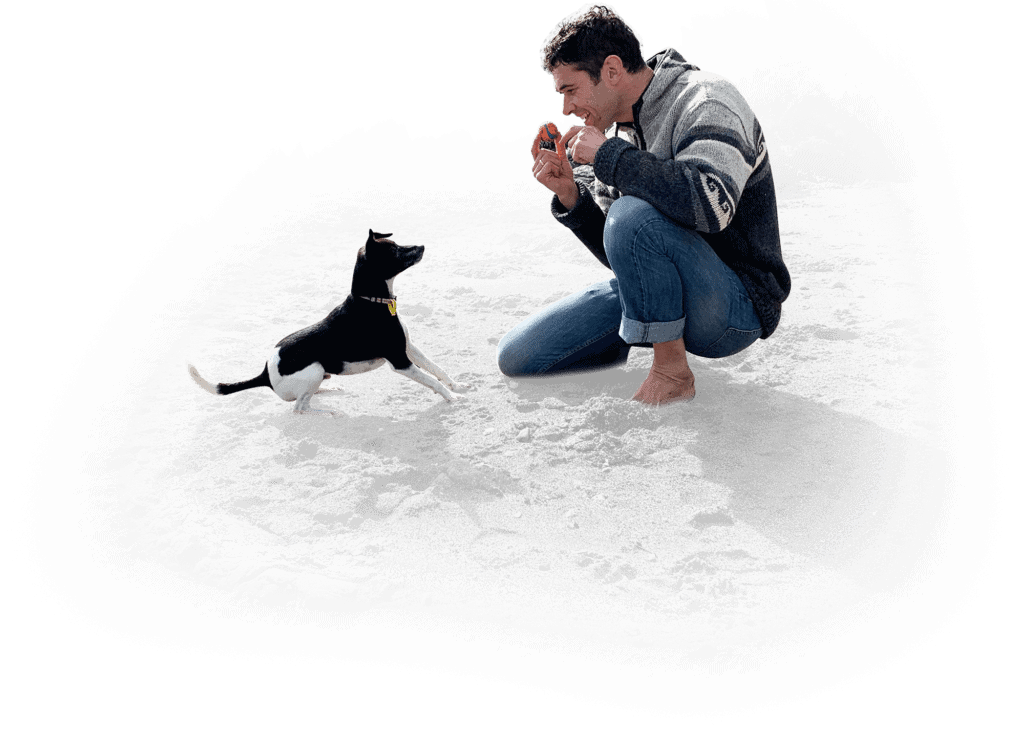
Dealing with dog anxiety on walks requires a shift in perspective: your dog is purely focused on survival. To a dog anxious when outside the house, every sight and sound outside the home is a potential threat. One of the best tools to help them feel safe the moment you step outside is by utilizing a technique called “The Calm Freeze.”
It’s a heart-wrenching shift to watch—your calm dog indoors becomes a nervous wreck the second the leash goes on. When your dog is anxious when outside the house, they aren’t doing this because they’re naughty.
An anxious dog is just a dog who needs to make sure they’re safe. If you want to know how to ease dog anxiety on walks, you must stop trying to push through the fear.
Instead, you need to understand why your dog is scared to go on walks and how to use The Calm Freeze to show them that you are the one in control of their safety.
Read on to learn more about how to have calmer, anxiety-free walks with your dog.
Key Takeaways
- When a dog is anxious when outside the house, they’re showing a hardwired survival response. Your dog feels they are responsible for their own safety, and without a clear leader to protect them, the sights, sounds, and smells of the world become overwhelming threats.
- To truly understand how to ease dog anxiety on walks, you must address the leadership gap. By implementing a clear structure at home and on the lead, you take the burden of responsibility off your dog’s shoulders, allowing them to stop scanning for danger and start trusting your guidance.
- Calming an anxious dog doesn’t require force or shouting; it requires “The Calm Freeze.” By stopping, staying silent, and gently holding your dog’s collar, you act as a calm anchor that mirrors the peace you want your dog to feel, physically lowering their energy from a state of panic to a state of stillness.
What Causes Dog Anxiety On Walks?
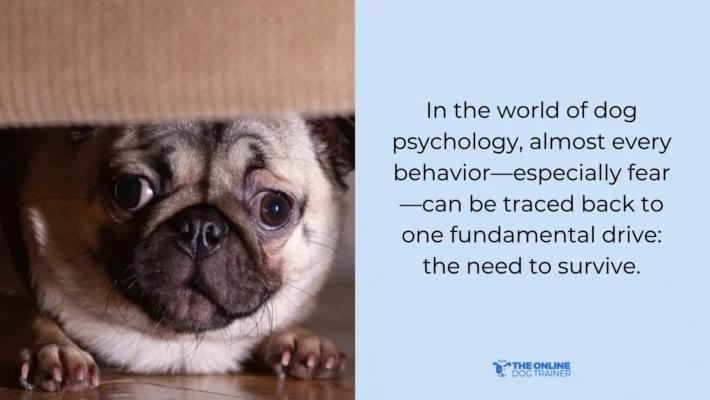
To understand how to calm an anxious dog, we have to look at the world through their eyes. In the world of dog psychology, almost every behavior—especially fear—can be traced back to one fundamental drive: the need to survive.
Survival is hardwired into your dog’s DNA. It is the single most important thing in their life. In any given environment, a dog is typically in one of two mindsets: they are either prepared to work and fight for their own survival, or they are looking for a trusted leader to help them navigate the world safely.
The Leadership Gap
The reason for dog anxiety on walks often boils down to a leadership issue. If your dog doesn’t believe you are the one in charge of their protection, they feel forced to take on the role themselves. Here is why a lack of leadership can cause anxiety in walks all the time.
The Burden of Responsibility
When a dog feels they are the “Pack Leader,” they believe it is their job to monitor every potential danger. That is a massive, stressful weight for a dog to carry in a busy neighborhood.
They Don’t Have A Lot of Trust in Your Protection
If they don’t see you making the decisions, they don’t feel safe under your wing. Without that canopy of safety, they feel vulnerable and exposed.
Dog Still Thinks They’re the Leader
Inside the house, things are quiet, and roles are clear. But the moment you step out, if you aren’t leading, your dog assumes they must—and they aren’t equipped to handle the modern human world.
Your Dog Experiences Sensory Overload
We often forget that while our homes are predictable, the great outdoors is a sensory explosion. For a dog anxious when outside the house, the environment is overwhelming:
- Dozens of unfamiliar people, moving vehicles, and strange dogs appear from every corner.
- The roar of engines, sirens, or even loud wind can feel like an aggressive threat.
- An incredible flood of scents that tell your dog a thousand stories they feel they need to react to or defend against. For an animal with a very strong sense of smell, this is completely overwhelming.
Signs Your Dog Is Still In Survival Mode During Walks
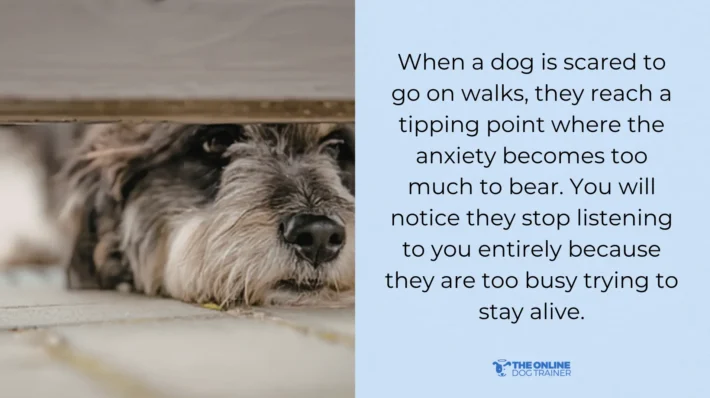
When a dog is scared to go on walks, they reach a tipping point where the anxiety becomes too much to bear. You will notice they stop listening to you entirely because they are too busy trying to stay alive. Common signs include:
- Constant scanning, pulling on the leash, or being unable to settle.
- Ignoring your voice or treats because their brain is locked on the threat.
- Heavy panting, a tucked tail, or visible trembling.
Understanding that this is a survival response—not just bad behavior—is the first step in learning how to ease dog anxiety on walks. Your dog is not doing this to be difficult; they are simply overwhelmed and waiting for you to show them that you’ve got everything under control.
The Story of Kerry: How To Ease Dog Anxiety On Walks
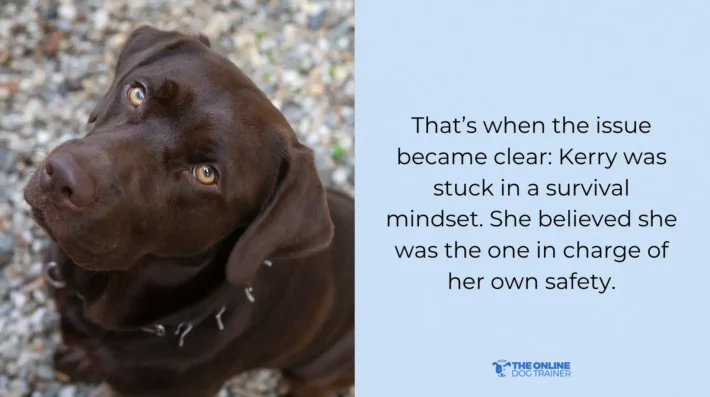
I remember meeting Judy and her lovely Labrador Retriever, Kerry. Inside their living room, Kerry was the picture of a relaxed Lab—thumping her tail against the floor and leaning in for head scratches. But Judy was at her wits’ end.
“I don’t understand it,” Judy told me. “The moment we get to the front door, she’s a different dog. A car honk or a distant bark makes her tremble. Most days, we just turn around and go home because she’s so distraught. I feel like I’m failing her.”
The moment we stepped onto the front yard, I saw exactly what Judy meant. Kerry’s ears pinned back, her tail tucked, and she began frantically pulling the leash back toward the house. She wasn’t being stubborn; she was desperate to get back to the only place she felt safe.
The Realization
That’s when the issue became clear: Kerry was stuck in a survival mindset. She believed she was the one in charge of her own safety. To her, the yard wasn’t a place to sniff the grass—it was a battlefield where she thinks her safety is jeopardized. When a dog is scared to go on walks, it’s almost always because they feel the heavy burden of leadership on their shoulders.
I knew that to help Kerry, I had to change the energy of the walk. I didn’t say a word. I simply stepped in and did The Calm Freeze.
The Moment of Connection: Using The Calm Freeze
I calmly guided Kerry toward me and gently hooked two fingers into her collar with my hand upturned. At first, Kerry resisted. She tried to pull away, her eyes wide as a car drove past. Most owners would react by pulling back or shushing the dog, but that just adds more energy to the fire.
I stayed completely still. To help Kerry calm down, I wanted to make her see that what made her panic was not affecting me.
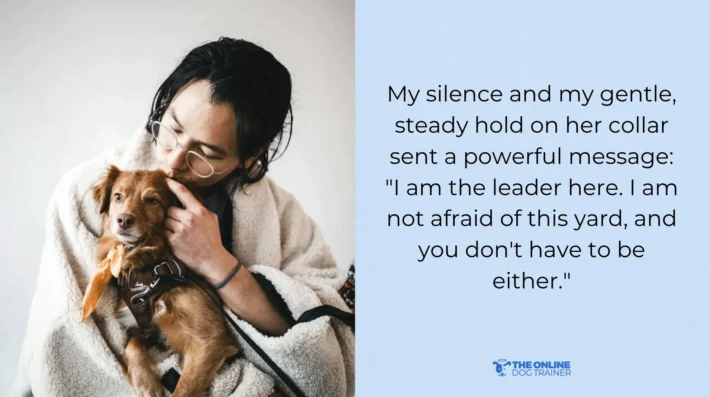
For about sixty seconds, Kerry was a “Level 8” on the anxiety scale. She was panting and restless. But because I didn’t move, shout, or tense up, she had nothing to fight against. My silence and my gentle, steady hold on her collar sent a powerful message: “I am the leader here. I am not afraid of this yard, and you don’t have to be either.”
The Release
Then, it happened. I felt it through my fingers first—the tension in her neck muscles simply melted away. Kerry took a long, deep sigh of a breath, her ears relaxed, and she finally sat down and looked up at me. Her energy had dropped from an 8 to a 2 in a matter of moments.
I waited for another beat to ensure the calm was real, and then I gradually loosened my grip and released her.
The Result: A More Relaxed Dog On Walks
The walk that followed was unrecognizable. When we reached the sidewalk where Kerry usually panicked, she paused, looked at me for guidance, and seeing that I was still unbothered and calm, she simply kept walking.
This is the beauty of knowing how to calm an anxious dog. By using the Calm Freeze, I didn’t just stop her from pulling; I changed her internal emotional state. I took the weight of the world off her shoulders and put it onto mine.
Judy watched in silence, finally seeing that her dog’s anxiety on walks wasn’t a permanent personality trait—it was just a cry for leadership. Once Kerry knew I had the survival part covered, she was finally free to just be a dog.
What Is “The Calm Freeze” and How Do You Do It?
When your dog transforms from calm to chaotic in a heartbeat—whether due to a car honking, a squirrel, or a strange dog—you need a way to bring them back to calmness. The Calm Freeze is a powerful, force-free technique that shifts your dog from a state of survival or overexcitement back to a state of peace.
The Calm Freeze is a gentle way to emphasize emotional resonance. By showing your dog you are calm in an environment that triggers them, you communicate to them that you are the leader and they are safe.
How to Perform the Calm Freeze
The goal is to lower your dog’s energy from a “Level 8” spike back down to a “Level 2” or “3.” Here is how you do it:
Step 1: Guide Calmly
When your dog becomes agitated, guide them toward you. Avoid shouting or jerking the leash, as high-energy corrections only add fuel to their fire.
Step 2: The Gentle Hook
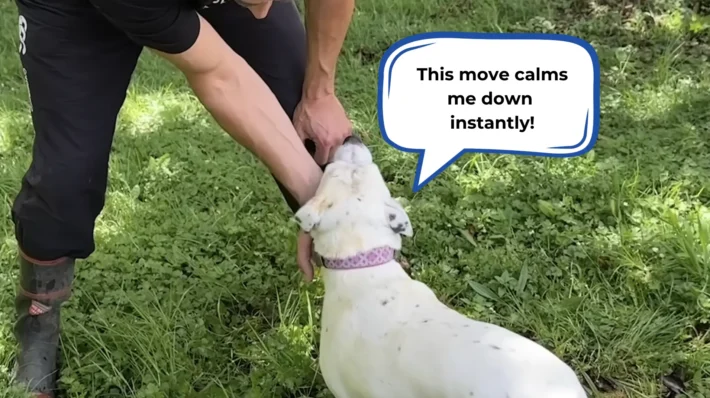
With an upturned hand, use one or two fingers to lightly but securely hold your dog’s collar. Do not grip tightly; the touch should be gentle but firm.
Step 3: Be the Rock
Stand perfectly still and silent. Do not pet, soothe, or talk to them. Your steady, calm presence acts as a mirror for your dog’s emotions.
Step 4: Manage Negative Reactions
If your dog becomes so overwhelmed they attempt to bite, calmly transition them into a timeout to let the adrenaline dissipate before trying again.
Step 5: The Release
Wait until you feel their muscles soften or see them take a deep breath. Once their energy has dropped, gradually loosen your hold and release.
Why The Calm Freeze Is Important
This technique is a cornerstone of effective dog ownership for three vital reasons:
Your Dog Understands It
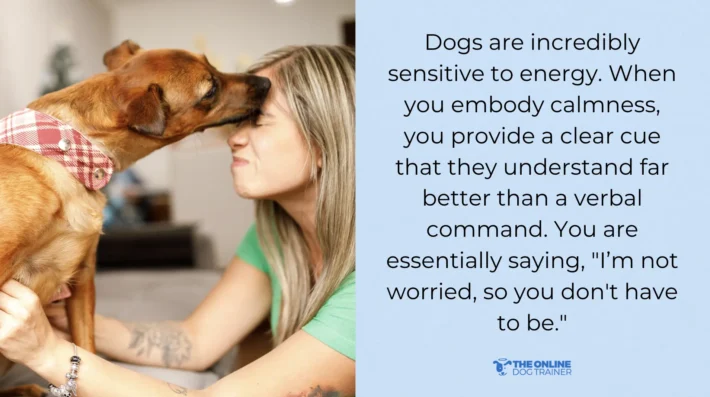
Dogs are incredibly sensitive to energy. When you embody calmness, you provide a clear cue that they understand far better than a verbal command. You are essentially saying, “I’m not worried, so you don’t have to be.”
This Move Re-establishes Leadership
Strong emotions like aggression, anxiety, or hyper-reactivity usually stem from a dog feeling they must be the “Pack Leader.” The Calm Freeze proves you are the one in charge of their safety.
It De-escalates Situations Fast
Unlike shouting or force—which often increases a dog’s heart rate—the Calm Freeze diffuses tension immediately. It works for everything from interrupting a potential dog fight to comforting a dog who is scared to go on walks.
What To Do When Your Dog Is Scared To Go On Walks
If your dog is putting on the brakes or trembling at the door, you can’t just pull them through it. You have to address the root cause: their need for leadership and a sense of safety. Here is how to handle it:
Step 1: Check If Leadership Is In Place
Before you even pick up the leash, ask yourself: Does my dog think I am the one in charge of our survival? If your dog is making the decisions at home—deciding when to eat, when to play, or who gets on the couch—they will naturally feel they have to make the decisions outside, too. That responsibility is what causes the panic.
Step 2: Follow My Five Golden Rules of Leadership
If the foundation isn’t there, you need to go back to the basics. Being a confident leader is the prime goal here. Dogs don’t want a “boss”; they want a protector they can trust.
The Five Golden Rules are a set of essential things to do to ensure your dog truly sees you as a capable, confident, and trustworthy leader.
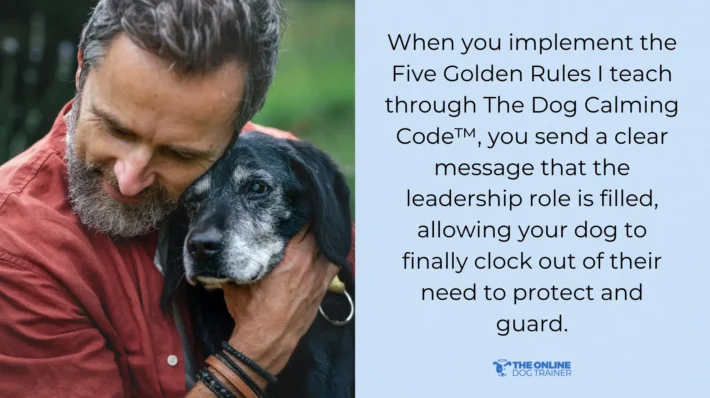
When you implement the Five Golden Rules I teach through The Dog Calming Code™, you send a clear message that the leadership role is filled, allowing your dog to finally clock out of their need to protect and guard.
Step 3: Be The Source of Calm
Your dog is a mirror. If you are tensing up because you’re worried your dog might react, they will feel that tension and assume there is a reason to be afraid. You must project an aura of “all is well.”
How To Help Your Dog Be More Confident To Walk Outside
Always Show Leadership
Leadership isn’t a part-time job. It starts at the front door. You should be the first one to walk through it, setting the tone that you are leading the way into the “unknown.”
Start with Small Training
Don’t aim for a three-mile hike on day one. Start by just standing in the yard or walking to the end of the driveway. Use the Calm Freeze the moment you feel their energy spike, then go back inside once they are calm.
Always Lead the Walks (Structured vs. Social)
For an anxious dog, structured walks are vital. This means the dog is walking beside or slightly behind you on a loose lead. Social walks—where the dog is allowed to roam, sniff, and “be a dog”—are great, but only once the anxiety is gone. For now, a social walk makes a fearful dog feel they are the ones out in front, scouting for danger. Structure provides safety.
Respect Your Dog’s Readiness
Never force or drag your dog. If they are truly overwhelmed, stop, perform the Calm Freeze, and if they can’t settle, turn around. Forcing a dog into a “fear zone” only reinforces that the outside world is a place of trauma.
Acknowledge Progress
It might be a small win—maybe they walked ten feet further than yesterday—but acknowledge it. A calm “good boy” or a gentle pat goes a long way.
Be Patient. Don’t Be Angry
Leadership is never about anger or frustration. If you lose your cool, you prove to your dog that you aren’t a stable leader. Stay patient, stay calm, and remember: you are building a lifetime of trust, one step at a time.
The Dog Calming Code™ Will Help You Establish Leadership For More Peaceful Walks
If you’re struggling with dog anxiety on walks, the most important thing to realize is that the walk doesn’t actually start at the front door—it starts at home.
When a dog is anxious when outside the house, it’s often because they haven’t been given the clear signal that you are the one in charge of the pack and its survival. If your dog is making the rules in the living room, they will feel forced to make the rules on the sidewalk. This is why techniques like the Calm Freeze are so much more effective when they are built on a solid foundation of leadership.
This is exactly why I created The Dog Calming Code™.
- Learn the “Five Golden Rules” that show your dog you are the leader in a way they naturally understand.
- Shift your dog’s mindset from a “security guard” on high alert to a relaxed companion who trusts your protection.
- Get deeper insights into how to calm an anxious dog using force-free methods that prioritize emotional resonance over physical control.
Stop struggling with a dog who is scared to go on walks and start enjoying the peaceful, structured outings you’ve always wanted. By following The Dog Calming Code™, you aren’t just training your dog to walk—you’re training them to trust you so they can be confident going outdoors.

~Doggy Dan 🙂